Beguni
A thin slice of brinjal in a lacy golden crust that cracks when you bite it, the inside gone soft and creamy, eaten hot with muri on a wet evening.

Ingredients
Serves 4
- 1 long brinjal (300 g), the pale purple variety, cut lengthwise into 3 mm slices
- 1/2 tsp salt and 1/2 tsp sugar, to draw water from the slices
- 3/4 cup (80 g) besan (gram flour)
- 3 tbsp (20 g) rice flour
- 1/2 tsp turmeric
- 1 tsp stone-ground red chilli powder
- 1/2 tsp kalonji (nigella seeds)
- 1 tsp (5 g) sugar and 3/4 tsp salt, for the batter
- 1/2 cup (120 ml) cold water, or a little more
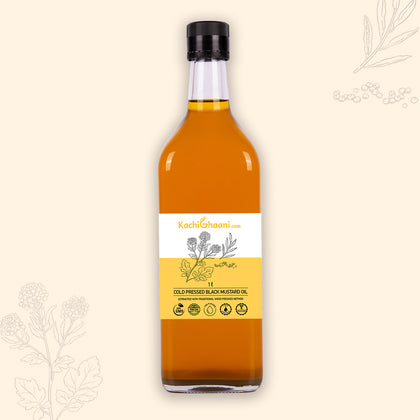
- 400 ml wooden cold pressed black mustard oil, for deep frying
- 1/4 tsp black salt, to finish
- 1 lemon, cut into wedges, to serve
Quantities are scaled up. Taste as you go and adjust the salt and spice.
Shop this recipe
Everything you need, from our press house
Five in the evening on a Kolkata street, and the telebhaja shop has a kadhai of mustard oil going. Long slices of brinjal come out of a bowl of yellow batter one at a time, and the oil roars each time one goes in. They fry flat, curl slightly at the edges, and come out on a wire rack the colour of old gold, still hissing. They are handed over in a cone of newspaper with a pinch of black salt and a handful of muri. You bite in and the crust shatters, and behind it the brinjal has gone completely soft, almost creamy, the way only brinjal does.
Do not confuse this with begun bhaja. Begun bhaja is a thick round of brinjal rubbed with turmeric and salt and shallow fried bare, no batter, soft and glossy. Beguni is a thin lengthwise slice dipped in a besan batter and deep fried, and it is all about the crust. Frying it in wooden cold pressed black mustard oil is the whole point. Heat it until it smokes and goes pale, which burns off the raw sharpness and leaves a clean pungency, and it holds around 180C beautifully. That pungency goes right into the besan and gives beguni a taste that no neutral oil can copy.
The batter ratio is the thing to get right. Four parts besan to one part rice flour is what keeps it crisp for more than two minutes, and the batter should be the thickness of thin cream, so it coats the slice and you can still see the shape of the brinjal through it. Too thick and you are eating a pakora. Salt the slices for ten minutes and pat them dry first, or the water inside will steam the crust soft from within.
How to make it
- Cut the brinjal lengthwise into slices no thicker than 3 mm. Thick slices stay raw in the middle while the crust burns. Lay them on a plate, sprinkle with the 1/2 tsp salt and 1/2 tsp sugar, and leave for 10 minutes.
- Sift the besan, rice flour, turmeric, stone-ground red chilli powder, sugar and salt together. Sifting matters, because besan lumps refuse to break up later.
- Add the cold water little by little, whisking, until you have a smooth batter the thickness of thin cream. Lift the whisk: it should fall in a ribbon that disappears in two seconds. Stir in the kalonji and rest the batter 10 minutes.
- Pat the brinjal slices completely dry with a cloth. Beads of water on the surface will make the batter slide off in the oil.
- Heat the mustard oil in a kadhai until it smokes and turns pale yellow and the raw smell has gone, then bring it back to a steady medium, about 180C. A drop of batter should rise and sizzle straight away without browning instantly.
- Hold a slice by one end, drag it through the batter so both sides are coated thinly, let the excess run off for a second, and lay it into the oil away from you. Fry two or three at a time, no more, or the oil temperature drops.
- After about 5 seconds, when the underside has set, flip it. Fry 3 to 4 minutes in total, turning once more, until the crust is even gold and stiff and the bubbling around it has quietened down.
- Lift onto a wire rack, never onto paper, or the underside goes soft in its own steam. Let the oil come back up to heat before the next batch.
- Sprinkle with black salt and serve straight away, with muri, a wedge of lemon, and a cup of tea. Beguni waits for nobody.
Tips
- The rice flour is the crunch. Besan alone goes leathery within minutes. About a fifth of the dry mix as rice flour keeps the crust crisp long enough to reach the table.
- Cold water, not warm. A cold batter hitting hot oil sets fast and traps less oil, which is why the fritters come out light rather than heavy.
- Beguni is not begun bhaja. Begun bhaja is thick rounds, no batter, shallow fried in mustard oil until soft. Beguni is thin, battered and deep fried. Both are Bengali, they are not versions of each other.
- Reuse the oil sensibly. Cool it, strain it through a cloth, and keep it for the next round of frying or for a mustard oil torkari. Do not use frying oil for raw dressings.
- Serve with khichuri on a wet day. Beguni next to a bowl of khichuri on a rainy evening is a fixed combination in Bengal, and it is worth cooking one for the other.