Dhuska
The batter hits hot oil and swells into a puffed golden disc in seconds, crisp all around the rim and soft in the middle, ready for a spoon of ghugni.

Ingredients
Serves 4
- 1 cup (200 g) raw rice, soaked 5 hours
- 1/2 cup (100 g) chana dal, soaked 5 hours
- 2 tbsp (25 g) urad dal, soaked 5 hours (optional, for softness)
- 1 inch (15 g) ginger and 3 green chillies
- 1 tsp cumin seeds
- 1/4 tsp hing (asafoetida)
- 1/2 tsp turmeric
- 1 tsp stone-ground red chilli powder
- 1.25 tsp salt, or to taste
- 3 tbsp coriander leaves, chopped
- 1/2 cup (120 ml) water, or a little more, for grinding
- 500 ml wooden cold pressed groundnut oil, for deep frying
Quantities are scaled up. Taste as you go and adjust the salt and spice.
Shop this recipe
Everything you need, from our press house
A roadside stall in Ranchi at eight in the morning. The batter is in a big steel basin, thick and pale yellow, and the man ladles it into oil that is properly hot. It sinks, then rises and swells into a golden disc with an uneven puffed middle and a lacy crisp rim. He presses it once with the ladle, turns it, and lifts it out onto a mound of newspaper. On the side is a pot of ghugni and another of aloo chana. You tear a piece of dhuska, still too hot to hold properly, scoop up some ghugni with it, and the crisp edge gives way to a soft, faintly sour, savoury inside that tastes of rice and roasted dal.
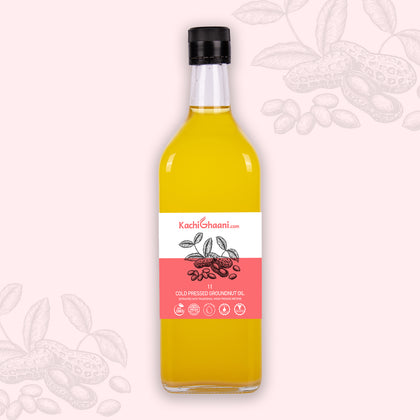
Dhuska is deep fried, so the oil is not just a cooking medium, it is a large part of what you taste. Wooden cold pressed groundnut oil is the right choice here. It stays stable at frying heat, it does not foam up when a wet batter goes in, and it has a mild nutty taste that suits a rice and chana dal batter instead of fighting it. It also drains off cleanly, so the dhuska sits crisp on the rack rather than turning heavy.
Get the batter thick. This is not dosa batter. It should be like a thick idli batter that falls off the ladle in one heavy lump, not a stream. Grind the rice and the dal separately with very little water and stop grinding while the rice is still slightly grainy, because that small grittiness is what makes the outside crisp. A thin batter spreads out in the oil and gives you a flat, oily pancake instead of a puffed dhuska.
How to make it
- Rinse the rice and the dals separately until the water runs clear, then soak them in separate bowls for 5 hours. Soaked properly, a grain of rice should break cleanly between your nails.
- Drain the chana dal and urad dal and grind them first with the ginger, green chillies and 3 tbsp water into a thick, slightly coarse paste. Scrape it into a bowl.
- Drain the rice and grind it with about 5 tbsp water. Stop while it is still slightly grainy, like fine sooji. This grit is what gives dhuska its crisp edge, so do not chase a smooth batter.
- Mix the two together with the cumin seeds, hing, turmeric, stone-ground red chilli powder, salt and coriander. The batter should be thick enough to fall off the ladle in one heavy lump. Add water only a spoon at a time if it is too stiff.
- Rest the batter for 20 minutes at room temperature. It does not need to ferment. If you leave it overnight in a warm kitchen it will sour slightly, which many people in Jharkhand prefer.
- Heat the groundnut oil in a kadhai to about 180C. Drop in a small blob of batter: it should sink briefly, then rise and start sizzling within 3 seconds without browning immediately.
- Take a ladleful of batter and pour it into the oil from just above the surface, in one go, so it spreads into a rough disc. Do two at a time at most.
- Spoon hot oil over the top for the first 10 seconds and the dhuska will puff. Turn it after about 45 seconds and fry another 1 to 2 minutes, turning once more, until both sides are deep gold and the edges are crisp.
- Lift onto a wire rack so the base stays crisp. Let the oil come back to temperature before the next batch, otherwise the dhuska soak up oil.
- Serve hot with ghugni, aloo chana sabzi or a coriander chutney. Dhuska go soft within 20 minutes, so fry and eat in rounds.
Tips
- Grind the rice and dal separately. They break down at different speeds. Ground together, the dal turns to paste before the rice has given up its grit and the texture is wrong.
- Thick batter, hot oil. The two mistakes that ruin dhuska are a runny batter and lukewarm oil, and both end in the same greasy flat disc. Test with a blob before every batch.
- An appe pan works too. For a lighter version, pour the same batter into a greased appe pan with half a teaspoon of oil in each mould and cook covered on low for 4 minutes a side.
- Strain and reuse the oil. Cool it, pour it through a fine cloth, and keep it for the next fry. Cold pressed groundnut oil handles a couple of rounds of frying well.
- Ghugni is the pairing. A bowl of white peas ghugni next to hot dhuska is the standard Jharkhand plate, and the two are cooked together in every household that makes this.