Khandvi
Pale yellow rolls the thickness of a pencil, soft enough to give way at the first bite, with mustard seeds and sesame popping on top.

Ingredients
Serves 4
- 1 cup (120 g) besan (gram flour), sieved
- 3/4 cup (185 g) sour curd, whisked
- 2.25 cups (560 ml) water
- 1 tsp ginger-green chilli paste
- 1/4 tsp turmeric powder
- 3/4 tsp salt
- A pinch of hing (asafoetida)
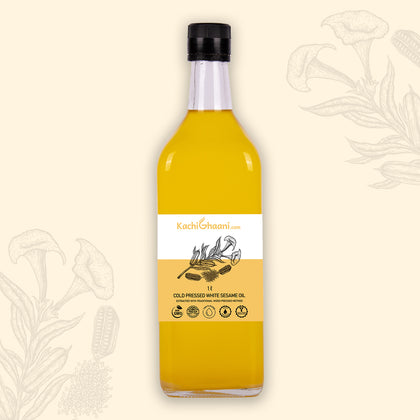
- 2 tbsp Wooden Cold Pressed White Sesame Oil, for the tempering
- 1 tsp mustard seeds
- 2 tsp white sesame seeds
- 2 green chillies, slit lengthways
- 10 curry leaves
- A pinch of hing, for the tempering
- 3 tbsp fresh coconut, grated, to finish
- 3 tbsp coriander leaves, chopped, to finish
Quantities are scaled up. Taste as you go and adjust the salt and spice.
Shop this recipe
Everything you need, from our press house
A Sunday afternoon in Ahmedabad and there is a plate of khandvi on the table, twenty or so pale yellow rolls lined up like little logs, each one about the thickness of a pencil. Mustard seeds and white sesame sit on top in a slick of oil, with green chilli slit lengthways and a snow of grated fresh coconut and coriander. You pick one up and it is cool and soft and gives way completely at the first bite, sour from the buttermilk, with the ginger arriving last.
The tempering is the only cooked fat in the dish, and it lands on the rolls at the very end, so you taste it plainly. Wooden cold pressed white sesame oil is a natural fit, because it picks up and repeats the sesame seeds sitting in the same spoon. It takes the mustard seeds to popping without any trouble, and it leaves a warm nutty note across the top of the rolls rather than sitting there as plain grease. Cold pressed in a wooden ghaani in small batches, so it still smells of til.
Everything here rests on cooking the batter long enough, then moving fast. One part besan to three parts liquid, stirred without stopping over a low flame for twelve to seventeen minutes, until it thickens into a glossy paste that pulls away from the pan. Test a spoonful on the back of a steel plate: if it sets in a minute and peels off in a clean strip, it is ready. Then you must spread the rest while it is screaming hot, because khandvi batter turns into a stubborn blob the moment it cools.
How to make it
- Turn 3 or 4 large steel plates or the back of your kitchen counter upside down, wipe them clean and dry, and keep them right next to the stove. Once the batter is ready there is no time to hunt for a surface.
- Whisk the besan with the curd first, adding the curd a little at a time, until you have a smooth thick paste with no lumps at all. Then whisk in the water, ginger-chilli paste, turmeric, salt and hing. Strain it once through a sieve into a heavy non-stick pan.
- Cook on low, stirring constantly with a flat spatula and scraping the base. For the first 6 or 7 minutes it stays thin. Do not raise the flame to speed it up, the besan will catch at the bottom and the whole batch will taste burnt.
- At 10 to 12 minutes it will start thickening quickly. Keep stirring hard through this stage. It is ready at around 15 to 17 minutes, when it is glossy, pulls away from the sides in one mass, and a spoonful holds its shape.
- Do the plate test. Spread a small spoonful thinly on the back of a plate and count to 60. Run a knife under one edge and lift. If it peels away in a clean, whole strip, the batter is cooked. If it tears or stays sticky, cook 2 minutes more and test again.
- Now work fast. Take a ladle of the hot batter onto an upturned plate and spread it out as thin as you can with a flat spatula or a palette knife, in long sweeping strokes. Aim for a layer you can almost see the steel through. Keep the pan on the lowest flame while you spread.
- Repeat until all the batter is spread. Leave everything to cool for 10 to 12 minutes until set and no longer warm to the touch.
- Cut into strips about 5 cm wide with a knife or a pizza cutter. Starting at one end, roll each strip up tightly into a small log and line them up on a serving plate, seam down.
- Heat the sesame oil in a small pan on medium. Add the mustard seeds and wait for them to pop, about 20 seconds, then the sesame seeds until they turn a shade darker, then the hing, slit green chillies and curry leaves. Take it off after 5 seconds.
- Spoon the hot tempering evenly over the rolls, scatter the fresh coconut and coriander, and serve at room temperature within a couple of hours.
Tips
- If the strips tear when you roll them, the batter was undercooked. There is no rescue for that batch, but you can scrape it back into the pan, cook it 3 minutes longer and spread again while hot.
- Sour curd is better than fresh. Leave curd out for 5 to 6 hours first. That gentle sourness is what makes khandvi taste like khandvi rather than plain besan.
- Spread thinner than feels sensible. A thick layer gives you a heavy roll that tastes stodgy. The right thickness is roughly that of a thick sheet of paper.
- Cook in a wide non-stick pan, not a kadhai. More surface area means faster, more even cooking and far less chance of the base catching.
- Do not refrigerate khandvi. Cold turns the rolls firm and rubbery. Make it in the morning, keep it covered at room temperature, and eat it the same day.