Which oil should you deep-fry in?
On our own measured figures, mustard oil is the only oil we press that comfortably holds deep-frying heat. The smoke points, what Indian frying actually needs, and where every other oil belongs.

Deep frying is the one job in an Indian kitchen where the oil is doing chemistry, not just carrying flavour. Get it wrong and the oil breaks down in the kadhai. Here is the honest answer, on our own measured numbers.
Which oil should you deep-fry in?
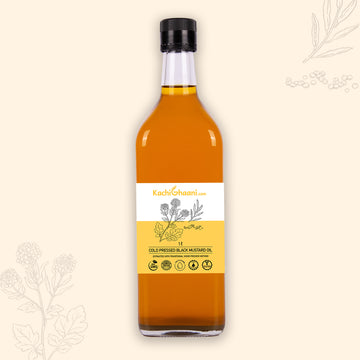
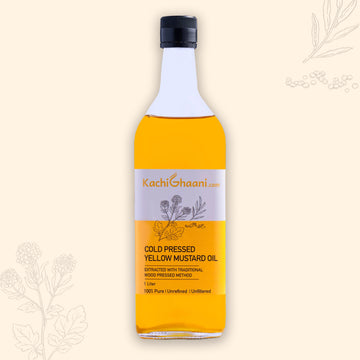
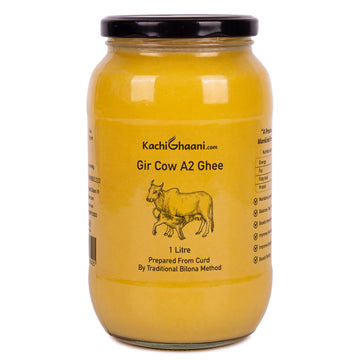
Mustard oil. Of everything we press, it is the only oil that comfortably holds deep-frying heat — black and yellow mustard both sit at 250°C, while Indian deep frying runs at roughly 175°C to 190°C. That leaves a genuine cushion before the oil begins to smoke and break down. A2 Gir cow ghee matches it at 250°C.
Every other oil we press sits lower, and several sit a long way lower. That is not a flaw in the pressing — it is what unrefined oil is. The honest position is that most Truly Cold Pressed oils are finishing, tempering and shallow-frying oils, not deep-frying oils.
What is a smoke point, and why does it decide the oil?
The smoke point is the temperature at which an oil stops holding together and starts to visibly smoke. Past that point the fat breaks down, the flavour turns sharp and bitter, and the food picks it up. For deep frying you want an oil whose smoke point sits well above your cooking temperature, not level with it.
Indian deep frying — poori, samosa, pakoda, vada, jalebi — generally runs between 175°C and 190°C. A cushion of fifty degrees or more above that is what lets an oil survive a full batch without turning. At 250°C, mustard oil has that cushion. At 180°C, groundnut oil is sitting right on the line — it will fry, but only if you hold the oil steady and never let it smoke.
What are the smoke points of KachiGhaani oils?
These are the figures our own product pages carry. Where a much higher number circulates online for the same oil, it almost always belongs to the refined version of that oil rather than the unrefined one.
| Oil | Smoke point | What it is actually for |
|---|---|---|
| Black mustard | 250°C / 482°F | Deep frying, achaar, tadka, winter cooking |
| Yellow mustard | 250°C / 482°F | Deep frying and everyday cooking, gentler nose |
| A2 Gir cow ghee | 250°C / 482°F | Frying, tadka, halwa and festive sweets |
| White sesame | 177°C / 350°F | Everyday cooking, sautéing, South Indian tempering |
| Black sesame | 177°C / 350°F | Oil pulling, massage, low-heat cooking |
| Coconut | 177°C / 350°F | Kerala cooking, sautéing, hair and skin |
| Groundnut | about 180°C / 356°F | Sabzi, tadka, steady shallow frying |
| Safflower | about 107°C / 225°F | Low heat and raw use — not a frying oil |
| Flaxseed | about 107°C / 225°F | Never heat — cold drizzle only |
| Almond | Not a frying oil | Raw use, and the badam rogan malish |
| Kalonji | Raw only | Drizzles and the hair ritual |
| Castor | External use only | Not a cooking oil at all |
Why does mustard oil handle the kadhai so well?
Two reasons. Its fat is dominated by monounsaturates, which are structurally more stable under heat than the polyunsaturates that make up most of an oil like flaxseed or safflower. And cold pressing at low temperature leaves the oil intact rather than stripped, so what reaches your kadhai is a whole oil with a naturally high tolerance for heat.
There is also the old kitchen step of heating mustard oil until it just smokes before cooking, to mellow the raw pungency. For a tadka that is tradition worth keeping. For deep frying you do not need it — bring the oil to frying temperature and stop there, and the pungency softens on its own across the batch.
Can you deep-fry in groundnut oil?
You can, but not hard and not for long. Truly Cold Pressed groundnut oil sits at about 180°C — the very bottom of frying temperature, with nothing held in reserve. Keep it steady at 160–175°C and it will see a batch of pakoras through; let it reach a rolling, smoking heat and you are past its limit. The 227°C figure you will find quoted everywhere for groundnut oil is the refined figure, and refined groundnut oil is a genuinely different product from ours.
What our groundnut oil is very good at is everyday cooking: sabzi, tadka, shallow frying, a paratha on the tawa. It is our best-selling oil for exactly that reason. Groundnut oil compared with mustard oil sets out where each one earns its place.
Is refined oil better for deep frying?
On smoke point and on price, yes — and it would be dishonest to pretend otherwise. That is precisely what refining is engineered to do. Solvent extraction using hexane, a wash with bleaching earth, and deodorisation at around 200°C strip out the free fatty acids, sediment, colour and aroma that lower an unrefined oil's smoke point.
What comes out is neutral, heat-tolerant and cheap. What also comes out is the aroma and character of the seed. That is the trade, stated plainly, and it is yours to make. We would rather press an oil that tastes of what it came from and tell you exactly where it belongs. Wood pressed compared with refined oil goes through the two processes side by side.
How many times can you reuse frying oil?
Once or twice at most, and only if you strain it while it is still warm and keep it away from light. Never top fresh oil into old — the used oil drags the new one down with it. Discard it once it darkens, thickens, foams at the edges or smells sharp when cold.
Because our oils are pressed in small batches with no preservatives, they carry a 4 to 6 month shelf life to begin with. Oil that has already been through a fryer has considerably less than that.
So what belongs in your kadhai?
If you are frying, buy for the smoke point. Truly Cold Pressed black mustard oil gives you the full pungent, achaar-grade character at 250°C. Yellow mustard oil gives you the same 250°C headroom with a gentler nose. Keep the lighter oils for the jobs they are actually built for — they are better at those than mustard is.