
 Tap to zoom
Organic · Slow-Crystallised
Desi Dhaga Mishri - Krishna's Favourite
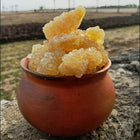
Old-style dhaga mishri — sugarcane slowly crystallised on a cotton thread, free of bleach and whitening chemicals. The gentle sweet of pujas, paans and warm milk.
- Crystallised slowly on thread, the traditional way
- No sulphur or whitening agents — ever
- Lab-tested every batch — report published openly
Inclusive of all taxes · Free shipping above ₹999
In stock — fresh from the thread
Refill — remind me to reorder
5% OFF REFILLNo auto-charge, no subscription. Just choose how often you want it, and we'll WhatsApp you a 5% refill discount when your pack is due. Every batch takes 8–10 days on the thread, so we make it in small lots and keep only a little stock.
Done — your 5% refill nudge will arrive on WhatsApp with your order. Cancel with one reply, anytime.
- Crystallised on cotton thread over 8–10 days — the slow, traditional way.
- No bleaching, no chemicals, no additives — cane sugar and patience.
- Lab report published for every batch — view reports · FSSAI 10724999001232
- One ingredient. Nothing else in the pack.
Order today
—
Dispatches by
—
Delivered by
—
Free shipping above ₹999 · Ships worldwide to 125+ countries · Premium couriers only — BlueDart, DHL, FedEx & Amazon
Earn KachiGhaani Rewards on this order — up to 10% off your next one.
Nutrition facts per 100 g
| Energy | 387 kcal |
|---|---|
| Total fat | 0 g |
| saturated | 0 g |
| monounsaturated (MUFA) | 0 g |
| polyunsaturated (PUFA) | 0 g |
| trans fat | 0 g |
| omega-3 (ALA) | 0 g |
| omega-6 (LA) | 0 g |
| omega-9 (oleic) | 0 g |
| Cholesterol | 0 mg |
| Carbohydrate | 100 g |
| of which sugars | 99.8 g |
| Protein | 0 g |
| Vitamin E (alpha-tocopherol) | 0 mg |
| Vitamin K | 0 µg |
| Calcium | 1 mg |
| Iron | 0.05 mg |
| Potassium | 2 mg |
Typical values per stated basis, from USDA FoodData Central and published composition studies. Unrefined, natural produce varies from batch to batch.
Shipping & delivery
- Hand-sorted, packed and dispatched within 1–2 business days.
- India: express delivery in 3–7 business days · free above ₹999.
- Worldwide: 125+ countries, typically 8–14 days, duties shown at checkout.
- Cash on Delivery available across India up to ₹50,000.
Why premium pricing?
Thread mishri takes eight to ten days to crystallise on cotton. Machine-moulded lumps take hours. That difference is the whole price difference:
- Crystallised on cotton thread over 8–10 days — never machine-moulded
- No sulphur, no bleaching agents, no free-flow chemicals
- Made from pure sugarcane juice, not re-melted refined sugar
- Naturally cooled and hand-sorted, so the crystals stay whole
Faster mishri is cheaper because time, thread and hand-sorting were taken out of it. Here they're still in.
Thread-crystallised
Grown slowly into crystals on a cotton dhaga — patience, not processing.
No whitening agents
No sulphur, no bleach — its lightness is natural.
Lab report, every batch
Independently tested — and every report is published openly.
One ingredient
Sugarcane. Nothing else.
Why families keep it
The gentlest sweet in the house
The saunf-mishri ritual
With fennel seeds after meals — the classic mouth-freshener and digestive pairing found on every Indian table.
Soothing by tradition
Mishri with warm milk or tulsi is the age-old home comfort for the throat and voice.
Puja-pure
The traditional prasad and offering sweet — unbleached, honest and made the old way.
Proof, not promises
Don't take our word for it
Take the lab's. And the certifiers'. And the word of families in 125+ countries.
Lab reports, published
Every batch is third-party tested for purity — and we publish the reports for anyone to read.
Certified end to end
FSSAI 10724999001232 · ISO 9001:2015 · ISO 22000:2018 · GMP · HACCP · Halal · USFDA-registered for exports.
Sold across the world
The same packs sell on Amazon US, Amazon UAE, Amazon India, Noon and Walmart — and ship from here to 125+ countries.
Rated 4.9★ by families
241+ verified Google reviews for the brand — earned one honest pack at a time.
"Either love your items, or we will make it right for you."— Our promise, on every single order
Daily use
A little goes a long way
After meals
A pinch with saunf as a natural mouth-freshener and digestive.
In warm milk
Dissolve a small piece in warm milk or tulsi water — the classic evening soother.
For puja & prasad
The traditional offering sweet for festivals and daily puja.
In detail
The full story
Look closely at a piece of real dhaga mishri — mishri with thread, dhage wali mishri, thread rock sugar — and you will find a cotton thread running straight through the middle of it. That thread is the whole product. Saturated sugarcane syrup is hung over it and left alone for 8 to 10 days while the crystal grows outward around the fibre — slowly, unevenly, and in a shape no machine could counterfeit. Nothing bleached, nothing added. The faint golden cast is the syrup’s own.
How is it different from the mishri in most shops?
Most of what is sold as mishri today is refined sugar re-melted and moulded into lumps in a matter of hours, then whitened. Ours is grown, not moulded. You can tell them apart in the hand: moulded lumps are uniform, opaque and snap flat, while thread-grown crystals are irregular, semi-translucent, and every single one has that cotton dhaga through its heart. Eight to ten days is not a marketing detail — it is the entire reason this tastes cleaner and costs more. If you want the long version — what mishri is made of, how it is grown, and what dhaga mishri is called in English — we have written it out in full: what mishri actually is.
What does it taste like?
Gentler than sugar. It dissolves slowly rather than hitting all at once, and there is a faint cane note behind the sweetness that refined sugar does not have. Crush a crystal between your teeth and it gives before it cracks. In warm milk it melts without clouding the glass.
How is it used?
- With saunf after a meal — the fennel-and-mishri bowl on every Indian restaurant counter, and the way most families eat it
- In warm milk, or dissolved in tulsi water in the evening
- As prasad — the traditional offering sweet for daily puja and festivals
- In tea, coffee and kheer, crushed, in place of sugar
- Crushed into dhaga mishri powder — crush the crystals in a mortar or pulse them briefly in a dry grinder and you have the old-fashioned boora that goes into laddoo, halwa and panjiri in place of icing sugar. There is no separate product to buy; mishri powder is just this, ground.
- Crushed over a dessert, or eaten plain by children who find the thread fascinating
Why is it associated with Krishna?
Makhan-mishri — fresh butter with mishri — is the offering most closely linked with Krishna, and it is still what goes on the thali at Janmashtami in a great many homes. Mishri has sat in the puja room for as long as it has sat in the kitchen. We share that as tradition, and we make it the way it was always made rather than the fast way.
Why is some mishri golden, and some brown?
The faint golden cast in ours is the cane syrup's own colour, left in because nothing was bleached out. Brown mishri — brown dhaga mishri — is the same crystal grown from a less-clarified syrup, so it keeps more cane character and reads a shade darker. Neither is better and neither is caramelised. What is worth being suspicious of is the opposite: a flat, chalky, identical white across every single piece, because that uniformity is usually a whitener rather than nature.
How should I store it?
Airtight, cool and dry. Mishri draws moisture from humid air and the crystals will begin to stick to one another if the pack is left open — harmless, but it spoils the look of them. The cotton thread is edible and is usually eaten along with the crystal; pull it out if you prefer.
Crystallised, hand-sorted and packed in small batches under FSSAI licence 10724999001232, ISO 9001, ISO 22000, GMP, HACCP and Halal certified, USFDA-registered, with the lab report published for every batch. This is the sweet that belongs in the puja room, the after-dinner bowl and the child’s hand — and once you have had thread-grown khadi shakkar, moulded lumps taste like exactly what they are. This is organic mishri as it was made before machines: buy dhaga mishri once and moulded lumps stop being an option. Pick your pack, and keep our organic jaggery beside it for everything that needs cooking.
At a glance
- Made from: sugarcane syrup. One ingredient.
- Method: crystallised on cotton thread over 8–10 days, then hand-sorted
- Free from: sulphur, bleaching agents, whiteners, free-flow additives
- Appearance: irregular semi-translucent crystals with a thread through the centre
- Storage: airtight, cool and dry
- Price per kg: the 2 kg pouch works out cheapest per kilo, the 1 kg next, the 500 g pouch highest — the usual pattern. Current rates for every pack size are on this page; compare mishri prices per kilogram rather than per pouch, because pack sizes differ between brands.
We ship across India and to 125+ countries. Contact us to place an international order, or send us a WhatsApp message.
From our families
What customers say

Voices of our valued customers








Good to know
You asked, we answered
What is Dhaga Mishri and how is it used?
Dhaga mishri is crystallised unrefined sugar formed naturally on cotton threads — the traditional Indian sweetener you'll remember from temples and grandmothers' kitchens. It's used in prasad, in traditional remedies for throat comfort, and as a gentler, less processed alternative to white sugar.
Is dhaga mishri the same as the mishri sold as rock sugar?
Not quite. Dhaga mishri crystallises naturally on cotton threads over several days, which is why it arrives as irregular, thread-run crystals. Much of what is sold simply as mishri or rock sugar is machine-crystallised and often chemically refined and polished for a uniform white look. Ours is the older, slower version.
There are cotton threads running through it. Should I remove them?
Those threads are the whole point — the crystals grow along them, and that is what makes it dhaga mishri. Pull the crystals off the thread before use and discard the thread; it is plain cotton and not meant to be eaten. Finding it in the jar is a good sign you have the real thing rather than a moulded lump.
How do I use dhaga mishri day to day?
Most people keep it as a mukhwas after meals, offer it as prasad, or use it to sweeten milk, kesar doodh and thandai. It is the traditional companion to saunf, and a piece kept in the mouth is an old household habit for throat comfort. It dissolves more slowly than sugar, which is a good part of its charm.
How should I store dhaga mishri?
In an airtight jar in a cool, dry place, always with a dry spoon — like jaggery, it takes up moisture from the air and the crystals will clump if it gets damp. Stored properly it keeps for a very long time. If a few crystals fuse together, a light tap breaks them apart again.
Is this suitable for bhog and prasad?
Yes — mishri is one of the classic offerings, and dhaga mishri in particular is associated with Bhagwan Krishna, which is where our product name comes from. It is unrefined and unbleached, with nothing added and no bone char or chemical clarifiers used anywhere in the making. A good number of our customers buy it specifically for the puja room and for festival prasad.
Still wondering about something? WhatsApp us — a real human replies in minutes · or read all FAQs.
Customers also explore
More from the KachiGhaani pantry
Cold Pressed Groundnut Oil
Cold Pressed Almond Oil
Cold Pressed Coconut Oil
Cold Pressed White Sesame Oil
Try our oils too
The Trial Pack — 5 oils, 50 ml each
Taste the Truly Cold Pressed difference across five of our oils before you commit to full bottles. One pack per family, while it lasts.
₹199 all five oils
Get the trial pack FSSAI · Lic. 10724999001232
 ISO 9001:2015
 ISO 22000:2018
 GMP certified
 USFDA registered
 Halal certified
 IAF accredited
From our kitchen
What to cook with it
Real Indian recipes that use this, with every step written plainly.

Aam Panna
See the recipe
Dhaniya Panjiri
See the recipe
Saunf Mishri Mukhwas
See the recipe
Badam ka Sharbat
See the recipe
Panchamrit
See the recipe
Bel ka Sharbat
See the recipe
Gulab Sharbat
See the recipe
Kashmiri Kahwa
See the recipe
Kesar Mishri Doodh
See the recipe
Kokum Sharbat
See the recipe
Meetha Sattu ka Sharbat
See the recipe
Rose Falooda
See the recipe
Shikanji
See the recipe
Thandai
See the recipeFrom the Journal
How to use it
Plain, honest guides to using this — including what it will not do.

Mukhwas: why Indians end a meal with saunf and mishri
Mukhwas explained: why Indians chew saunf and mishri after meals, what fennel may do for digestion and breath, how much to take, and the sugar in mishri.
Read the guide
Rock sugar around the world: bing tang, nabat and mishri
What is rock sugar, and how do China, Iran, Japan, East Frisia and India use it? Bing tang, nabat, kluntje and mishri, with swaps and an honest verdict.
Read the guide
Mishri vs sugar: calories, GI and what actually differs
Mishri vs sugar: both are sucrose, with about 4 calories per gram and a similar GI. What really differs is the crystal, how it dissolves and how it is used.
Read the guide
Mishri benefits: what Ayurveda says and what is actually true
Mishri benefits, honestly: how Ayurveda and Indian homes use mishri, from saunf after meals to warm milk and sore throats, and what the science really says.
Read the guide
What Is Mishri? What It Is Made Of, How It Is Made, and What It Is Called in English
Mishri is crystallised cane sugar, called rock sugar or rock candy in English. What it is made of, how it is made, and what a fair price per kg looks like.
Read the guide
Dhaga mishri vs regular mishri: what the thread changes
Real thread mishri grows on cotton over 8 to 10 days; the machine kind is done in hours. What the dhaga proves, and how to spot the fast version.
Read the guide
Jaggery tea: why gur chai curdles and how to stop it
Jaggery tea keeps curdling? Why gur splits hot milk, and the simple fixes that work: add it off the flame, use fresh milk, and the right amount per cup.
Read the guide
Milk with ghee at night: the benefits, honestly weighed
Milk with ghee benefits, honestly weighed: what the Ayurvedic bedtime drink is for, how much ghee to add, calories, side effects and what evidence supports.
Read the guide
Is jaggery just sugar? An honest answer
Mostly it is still sugar, and we sell it. What genuinely differs is the open-pan process and the molasses left in. Plus how to spot honestly made gur.
Read the guide
Besan laddoo in bilona ghee — the step-by-step
Why the 25 to 30 minute roast decides everything, the ghee-release sign to watch for, the halwai grain trick, and how to get them to bind every time.
Read the guide