Jaggery tea: why gur chai curdles and how to stop it
Jaggery tea, or gur wali chai, is a winter favourite, but it often splits. The kitchen science behind it, three methods that keep it smooth, how much jaggery to use, and an honest word on sugar.

Jaggery tea curdles because jaggery can be slightly acidic, especially once it is old or has soaked up moisture, and milk proteins clump when acid meets near-boiling heat. The fix is mostly timing: switch off the flame, then stir in the jaggery, and do not boil the tea again.
Gur wali chai, tea sweetened with jaggery, is a winter ritual across North India and Pakistan, loved for its deep, caramel-like taste. Nothing is more annoying than a pan of it splitting into grainy curds just as the family sits down. Here is why it happens, three methods that keep it smooth and an honest word on jaggery versus sugar.
At a glance
- Milk splits when acid meets heat. Jaggery adds a little acid, and old or damp jaggery adds more.
- The most reliable fix is timing: the jaggery goes in after the flame is off.
- Fresh milk matters. Milk that is a day from turning will split whatever you do.
- Fresh ginger can curdle milk too, so boil it in the water first.
- Jaggery is still sugar, and one heaped teaspoon per cup is plenty.
Why does milk curdle when jaggery is added?
Because jaggery tips hot milk past the point where its proteins can stay dispersed. Heat alone rarely splits fresh milk; heat plus a little extra acid does.
Milk's main proteins, the caseins, float as tiny clusters. At milk's natural, nearly neutral acidity, fresh milk is remarkably heat-stable, which is why you can boil it for chai every morning. Dairy scientists have shown that changes in acidity, or in minerals such as calcium, can reduce that stability a great deal, and the clusters start to stick together into curds.
Tea is mildly acidic already, and ordinary chai survives it. Jaggery adds a little more. Fresh, well-made jaggery can be close to neutral, but it turns more acidic as it ages and soaks up moisture: in one Indian storage study, uncoated jaggery started at pH 6.95 and had fallen to about 5.4 within roughly three and a half months. Jaggery also carries minerals, including calcium, which can nudge hot milk proteins towards clumping.
The usual culprits
- Old, sticky jaggery that has been sitting in a humid kitchen.
- Milk close to its use-by date, already turning slightly sour.
- Boiling the tea hard after the jaggery goes in.
- Fresh ginger added straight to the milk.
How do you add jaggery to tea without it curdling?
Add it after the flame is off, or keep milk and jaggery apart until the last moment. All three methods below work; the first is the most reliable.
Method 1: flame off, then jaggery (2 cups)
- Simmer 1 cup (240 ml) water with a small piece of crushed ginger and 2 lightly crushed green cardamom pods for 2 to 3 minutes.
- Add 2 teaspoons of loose black tea and simmer for 1 to 2 minutes.
- Pour in 1 cup (240 ml) fresh milk and bring it to the boil, letting it rise once.
- Switch off the flame and wait 30 to 60 seconds, until the bubbling stops.
- Stir in 2 heaped teaspoons of finely grated jaggery until it dissolves.
- Strain into cups and serve. Do not put the pan back on the heat.
Method 2: jaggery in the decoction
Dissolve the jaggery in the boiling water, spices and tea first, then pour in milk you have warmed separately and heat only until it steams, without boiling hard again. This suits people who like the jaggery to caramelise a little, but it is less reliable with older jaggery.
Method 3: jaggery in the cup
Grate the jaggery straight into each cup and pour the hot, strained chai over it. Everyone sweetens to taste, and nothing goes back on the flame.
Baking soda and the ginger trap
Some cooks add a pinch of baking soda to neutralise the acid. It works, but it can leave a flat, soapy taste and is not needed if you follow the methods above. If your chai splits even without jaggery, look at the ginger: fresh ginger contains an enzyme that clots milk, the same reaction behind a Cantonese ginger-milk pudding. Boiling the ginger in water before the milk goes in switches the enzyme off.
How much jaggery goes into one cup of chai?
Start with one heaped teaspoon of grated jaggery, roughly 5 to 7 g, per cup and adjust from there. Its flavour is rounder than sugar's, so a little goes a long way.
| Cups of chai | Grated jaggery | Jaggery by weight | Share of a 25 g daily added-sugar limit |
|---|---|---|---|
| 1 | 1 heaped teaspoon | 5 to 7 g | 20 to 28 per cent |
| 2 | 2 heaped teaspoons | 10 to 14 g | 40 to 56 per cent |
| 4 | 4 heaped teaspoons | 20 to 28 g | 80 to 112 per cent |
The 25 g figure comes from ICMR-NIN's 2024 Dietary Guidelines for Indians, which ask adults to keep added sugar under 5 per cent of daily energy, roughly 25 g on a 2,000 kcal diet. Two or three sweetened cups a day can use up most of it.
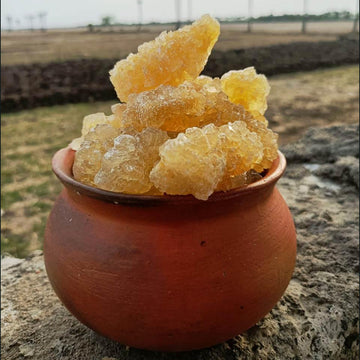
Grate block jaggery on the fine side of a box grater, or use jaggery powder. Fine pieces dissolve in seconds in hot tea, so you are never tempted to put the pan back on the heat to melt a stubborn lump.
Is jaggery tea better than tea with sugar?
It tastes richer, but for your body it is still sugar. The difference between a teaspoon of jaggery and a teaspoon of sugar is small.
Jaggery is roughly 65 to 85 per cent sucrose plus about 10 to 15 per cent glucose and fructose, and it carries about 375 kcal per 100 g, close to white sugar. It keeps small amounts of minerals such as potassium, iron and calcium that refining removes, but at a teaspoon or two a day these add little to your diet. The World Health Organization counts any sugar you stir in yourself as 'free sugar' and advises keeping free sugars under 10 per cent of daily energy, ideally under 5. We go deeper in is jaggery just sugar?
Can jaggery be added to coffee?
Yes. The same rule applies: add it in the cup or off the heat, never to milky coffee that is still boiling.
Coffee is acidic too, so milky coffee can split just as easily if you boil it with jaggery. In Tamil Nadu, coffee sweetened with karupatti, a palm jaggery, is a local favourite; stir it in at the end. Black coffee or black tea with jaggery cannot curdle at all, because there is no milk to split.
Who should go easy on gur chai?
- Diabetes or prediabetes: count jaggery exactly as you would sugar, and follow your doctor's or dietitian's advice.
- Children under two: ICMR-NIN advises no added sugar at all at this age, and jaggery is added sugar.
- Weight goals: each heaped teaspoon adds roughly 20 to 25 kcal, and several cups a day add up.
- Teeth: sipping sweet tea through the day keeps sugar on your teeth, so rinse with water afterwards.
- Spoiled jaggery: if it smells sour or alcoholic, or shows mould, throw it away rather than boiling it into tea.
Our jaggery and mishri
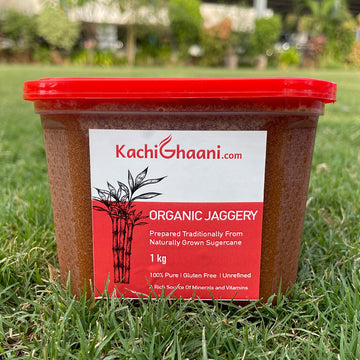
If you want to try it, our jaggery is made from cane juice reduced slowly in open pans in small batches, with no sulphur, soda, bleach or chemical clarifiers. Keep it in an airtight jar away from steam, so it stays dry and less likely to split your milk. If you would rather not risk curdling at all, a little of our dhaga mishri sweetens milky chai without splitting it, because it is crystallised sugar with almost no acid; here is what mishri is and how it is made.
The bottom line
Gur chai splits when acid meets boiling milk, and jaggery supplies a little of that acid, more when it is old or damp. Turn off the flame before the jaggery goes in, use fresh milk and dry jaggery, and keep it to a heaped teaspoon a cup. It is a lovely winter drink, but it is still sweet tea.
Frequently asked questions
Is curdled jaggery tea safe to drink?
If the milk was fresh and only split when the jaggery went in, it is usually safe; the grains are just clumped milk protein, and the tea will taste a little gritty. If the milk smelt sour before you used it, or the tea tastes off, throw it away and start again with fresh milk.
Does powdered jaggery curdle milk less than block jaggery?
Not by itself, because its acidity is the same. Powder simply dissolves faster, so you can stir it in with the flame off and never need to reheat the tea. Keep powdered jaggery in an airtight jar, as it soaks up moisture quickly, and older, damp jaggery is more likely to split milk.
Can I use jaggery in tea without milk?
Yes, and it cannot curdle, because there is no milk. Black tea, lemon tea and infusions such as ginger or tulsi tea all take jaggery well. Stir it in once the water is off the boil, so its caramel flavour stays clean and bright.
Does jaggery tea help with a cold?
A hot, spiced drink can feel soothing when you have a cold, and ginger and tulsi are traditional winter choices. There is no good evidence that jaggery itself protects you from colds or helps you recover faster. Rest, fluids and your doctor's advice matter far more.
Why does my gur chai taste bitter or burnt?
The jaggery probably caramelised too far, either because it boiled in a little water for too long or hit a very hot, dry pan. Add it to the finished tea with the flame off, and choose a fresher jaggery if your batch tastes strongly of molasses.
Sources
- Kumar et al., coatings and storage quality of jaggery, Indian Journal of Agricultural Sciences, 2017
- Huppertz, Heat stability of milk, Advanced Dairy Chemistry, 2016
- ICMR-NIN, Dietary Guidelines for Indians, 2024
- World Health Organization, Healthy diet fact sheet (accessed 2026)
- Jaggery: nutrition and uses, Medical News Today (accessed 2026)