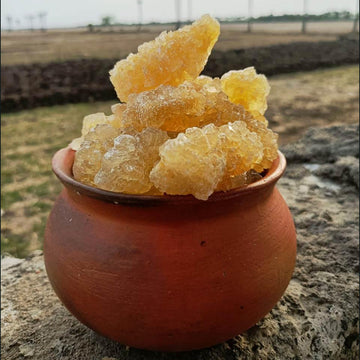
What Is Mishri? What It Is Made Of, How It Is Made, and What It Is Called in English
What mishri is, what it is made of, how dhaga mishri is grown on cotton thread over 8 to 10 days, what it is called in English, what it should cost per kg - and the honest answer on mishri versus sugar.

Mishri is one of those things every Indian household keeps and almost nobody can define. It sits in a steel dabba beside the saunf. It goes on the puja thali. Somebody's grandmother gives it to you for a sore throat. And if you ask five people what mishri actually is, you will get five answers.
Here is the straight one, from a house that makes it.
What is mishri?
Mishri is rock sugar — sugarcane sweetness grown into large crystals instead of ground into powder. That is the entire definition. It is not a different substance from sugar, it is a different shape of the same substance, made by a slower process.
The confusion comes from the fact that two very different products are sold under the name. One is grown over days on a cotton thread. The other is refined white sugar re-melted and set into lumps in a few hours. Both are called mishri. Only one of them has a thread through it.
What is mishri made of?
One ingredient: sugarcane.
Sugarcane juice is boiled down to a saturated syrup — so much sugar dissolved in so little water that the water can no longer hold it. As that syrup cools, the sugar has to come out of solution somewhere. Given a surface to build on and enough time, it does not come out as powder; it grows into crystals.
Chemically, mishri is sucrose, the same molecule as table sugar. Anyone who tells you it is something else is guessing or selling. What differs is everything around the molecule: how much of the cane's own colour and minerals survive the process, whether anything was bleached out, and how the crystal behaves in your mouth.
Traditional dhaga mishri is made with nothing added — no sulphur, no whitening agent, no free-flow powder. It does not need them, and the reason is interesting.
Put plainly: mishri is made from sugarcane juice, and mishri is made up of sucrose crystals — nothing else needs to be in the bottle, the pouch or the answer.
How is mishri made?
How mishri is made has not changed in centuries, and the old method is almost embarrassingly simple — and almost impossible to hurry.
- Cane juice is reduced to a heavy, saturated syrup.
- Cotton threads are strung across a vessel, top to bottom.
- The hot syrup is poured in and the vessel is closed.
- It is left alone for eight to ten days. Nothing is stirred, heated or tended. As the syrup slowly cools, sugar comes out of solution and begins building along the threads — the way frost grows along a branch overnight, only far slower.
- The vessel is opened, the thread-grown crystal is lifted out, drained of the remaining syrup, dried and hand-sorted.
The slowness is the whole trick. A crystal growing that slowly is extremely fussy about what it lets in: the lattice accepts sucrose molecules and pushes almost everything else out into the leftover syrup. That self-purifying effect is why thread mishri comes out clean and glassy without being bleached. The old method got a clear crystal by being patient. The new method gets one by starting with already-refined sugar and adding a whitener.
How is machine mishri made? Refined sugar is dissolved, crystallised fast in vacuum pans, and tumbled into uniform cubes or pellets — hours, not days. Perfectly edible. Just a different object: opaque, dense, hard, and without the thread.
How to make mishri at home — and why we would not bother. You can make rock candy at home — dissolve sugar into near-boiling water until no more will go in, suspend a clean cotton thread in the jar, cover it and leave it undisturbed for a week or two. What you cannot do at home is what makes dhaga mishri worth buying: start from cane syrup rather than refined sugar, at a scale and consistency that produces crystals worth sorting. The home version is a lovely thing to do with a child. It is not the same product.
What is dhaga mishri, and what is it called in English?
Dhaga mishri — also written dhage wali mishri, dhaga misri or mishri dhaga — simply means "thread mishri". Dhaga is Hindi for thread. It is the mishri grown on cotton string by the method above, and every genuine piece has a fibre running through its heart. So the answer to what is dhage wali mishri is exactly the answer to what is dhaga mishri: the same crystal, the same thread, two ways of saying it.
Dhaga mishri in English is usually thread rock sugar or rock candy on a string; dhage wali mishri in English translates literally as "mishri with thread". If a recipe or an import label asks for rock sugar or rock candy, dhaga mishri is what it means.
Khadi shakkar in English is the same idea from the other direction: khadi here means standing, upright or lump-form, and shakkar is sugar — so khadi shakkar is lump sugar or rock sugar, another regional name for the same crystal. Across India you will also hear misri, kalkandam or kalkandu in the south, patti saakar in parts of Gujarat, and kuza mishri for the pot-grown variety.
They are all describing crystallised cane sugar. The names differ by region; the thread is what tells you which method made it.
Dhaga mishri vs sugar — the honest comparison
This is the question people most want a dramatic answer to, so here is the undramatic one.
- Source — dhaga mishri: sugarcane. Table sugar: sugarcane or beet.
- Chemically — both are sucrose. There is no difference here, and there is no honest way to claim one.
- Process — dhaga mishri is grown slowly on cotton thread over 8 to 10 days. Table sugar is refined, centrifuged and dried.
- Additives — thread mishri needs none. Table sugar varies by brand.
- Colour — dhaga mishri is glassy and faintly golden. Table sugar is uniformly white.
- In the mouth — dhaga mishri dissolves slowly. Sugar dissolves at once.
- Calories — effectively identical, gram for gram.
Mishri is not a health food, and we will not sell it to you as one. It is sugar. It should be treated in your diet exactly the way sugar is treated. Anyone marketing rock sugar as diabetic-friendly, fat-free or "natural so it doesn't count" is being dishonest, and you should read the rest of their label with suspicion.
What is genuinely different is the experience. A thread crystal dissolves slowly rather than hitting all at once, which is why a single small piece satisfies where a spoon of sugar does not. There is a faint cane note behind the sweetness that refining strips out. And it is made by hand over ten days, which is a reason to like a thing even when it is nutritionally identical to a thing made in ten minutes.
What are the benefits of mishri?
Search for mishri benefits or dhaga mishri benefits and you will find pages promising cures for a dozen things. Here is what we are willing to say.
Not a benefit: mishri is not low-calorie, not low-glycaemic, not safe for diabetics in a way sugar is not, and not a source of any meaningful vitamin or mineral. Its sugar content is its calorie content. Treat it as sugar.
Arguably a benefit: because a crystal dissolves over a minute or two rather than a second, a single small piece registers as a satisfying sweet in a way that the same weight of loose sugar does not. If mishri after a meal replaces a mithai after a meal, that is a real reduction, and it is the honest case for keeping a dabba of it.
Traditional, not clinical: holding a crystal for a dry or scratchy throat, a pinch with saunf to close a meal, mishri in warm milk at night. These are long-standing household practices and we are glad they exist. They are not medicine and we make no medical claim for them.
What is mishri traditionally used for?
- With saunf, after a meal. The fennel-and-mishri bowl at the door of every Indian restaurant. This is how most families actually eat it.
- As prasad and bhog. Mishri is the classic offering sweet, and makhan-mishri — fresh white butter with rock sugar — is the offering most closely tied to Krishna. It is still what goes on the thali at Janmashtami in a great many homes.
- In warm milk, kesar milk or tulsi water in the evening.
- For a scratchy throat. A crystal held in the mouth, sometimes with a few grains of black pepper, is one of the oldest household comforts in the country. It works the way any slowly-dissolving sweet works on a dry throat — by keeping it wet. We share that as tradition, not as medicine.
- Ground into powder. Dhaga mishri powder, sometimes called boora, is the old-fashioned stand-in for icing sugar in laddoos, halwa and panjiri. Crush the crystals in a mortar or pulse them briefly in a dry grinder — thread and all, or pick the threads out first if you prefer a finer powder. There is no need to buy a separate product; mishri powder is just mishri, ground.
- In tea, coffee and kheer, crushed, in place of sugar.
Why is some mishri brown?
Brown mishri — sometimes sold as brown dhaga mishri — is simply mishri that kept more of the cane's own colour, either because the syrup was less clarified or because the crystal grew from a darker reduction. It is not caramelised and it is not a different plant. It tastes marginally more of cane and slightly less clean than the pale kind.
Neither is better. A faint golden cast in pale mishri is normal and is the syrup's own colour; a flat chalk-white across every single piece is the thing to be suspicious of, because that uniformity is usually a whitener rather than nature.
Dhaga mishri price: what should it cost per kg?
Prices move, so treat these as the shape of the market rather than a quote. As of August 2026 our own dhaga mishri works out at roughly ₹700 per kg in the 500 g pouch, ₹499 per kg in the 1 kg pouch and about ₹400 per kg in the 2 kg pouch — the larger the pack, the lower the per-kilo rate, which is the usual pattern. The live mishri price for every pack size is on the product page.
Machine-made mishri sells for a fraction of that, and that gap is the honest signal. Ten days of vessel time, cotton thread, hand-sorting and a lower yield cannot cost the same as a few hours in a vacuum pan. If thread mishri is priced like table sugar, it is not thread mishri.
When you compare, always compare per kilogram, not per pack. Pouch sizes are deliberately uneven across brands.
How to tell real dhaga mishri from the fast kind
- Look for the thread. The cotton fibre through the crystal is the process wearing its own certificate. No thread, no eight days.
- Expect irregularity. Grown crystals are uneven and knobbly. Perfect identical cubes are moulded.
- Hold it to the light. Real thread mishri is semi-translucent and glassy. Flat opaque white across every piece suggests hurried, often bleached sugar.
- Read the ingredient list. It should say sugarcane and then stop.
- Check the price per kilo against the point above.
The thread, incidentally, is edible cotton and is usually eaten along with the crystal. Pull it out if you would rather.
Storing it
Airtight, cool and dry. Mishri is hygroscopic — it draws moisture out of humid air, and crystals left in an open pack will begin to stick to one another. That is harmless and it does not spoil, but it ruins the look of them, and in a Mumbai monsoon it happens quickly.
The short version: mishri is crystallised sugarcane sugar. Dhaga mishri is the version grown over eight to ten days on a cotton thread, which is why it is clear without bleaching and why it costs more. In English it is thread rock sugar. It is not a health food and it is not chemically different from sugar — it is simply sugar made slowly, by hand, and it tastes and behaves like something that was.
Our organic dhaga mishri is grown on cotton thread over 8 to 10 days from a single ingredient, hand-sorted, with nothing bleached and nothing added. 500 g, 1 kg and 2 kg pouches. If you want the side-by-side, we have written on what the thread actually changes, and the same honest treatment of whether jaggery is really better than sugar.
Traditional-use references describe long-standing household practice, not medical advice. Mishri is sugar and should be eaten as such; anyone managing blood sugar should speak to their doctor.