Mishri vs sugar: calories, GI and what actually differs
Mishri vs sugar, compared: both are the same molecule, sucrose, with the same calories and a similar effect on blood sugar. The crystal, the slow dissolving and the traditions are what differ.

Mishri vs sugar is closer than most people think: both are sucrose, so they have the same calories, about 4 per gram or roughly 16 in a level teaspoon, and a similar effect on blood sugar. Mishri is grown slowly into large crystals, often on cotton thread, so it dissolves slowly. It is a nicer way to have a little sugar, not a healthier sugar.
Many people reach for mishri believing it is lighter or more natural than the sugar bowl. As makers of dhaga mishri, we would rather you knew the truth: the difference lies in the crystal, the way it dissolves and the traditions around it, not in the nutrition. Here are the numbers, side by side.
At a glance
- Both are sucrose: one glucose unit joined to one fructose unit.
- Calories: about 390 per 100 g for either, roughly 16 in a level teaspoon (4 g).
- Glycemic index: sucrose sits in the medium band (56 to 69). We found no published GI test of mishri, and there is no reason to expect it to differ.
- Mishri's large crystals dissolve slowly; dhaga mishri forms on cotton threads over several days.
- Health guidelines count both as free or added sugar.
Mishri vs sugar: how are they different?
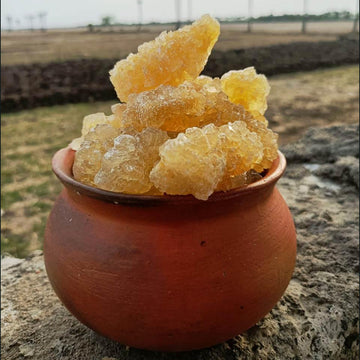
Only in its crystals. White sugar is crystallised quickly from refined cane or beet syrup into grains about half a millimetre across. Mishri is made by dissolving sugar into a syrup and letting it cool and crystallise slowly, so the crystals grow large. For dhaga mishri, cotton threads are strung through the syrup and the crystals build up on them over several days.
Chemically, the result is the same. Fully refined sugar is about 99.9% sucrose, and mishri crystals are almost pure sucrose too, with any colour or minerals present in trace amounts at most.
| White sugar | Dhaga mishri | |
|---|---|---|
| What it is | Sucrose | Sucrose |
| How it is made | Quick crystallisation, then dried | Slow crystallisation on cotton threads over several days |
| Crystal | Fine grains, about 0.5 mm | Large, chunky crystals |
| Calories per level teaspoon (4 g) | About 16 | About 16 |
| Dissolves | Quickly | Slowly |
| Typical uses | Tea, cooking and baking | With saunf, in warm milk, as prasad |
| Counts as free or added sugar | Yes | Yes |
Rock sugar vs white sugar: is there any difference?
Chemically, almost none. Rock sugar, whether Indian mishri, Chinese rock sugar or Persian nabat, is sucrose in large crystals. Some rock sugars are made from less refined syrups and look pale gold, but the amount of anything other than sucrose is tiny.
Mishri calories: how many are in a teaspoon?
About 4 per gram, the same as sugar: roughly 390 calories per 100 g, or about 16 in a level teaspoon. Crystal size does not change this, because a gram of sucrose is a gram of sucrose.
| Amount | About | Calories | Share of the WHO's ideal limit (25 g) |
|---|---|---|---|
| 1 level teaspoon | 4 g | 16 | 16% |
| 1 level tablespoon | 12 g | 46 | 48% |
| 6 level teaspoons | 25 g | 97 | 100% |
| 100 g | 100 g | About 390 | 400% |
The World Health Organization recommends keeping free sugars below 10% of daily energy, which on a 2,000-calorie diet is about 50 g, and says that cutting them below 5%, roughly 25 g or 6 teaspoons, brings further benefit. Mishri counts towards both limits, exactly like sugar.
Does mishri have a lower glycemic index than sugar?
Not as far as anyone has shown. The glycemic index (GI) ranks how quickly a food raises blood sugar compared with pure glucose, which is set at 100. Table sugar sits in the medium band of 56 to 69, with tests usually putting it at around 65. We could not find any published GI test of mishri, and since it is the same molecule, there is no reason to expect a different result.
Sucking a crystal slowly spreads the same sugar over a few minutes, but once it is swallowed, your gut splits sucrose into glucose and fructose and absorbs them quickly, just as it does with sugar from the bowl. What you eat alongside it, such as a full meal, makes more difference than the size of the crystal.
Is mishri better than sugar?
For your health, no. For your table, sometimes. Mishri's large crystals make it pleasant to nibble with saunf (fennel seeds) after a meal, slow to dissolve in the mouth and lovely in a bowl at a puja. Some people find that a few crystals satisfy them more than a spoonful of sugar would, which can mean eating less. That is a habit benefit, not a nutritional one.
If you want a sweetener that brings something besides sucrose, jaggery keeps some of the cane's minerals and molasses, though it is still mostly sugar; see is jaggery just sugar?
Dhaga mishri or sugar: which is better?
Use each where it works best. Sugar dissolves almost at once, so it suits tea, coffee, baking and cooking. Dhaga mishri suits slow moments: a few crystals with saunf after dinner, in a glass of warm milk, or as prasad. Whichever you use, count it as sugar.
Our article on dhaga mishri vs regular mishri explains what the thread changes, and what mishri is made of covers how it is made and what it is called in English.
Who should count mishri carefully?
- Diabetes or prediabetes: mishri raises blood sugar like table sugar. Count it in your carbohydrates and follow your doctor's or dietitian's advice.
- Weight goals: it is pure sugar, with nothing in it to fill you up.
- Young children: the US Dietary Guidelines advise avoiding added sugars in infancy and early childhood, and hard crystals can be a choking risk. Take the thread out before serving.
- Teeth: sucking crystals over a long time bathes the teeth in sugar, so keep mishri to mealtimes and rinse afterwards.
Our dhaga mishri
Our Desi Dhaga Mishri is sugar syrup crystallised slowly on cotton threads over several days, with nothing bleached or added. We make no health claims for it: it is sugar, made the slow, traditional way, to be enjoyed a few crystals at a time.
The bottom line
Mishri and white sugar are the same sucrose, with the same calories and a similar effect on blood sugar. Choose mishri for its crystals, its slow sweetness and its traditions, not for your health, and count every crystal as sugar.
Frequently asked questions
Is mishri natural sugar?
It is made from sugar, which comes from cane, so in that sense it is natural. Nutritionally, though, it counts as a free or added sugar, just like the sugar in your bowl, and the WHO's limits on free sugars apply to mishri in exactly the same way.
Is mishri good for diabetics?
No more than sugar is. Mishri is sucrose and raises blood sugar like table sugar. If you have diabetes, count any mishri as part of the carbohydrate in that meal, keep amounts very small, and follow your doctor's or dietitian's advice.
Does mishri contain minerals?
Only trace amounts, if any, because it is crystallised from sugar syrup and the crystals are almost pure sucrose. It is not a meaningful source of iron, calcium or any other mineral. If minerals are your aim, foods such as dal, leafy greens and dairy do far more.
Which is better for tea, mishri or sugar?
Sugar, for convenience: it dissolves almost at once, while mishri crystals take time unless you crush them first. The calories are the same either way. Many people keep mishri for warm milk, saunf and prasad, and use ordinary sugar for tea and cooking.
What is mishri called in English and other languages?
In English it is called rock sugar or sugar candy. Regional names include khadi sakhar in Marathi and kalkandu in Tamil. Dhaga mishri is the kind grown on cotton threads, with the thread still running through each crystal.
Sources
- WHO calls on countries to reduce sugars intake among adults and children, World Health Organization, 2015
- Sucrose: energy, glycemic index and digestion, Wikipedia, accessed 2026
- Glycemic index, Wikipedia, accessed 2026
- Dietary Guidelines for Americans 2025-2030, US Departments of Agriculture and Health and Human Services, 2026