Mishri benefits: what Ayurveda says and what is actually true
Mishri benefits, honestly weighed: it is loved as a cooling sweet, a partner for saunf and a soother for scratchy throats. What tradition says, what is true, and why it is still sugar.

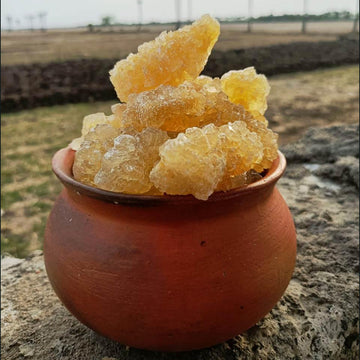
The real mishri benefits are flavour and ritual. Mishri is crystallised sugar (sucrose), a slow-dissolving sweet for saunf after meals, warm milk or prasad. Ayurveda calls it cooling and soothing, but there is no good research showing that mishri has health effects of its own, and it carries the same calories as table sugar.
Mishri, rock sugar grown into large crystals, is one of India's oldest sweets, and "mishri khane ke fayde", the benefits of eating mishri, is a question asked thousands of times a month. It deserves an answer that is both respectful and honest. Here is how Indian homes use it, what Ayurveda says, and what is actually true.
At a glance
- Mishri is sucrose crystallised slowly from sugar syrup; dhaga mishri grows on cotton threads over several days.
- It has about 4 calories per gram, roughly 16 in a level teaspoon (4 g), the same as table sugar.
- Ayurveda describes it as cooling, and it gives its name to Sitopaladi churna, a classical powder for coughs and congestion.
- No good study shows that mishri itself cools the body, soothes a throat or helps digestion.
- The WHO advises keeping free sugars under 10% of daily energy, and ideally under 5% (about 25 g, or 6 teaspoons).
Mishri benefits, according to tradition: five classic uses
In Indian homes mishri has five classic jobs. Each has a kernel of everyday sense, and none has been tested as medicine.
With saunf after meals
A pinch of saunf (fennel seeds) with a few crystals of mishri is India's traditional after-meal mouth freshener. The fennel brings the aroma and the mishri softens its sharpness. Tradition credits the pair with settling the stomach, but there are no good studies of mishri for digestion.
In warm milk
A crystal or two of mishri, often with a pinch of cardamom or saffron, sweetens a bedtime glass of warm milk in many homes. It is comforting, and the comfort comes from the warm milk and the routine as much as from the sugar.
With black pepper for a scratchy throat
Crushed mishri with a little black pepper, or a crystal sucked slowly on its own, is a grandmother's remedy for a tickly throat. Ayurveda's Sitopaladi churna follows the same idea. It takes its name from sitopala, crystal sugar, which is mixed with bamboo manna, long pepper, cardamom and cinnamon, and it is traditionally used for coughs and chest congestion.
As a cooling summer sweet
Ayurveda classes mishri as cooling, so it is stirred into summer drinks and sherbets, and handed out with water on hot afternoons.
As prasad
Mishri is a favourite temple offering, and makhan mishri, fresh white butter with rock sugar, is the sweet of the child Krishna, made at Janmashtami. Here its value is devotion, not nutrition.
Is mishri better than sugar?
No. Mishri and white sugar are the same molecule, sucrose, and a gram of either gives about 4 calories. Mishri's large crystals dissolve slowly, so a few pieces can feel like more sweetness than they are, and some people end up eating less. Gram for gram, though, it is not healthier.
You may see mishri described as natural or less processed. It is made by dissolving sugar into a syrup and letting it crystallise slowly, so whatever the starting sugar, the finished crystals are almost pure sucrose. Any minerals are present in trace amounts at most, far too little to matter in your diet.
The difference is in the crystal, not the chemistry. Our article on dhaga mishri vs regular mishri explains what the thread changes. If you want a sweetener with a little more than sugar in it, jaggery keeps some of the cane's minerals, though it is mostly sugar too; see is jaggery just sugar?
Is mishri cooling for the body?
In Ayurvedic terms, yes: it is described as cooling in potency. That is a traditional way of describing how a food behaves, not a measurement of body temperature, and no study shows that mishri lowers body heat.
On a hot day, what really cools you is water, shade and rest. A glass of cool water with a little mishri is refreshing mainly because of the water.
Is mishri good for a cough or a sore throat?
There is no research on mishri for coughs. A crystal sucked slowly makes your mouth produce more saliva, which can feel soothing, much as any lozenge does, but it will not shorten a cold.
See a doctor if a cough lasts more than three weeks, or comes with a high fever, breathlessness, chest pain or blood. And do not give mishri to babies or toddlers for a cough: the US Dietary Guidelines advise avoiding added sugars in infancy and early childhood, and hard crystals can be a choking risk.
Can you eat mishri every day?
Yes, in small amounts, as long as you count it as sugar. The WHO recommends keeping free sugars, the sugars added to food plus those in honey, syrups and juices, below 10% of daily energy, and says cutting them below 5%, about 25 g or 6 teaspoons a day, brings extra benefit. The newest US Dietary Guidelines suggest no more than 10 g of added sugar in any one meal.
| Amount of mishri | About | Calories | Share of the WHO's ideal 25 g |
|---|---|---|---|
| 1 level teaspoon | 4 g | 16 | 16% |
| 1 level tablespoon | 12 g | 46 | 48% |
| 6 level teaspoons | 25 g | 97 | 100% |
For your teeth, how often matters as much as how much. Sucking crystals through the day bathes your teeth in sugar again and again, so enjoy mishri with or after a meal, then rinse your mouth with water. A simple habit helps keep portions small: keep mishri in a little bowl with saunf rather than in a big jar, and take two or three crystals instead of a spoonful.
Who should go easy on mishri?
- People with diabetes or prediabetes: mishri counts fully as sugar. Include it in your carbohydrate count and ask your doctor or dietitian.
- Anyone watching their weight: it is pure sugar, with no fibre, protein or fat to fill you up.
- Babies and young children: avoid added sugars, keep hard crystals away from toddlers, who can choke on them, and remove the cotton thread from dhaga mishri before serving.
- People with cavities or sensitive teeth: keep it to mealtimes and rinse afterwards.
Our dhaga mishri
Our Desi Dhaga Mishri is sugar syrup crystallised slowly on cotton threads over several days, with nothing bleached or added. Enjoy it the way it has always been enjoyed: a few crystals with saunf after a meal, in warm milk, or as prasad. It is still sugar, so a little goes a long way.
The bottom line
Mishri's real gifts are flavour, ritual and a slow, gentle sweetness. Its cooling and soothing roles are tradition and comfort rather than proven effects, and nutritionally it is simply sugar, so enjoy a few crystals and count them.
Frequently asked questions
Mishri khane ke fayde kya hain?
In plain terms, mishri is a pleasant, slow-dissolving sweet, used with saunf after meals, in warm milk and as prasad. Ayurveda calls it cooling and soothing for the throat, but research has not shown these effects. It gives the same calories as sugar, about 16 in a level teaspoon.
Are tal mishri benefits different from cane mishri?
Not in any proven way. Tal mishri is rock candy made from palm sap, often from the palmyra palm, instead of cane sugar syrup, and many South Indian homes value it, especially in warm milk for sore throats. It is still mostly sugar, so the same advice applies: small amounts, counted as sugar.
Are dhaga mishri benefits different from regular mishri?
Not in nutrition. Dhaga mishri and other mishri are both sucrose; the thread simply gives the crystals something to grow on, so they form large, clear clusters that dissolve slowly. People choose it for its look, its gentle sweetness and tradition. Take the thread out before giving it to young children.
Is mishri good during pregnancy?
Small amounts are fine for most pregnant women, counted as part of the day's sugar. If you have gestational diabetes or have been asked to watch your blood sugar, count mishri exactly like table sugar and follow your doctor's or dietitian's advice on how much, if any, to have.
Is mishri the same as rock sugar?
Yes. Mishri is India's rock sugar: sucrose grown slowly into large crystals. Dhaga mishri forms on cotton threads, while other kinds form without them. Our guide to what mishri is made of and what it is called in English explains how it is made.
Sources
- WHO calls on countries to reduce sugars intake among adults and children, World Health Organization, 2015
- Dietary Guidelines for Americans 2025-2030, US Departments of Agriculture and Health and Human Services, 2026
- Sitopaladi churna, Wikipedia, accessed 2026
- Sucrose: energy and digestion, Wikipedia, accessed 2026