Face massage with oil: the Ayurvedic way, step by step
A face massage with oil takes five quiet minutes in the Ayurvedic tradition. Here is which oil suits your skin, each stroke step by step, how to use a kansa wand, and an honest word on lifting claims.

For a face massage with oil, the Ayurvedic way, warm 3 to 4 drops of almond or sesame oil between your fingertips, press it onto clean skin, then use slow upward strokes along the jaw, cheeks and forehead, ending with gentle circles at the temples. Five minutes is enough. It relaxes and brings colour to the skin but does not lift the face.
Mukha abhyanga, from mukha (face) and abhyanga (oil massage), is the Ayurvedic face massage: the face part of the daily oil massage that Ayurveda describes in its routines. Spas offer it as part of an Ayurvedic facial, and it has found a new audience through the kansa wand, a small bronze massage tool now popular well beyond India. Done gently, it is a calm way to end the day; done roughly, or with the wrong oil, it can upset sensitive or acne-prone skin.
At a glance
- Mukha abhyanga is the face part of abhyanga, Ayurveda's daily oil massage.
- Use 3 to 4 drops of almond or white sesame oil, or a fingertip of ghee with a kansa wand.
- Strokes go upwards and outwards with light pressure, for about five minutes.
- Massage warms the skin and draws blood to the surface for a while; there is no good evidence that it lifts, sculpts or smooths wrinkles.
- Oily or acne-prone skin: use one or two drops or none, and skip coconut oil on the face.
What is mukha abhyanga, the Ayurvedic face massage?
It is a gentle self-massage of the face, neck and temples with a little warm oil or ghee. Ayurveda's classical texts recommend daily oil massage, abhyanga, as part of dinacharya, the daily routine, and the face is simply where many people start. If you already oil the body, our guide to abhyanga at home covers the rest.
In the tradition, oiling the face is said to calm vata and keep the skin supple in dry weather, which is why the practice is especially popular in winter. Modern research has not tested those ideas, so read them as the tradition's view rather than proof.
The kansa wand is a modern twist on an old material. Kansa is bell metal, an alloy of copper and tin, long used in India for plates, bowls and the small bowl rubbed on the soles in a foot massage, as in padabhyanga. A wand puts a smooth kansa dome on a wooden handle so it can glide over the face.
Which oil is best for a face massage?
The best oil is the one your skin tolerates, used sparingly. For most skin, a few drops of almond or white sesame oil are a good start, and ghee is the traditional choice for very dry skin.
| Skin type | Choose | How much | Notes |
|---|---|---|---|
| Dry or mature | Almond or white sesame oil, or ghee with a kansa wand | 3 to 4 drops, or a fingertip of ghee | Sesame feels warmer, good for winter |
| Normal | Almond oil | 3 drops | Light and smooth |
| Oily or combination | Almond oil, very little | 1 to 2 drops | Or massage over a light, non-comedogenic lotion |
| Acne-prone | Little or no oil | 0 to 1 drop | Skip coconut oil; keep off active pimples |
| Sensitive or rosacea-prone | Ask your dermatologist first | None until you have asked | Massage can flare redness |
Research on plant oils and skin is mostly small studies. A 2018 review noted that almond oil helped protect skin structure from UV damage in mice and that sesame oil contains lignans with antioxidant activity, but neither finding adds up to a proven facial benefit. Coconut oil is rich and can block pores, so keep it for the body. For more, see almond oil benefits for skin and hair, honestly assessed.
How do you do a face massage with oil, step by step?
- Cleanse. Wash your face, or take off make-up with oil first as in our guide to taking off makeup with oil, and leave the skin slightly damp.
- Warm the oil. Rub 3 to 4 drops between your fingertips.
- Spread. Press the oil over the face and neck with flat palms.
- Neck. Stroke upwards from the collarbone to the jaw, five times on each side, very lightly over the front of the throat.
- Jaw. Glide from the chin to just below the ear along the jawline, five times on each side.
- Cheeks. Sweep from the sides of the nose out towards the ears, five times.
- Under the eyes. With your ring finger, tap very lightly along the bone from the inner to the outer corner. Keep oil out of the eyes.
- Forehead. Stroke upwards from the brows to the hairline, then outwards from the centre to the temples.
- Temples. Make slow, small circles five to ten times, then rest your palms over your face and take three slow breaths.
Blot any excess with a soft tissue. The whole sequence takes about five minutes.
How do you use a kansa wand?
Always on oiled skin, never dry. The wand needs slip to glide; dragged over dry skin, it tugs.
- Apply your oil, or a fingertip of ghee, as above.
- Hold the wand like a pen near the dome, so the dome lies flat on your skin.
- Make small circles on the cheeks and jaw, then long upward and outward glides, with feather-light pressure.
- Around the eyes, stay on the bony brow and cheekbone, never on the eyelids.
- Afterwards, wipe the dome with a soft, damp cloth and dry it.
Kansa can leave a faint grey tint on oiled skin, which wipes away with a damp cloth. Clean the wand after each use, and do not share it while you have any skin infection.
How often should you massage your face?
Daily or a few times a week, whichever you will keep up. Evening suits most people, because the oil has time to settle before sleep. Pause on days when your skin is irritated or breaking out.
It is easiest to keep when it is tied to something you already do: after you cleanse at night, before any night cream. Ending with a few slow breaths makes it feel like a pause rather than a chore.
Can a face massage cause breakouts?
Yes. Too much oil, a heavy oil, or massage over active pimples can all lead to breakouts in acne-prone skin. Use the fewest drops that let your fingers glide, wash your face afterwards if you are prone to spots, change pillow covers often, and skip coconut oil on the face.
Does a face massage lift or tone the face?
No massage has been shown to lift sagging skin, sculpt the jaw or remove wrinkles. What it does do is warm the skin and draw blood to the surface for a while, which is why your face looks pinker and feels fresh afterwards. Some people find morning puffiness looks softer after a few gentle strokes, but that effect is brief. Enjoy it as a calming ritual, not a facelift.
Who should be careful
- Keep oil out of the eyes; if any gets in, rinse with clean water.
- Patch test a new oil along the jawline for 24 hours. Almond is a tree nut and sesame a common allergen.
- Skip massage over broken skin, sunburn, cold sores, cystic acne, or a rosacea or eczema flare.
- After fillers, injections, peels or laser, ask your dermatologist when massage is safe.
- Use only light pressure on the front of the neck.
Using our almond oil, sesame oil and ghee
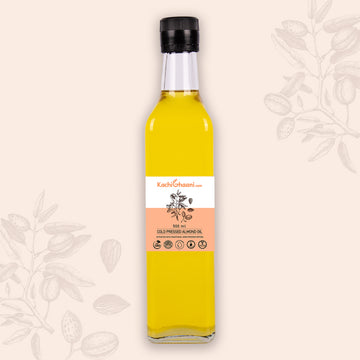
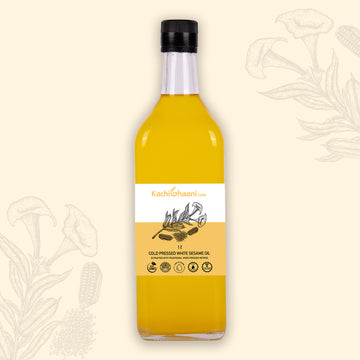
Our Truly Cold Pressed almond oil is pressed slowly in a wooden ghaani and left unrefined, and three or four drops are enough for one massage. For dry winter skin, our white sesame oil is the warmer classic, and a fingertip of our A2 Gir cow ghee, churned by the bilona method, pairs well with a kansa wand on very dry skin.
The bottom line
Mukha abhyanga is five quiet minutes: a few drops of almond or sesame oil, upward strokes and slow circles at the temples. It warms the skin and calms the mind, but it will not lift or reshape the face, so keep the touch light, keep oil out of your eyes, and use very little if you break out.
Frequently asked questions
Should I wash my face after an oil massage?
If your skin is dry, you can leave a thin layer on overnight and simply blot the excess. If you are prone to spots or the oil feels heavy, wash with a gentle cleanser after ten to fifteen minutes. In the morning, wash it off before sunscreen and make-up so they sit evenly on the skin.
Can I massage my face with ghee?
Yes. Ghee is a traditional choice in Ayurveda, especially with a kansa bowl or wand, and it suits very dry skin in winter. Use only a fingertip, warmed between your palms. Ghee is rich, so skip it if your skin is oily or acne-prone, and patch test it like any oil.
Can I use a kansa wand without oil?
No. Kansa needs a thin layer of oil or ghee to glide smoothly, and on dry skin it tugs and can irritate. Apply a few drops of oil first, and add another drop whenever the wand starts to drag during the massage. Keep the pressure light throughout.
Will a face massage get rid of dark circles?
There is no good evidence that it will. Dark circles come from genes, thin skin, pigment and shadows, and sometimes allergies or poor sleep. A gentle massage may make the area look fresher for a short while, but it will not remove them. Never press hard near the eyes or let oil run into them.
Is morning or night better for a face massage?
Night suits most people, because the oil can settle while you sleep and you are not rushing. A morning massage works too, with one or two drops, and many people like it on days their face looks puffy on waking. Wash the oil off before sunscreen and make-up.