Ghee for babies: when to start, how much, and what doctors say
Ghee for babies, the Indian way: when to add it to a first khichdi or dal, how much is sensible, what paediatric guidance says, and what ghee will not do for weight gain.

Ghee for babies starts with solid food: from about six months, a few drops can be mixed into meals such as dal, khichdi or mashed vegetables. Build up slowly. Ghee adds energy to small meals, but it will not make a healthy baby grow faster, and your paediatrician is the right guide.
For generations, Indian grandmothers have finished a baby's first khichdi with a little melted ghee, and Indian paediatric guidance supports adding some fat to a baby's meals. The confusion is about everything else: how early, how much, whether ghee "builds weight", and what goes in alongside it. Here is a calm, practical guide.
At a glance
- WHO advises breast milk only for the first six months, then small amounts of solid food alongside continued breastfeeding.
- The Indian Academy of Pediatrics advises making each meal energy-dense with a little ghee, butter or oil once complementary feeding starts at six completed months.
- Start with a few drops of melted ghee in one meal and build up slowly. There is no official dose; follow your paediatrician.
- Ghee adds calories, not growth on demand. Slow weight gain needs a doctor's check, not extra ghee.
- No honey before the first birthday and no added salt. The NHS also advises against sugar for young children, and that includes jaggery.
Ghee for babies: at what age can they start?
From about six months, when your baby starts solid food. Before that, babies need only breast milk or infant formula.
WHO and UNICEF recommend breast milk alone for the first six months, then complementary foods (the first foods given alongside milk) starting with small amounts and increasing gradually, with breastfeeding continuing to two years or beyond. The Indian Academy of Pediatrics (IAP) also advises introducing complementary foods at six completed months. So when to give ghee to a baby has a simple answer: with the first solid foods, as part of the food, never before.
Some families still follow the old custom of giving a newborn a lick of honey or ghee, often called janam ghutti. Paediatricians advise against it. Babies under six months need nothing but breast milk or formula, and honey must wait until after the first birthday.
Why do Indian paediatric guidelines suggest adding ghee or oil?
Because babies have small stomachs and high energy needs, and a little fat packs more energy into each spoonful.
Breast milk gets about half of its energy from fat. First foods, by contrast, are often watery and light: dal water, thin rice porridge, boiled vegetables. A baby can only eat a few spoons at a time, so the IAP's 2016 feeding guidelines say each meal should be made energy-dense by adding ghee, butter or oil. Fat also helps the body absorb vitamins A, D, E and K, and it makes food smoother and more appealing. The same guidelines mention sugar or jaggery as another way to add energy, but many health bodies now advise against added sugar for babies, as explained below.
How much ghee can I give my baby per day?
There is no official dose. Start with a few drops in one meal and build up slowly; many families settle at about half to one teaspoon per meal by the first birthday. Your paediatrician can tailor this to your baby.
| Age | Food texture | Ghee per meal (common practice, not an official dose) |
|---|---|---|
| 6 to 7 months | Smooth purées and soft porridge | A few drops, up to about 1/4 teaspoon (about 1 ml) |
| 8 to 9 months | Mashed food, soft lumps | About 1/4 to 1/2 teaspoon (1 to 2.5 ml) |
| 10 to 12 months | Soft family food, finger foods | About 1/2 to 1 teaspoon (2.5 to 5 ml) |
| 1 to 2 years | Family meals, chopped or mashed | About 1 teaspoon (5 ml) |
Use less if your baby already gets other fats in the same meal, such as full-fat curd, paneer or butter. More is not better: a baby who fills up on fat may eat less of the dal, vegetables, fruit and cereals that bring protein, iron and other nutrients. Never force a spoonful.
Ghee for baby weight gain: does it help?
It adds energy, so it can help a baby who is simply eating too little. It does not make a healthy baby grow faster than their own natural pattern, and it is not a fix for poor weight gain.
Babies grow at very different rates, and paediatricians judge growth on charts over months, not week to week. If your doctor is concerned about weight, there may be reasons that ghee will not solve, such as feeding difficulties or illness. Follow the plan your paediatrician gives. It may well include ghee or oil, but as part of a bigger picture.
Is cow ghee better than other fats for babies?
Not necessarily. Ghee, butter and suitable cooking oils all add energy, and there is no good evidence that cow ghee, A2 ghee or Gir cow ghee is better for babies than other fats.
Many Indian families choose ghee for its taste and tradition, and that is a perfectly good reason. Using a mix of fats across the family's meals is fine too. What matters most is that the ghee is fresh, clean and made only from milk fat. If your baby has a cow's milk protein allergy, ask your doctor before giving ghee, which can carry traces of milk protein.
Can babies have jaggery or honey with ghee?
No honey before 12 months, ever. Jaggery and sugar are best left out too.
The NHS explains that honey can carry bacteria that release a poison in a baby's intestines, causing infant botulism, a rare but serious illness. Jaggery is a gentler-looking sweetener, but it is still sugar, as our honest look at whether jaggery is just sugar explains. The NHS advises avoiding food and drinks with sugar for children aged four and under. Older Indian guidance does mention sugar or jaggery for energy, so ask your paediatrician, but most current advice is to let babies learn to enjoy unsweetened food. Do not add salt either; babies' kidneys cannot cope with much.
Safety: what to watch for
- Introduce one new food at a time and watch for rashes, vomiting or swelling, and stop and call your doctor if you see them.
- Melt the ghee, stir it in well and check the food's temperature before feeding.
- Use a clean, dry spoon in the jar, and never return a spoon from the baby's mouth to the jar.
- Never put ghee or oil into a baby's nose, ears or eyes.
- If your baby was born early, has a health condition or is not gaining weight, ask your paediatrician before changing their diet.
Questions about massage are different; our guide to baby malish and its safety rules covers them.
Choosing ghee for your baby's food
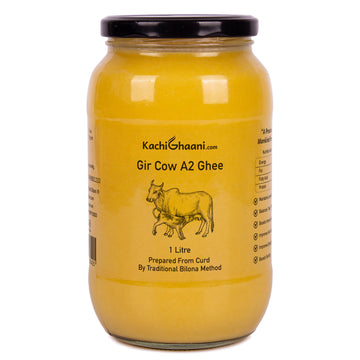
If you cook your baby's khichdi with ghee, our A2 Gir cow ghee is made the bilona way: Gir cow milk set as curd, hand-churned into makkhan (butter) and slowly simmered, with nothing added. At baby amounts a jar lasts a long time, it keeps for about 12 months stored cool and dry, and the rest of the family can enjoy it too.
The bottom line
From about six months, a few drops of ghee in your baby's dal or khichdi is a sensible, traditional way to make small meals more nourishing, building up to about a teaspoon per meal by the first birthday. Ghee is not a growth tonic, honey waits until after one, and sugar and salt are best left out. When in doubt, ask your paediatrician.
Frequently asked questions
Can I give ghee to my 6 month old?
Yes, once your baby has started solids at around six months, you can add a few drops of melted ghee to a meal such as dal, rice porridge or mashed vegetables. Build up slowly over the following weeks, and check with your paediatrician first if your baby was premature or has a health condition.
Is ghee good for a baby's brain development?
Babies need fat for their fast-growing brain, which is one reason breast milk gets about half its energy from fat. But there is no evidence that ghee is better for brain development than other fats. Continued breastfeeding and a varied diet matter most.
Should I give my baby ghee every day?
Most babies can have a little ghee in one or more meals each day once they are eating solids. Keep the amounts small, offer a variety of foods, and there is no need to add ghee to every spoonful. If your baby has a dairy allergy, ask your doctor first.
Is homemade ghee better for babies than bought ghee?
Not necessarily. What matters is that the ghee is fresh, clean and made only from milk fat. Homemade ghee is fine if it is prepared and stored hygienically, and bought ghee is fine if it comes from a maker you trust with an FSSAI licence on the pack. Throw away ghee that smells sour.
Can I mix ghee into formula or breast milk?
No. Formula and expressed breast milk should be given exactly as they are, because adding fat changes their careful balance and can upset your baby's tummy. Ghee belongs in solid food from about six months, stirred into dal, khichdi, porridge or mashed vegetables.