Ghee in Ayurveda: what the tradition actually holds

Few foods carry as much authority in the classical Ayurvedic texts as ghee — and few foods have had that reverence garbled as badly by modern marketing. This article lays out what the tradition actually says, clearly labelled as tradition, so you can meet the original ideas without the sales gloss.
One framing note first, because we repeat it wherever we write about Ayurveda: words like agni, snehana and dosha belong to the tradition’s own map of the body. We present them as heritage — what generations believed and practised — not as claims we are making about what ghee will do for you.
Why does Ayurveda single out cow ghee?
The texts are specific: goghrita — ghee made from cow’s milk — is the ghee the tradition prizes, ranked above every other fat it discusses. Buffalo ghee appears in the classical literature too, but it is described differently: heavier, cooler, harder work for the body. When an old text says “ghrita” with approval, cow ghee is almost always what it means.
That distinction survives in how the two are made even today. Buffalo milk carries much more fat, which is why buffalo ghee is cheaper to produce and chalky white — buffalo milk fat has no carotene to lend it colour. Cow ghee takes far more milk per litre — ours takes 25–28 litres of A2 Gir cow milk for a single litre — and turns golden from the natural beta-carotene of grazing cows. We have put the two side by side on our A2 ghee vs regular ghee page.
What is snehana, and why does it matter?
Snehana means oleation — the deliberate, generous use of fat, inside the kitchen and out. It is one of the tradition’s central ideas: fat as the carrier that makes food satisfying and rituals complete. Ayurveda’s cooking never feared fat the way the twentieth century did; it regarded good fat, used in sensible amounts, as a foundation of eating well.
The same idea sits behind the tradition of the ghee tadka — spices bloomed in hot fat before they meet the dal. The texts also describe ghee as an anupana, a carrier substance taken alongside other things. You do not need to adopt the vocabulary to notice the pattern: in this tradition, ghee is the vehicle, not the garnish.
Does the tradition say “more ghee is better”?
No — and this is the part modern marketing quietly drops. The classical view is consistently moderate: a spoon, not a ladle. Ghee is described as tridoshic in moderation — agreeable to vata, pitta and kapha alike when used sensibly — and the qualifier is doing real work in that sentence. The texts pair ghee with strong agni, the tradition’s term for the body’s inner fire, and counsel restraint when that fire is low. If you are curious where your own constitution sits in this old map, our two-minute dosha quiz walks you through the traditional framework.
Why does the method of making it matter so much?
Because the ghee the texts describe was not factory ghee. It was made the long way: milk cultured into curd, curd churned into makkhan, makkhan simmered slowly into ghee. That is the bilona method, and it is the process we still follow — curd churned by hand with a two-way bilona, never machine-separated cream. The slow simmer is what gives real bilona ghee its nutty aroma and its danedar grain — the texture of tiny golden granules that home cooks recognise on sight. We have written a full explainer on what the bilona method involves.
A practical corollary the tradition understood well: ghee keeps. Stored cool and dry, a jar of properly made ghee holds for around twelve months without refrigeration — it was the original preserved fat of the Indian kitchen.
How do you actually use ghee the traditional way?
- On rotis and rice — a small spoon melted over hot food, the everyday snehana.
- In the tadka — cumin, hing and chilli bloomed in ghee over dal or khichdi.
- In festive sweets — halwa, laddoos and mithai, where ghee is the flavour.
- For high-heat cooking — ghee holds up to 250°C / 482°F, so it fries confidently when the occasion calls for it.
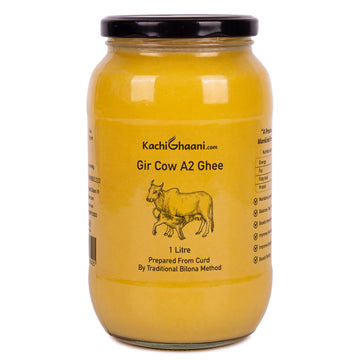
Our Gir Cow A2 Ghee is made bilona-style from free-grazing Gir cows, in small batches, with a lab report published for every batch. The tradition asked for care in the making and moderation in the eating — we handle the first part, and happily pass on the second.