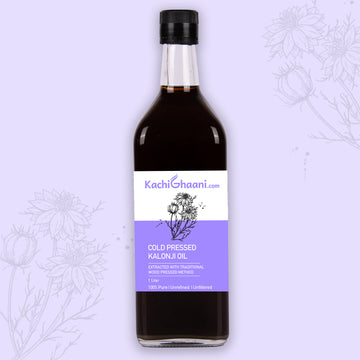
Kalonji oil on skin: what it does, and what it does not
One drop in five, at night, after a patch test. How to use kalonji oil on skin sensibly — and why the neat-on-face routine everyone publishes is a bad idea.

Open any of the top pages for kalonji oil on skin and you will be told to put three neat drops on your face at night. Some of them suggest doing it for acne. One suggests it for pigmentation. Almost none of them mention that this oil has a published record of causing skin reactions.
We sell the oil, and we still think that advice is poor. Here is a more careful version — what kalonji oil is on skin, how to use it if you want to, and the honest boundary of what it does.
What it actually is, on skin
Strip away the marketing and kalonji oil is a plant oil: mostly unsaturated fatty acids, with a small fraction of aromatic compounds — thymoquinone chief among them — that give it its smell and sharpness.
On skin, a plant oil behaves as an emollient. It sits on the surface, fills the microscopic gaps between the cells of the outer layer, and slows the rate at which water evaporates out of the skin. That is why oiled skin feels smoother and looks less papery within minutes. It is not adding moisture; it is slowing a loss. This is the least glamorous and most accurate description of what any face oil does, and it is true of kalonji exactly as it is true of almond.
What is different about kalonji is the aromatic fraction. Thymoquinone is a genuine subject of published research, and it is interesting. But that research is overwhelmingly work in cell cultures and animals; human evidence is limited and the small trials that exist are exactly the ones a marketing page will over-read. Interesting is not the same as proven, and a compound in a dish is not a result on your face.
Patch test before anything else
This step is not a formality with this oil, and we would rather lose a sale than skip it.
Allergic contact dermatitis from topical Nigella sativa oil is documented in the dermatology literature in more than one report, and there is at least one published case of a severe delayed reaction following topical use. These are rare. They are also more than exist for most kitchen oils, and they are the reason kalonji deserves more caution than the internet gives it.
- Mix your dilution first (see below).
- Put one drop on the inner forearm and leave it uncovered.
- Wait a full twenty-four hours, and look again at forty-eight if you have the patience.
- Redness, itching, small bumps or a burning feeling means stop. Do not try a weaker dilution and hope.
Dilute it — neat on the face is a poor default
Most pages tell you to use it neat because neat sounds potent. On a strong, aromatic oil, neat mostly means a higher chance of irritation for no additional benefit.
Start at one part kalonji to five parts almond oil. In practice: one drop of kalonji in five drops of almond, mixed in the palm. If that sits well for a couple of weeks, one in four is a reasonable place to stop. There is no version of this where one in one is the sensible choice.
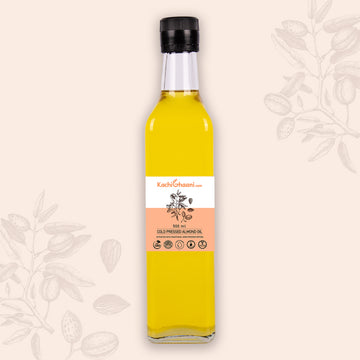
Almond is the carrier we would use — it is light, it has almost no smell of its own, and we have written about it in almond oil benefits, honestly assessed. If there is a tree-nut allergy in the house, use a different carrier.
The method
- Night, not morning. The smell is strong and it lingers for an hour or two.
- Cleanse first, and leave the skin slightly damp. Oil over damp skin holds the water in; oil over bone-dry skin has less to hold.
- Three drops of the blend, warmed between the fingertips. Three, not ten. This is a small-quantity oil.
- Press it in rather than rubbing. Flat palms, gentle downward presses over the cheeks, forehead and jaw. Dragging skin around achieves nothing.
- Stay away from the eye area — the skin there is thinner, and this is not a gentle oil.
- Twice a week to begin with. If your skin is happy after a month, three times.
On the body it is easier: a few drops of the blend into a palmful of a lighter oil, on damp skin after a bath, on elbows, knees and shins.
The smell
Peppery, herby, faintly like onion. On a face it is noticeable to you and to anyone sitting close for the first hour. This is one reason we suggest night use, and one reason the dilution helps as much as it does.
Where we would not use it
- Around the eyes. Thin skin, strong oil, and nothing worth the risk of getting it in an eye.
- On broken or inflamed skin. Cuts, cracks, raw patches, anything a doctor is treating. An irritant on damaged skin is a bad combination.
- On active breakouts. Adding an oil to an inflamed spot is not a plan, and see below on what we cannot claim here.
- On a child. Use something plain and mild instead.
- If your skin is congested and reacting. Which brings us to the honest limits.
What kalonji oil will not do for your skin
- It does not treat acne. Acne is a medical condition. It has real treatments, and they come from a dermatologist. Nothing on this page is one of them.
- It does not treat eczema, psoriasis or any other skin condition. Small studies exist and they are precisely the ones we are refusing to over-read.
- It does not lighten skin, even out tone or fade marks. No oil does. We have said the same about almond oil for years and we are not going to make an exception because kalonji is fashionable.
- It does not clean the skin of anything, in any sense of the word. Oils are emollients.
- We cannot tell you it will not block your pores. The comedogenic ratings passed around online are a crude, poorly standardised measure taken from old animal-ear testing, and for this oil specifically there is no good data either way. So we will not reassure you. If your skin is congestion-prone, treat kalonji as a body oil rather than a face oil, or skip it.
Used at one drop in five, at night, twice a week, on skin that has passed a patch test, this is a pleasant and slightly unusual face oil. That is the whole claim. If you have a skin condition you want addressed, please see a dermatologist — and if you want the wider picture on the oil itself, start with kalonji oil: what it actually is.