Safflower oil for skin: why it turns up in so many creams
Safflower oil for skin, honestly explained: why it appears on so many ingredient lists, what linoleic acid does, how to use it on your face, and why it is a light moisturiser, not an acne fix.

Safflower oil for skin is, above all, a light moisturiser: it sinks in quickly, rarely feels greasy, and the high-linoleic kind is rich in linoleic acid, a fatty acid your skin uses to build its protective barrier. That is why "Carthamus tinctorius seed oil" appears on so many cream and serum labels.
It is also easy to misunderstand. There are two quite different safflower oils, the evidence on acne is thin, and the safflower oil on many supermarket shelves abroad is not the type most skin-care talk is about. Here is what it does, what it does not do, and how to use it on your face without fuss.
At a glance
- Safflower oil is pressed from the seeds of Carthamus tinctorius, a thistle-like plant of the daisy family, called kardai in Marathi and kusum in Hindi.
- There are two types: high-linoleic (about three-quarters linoleic acid) and high-oleic (about three-quarters oleic acid). Skin-care interest centres on the high-linoleic kind.
- It is light and absorbs fast, so it suits normal, dry and combination skin, and many oily skins.
- A small 1998 study found that topical linoleic acid shrank the tiny blocked pores of mild acne by almost a quarter in a month. That is a hint, not proof that safflower oil clears acne.
- Patch test first, and skip it if you are allergic to ragweed, daisies, chamomile or marigolds.
Safflower oil benefits for skin: why creams use it
Because it is a light, affordable emollient that spreads easily and absorbs fast, and because the high-linoleic type is one of the richest plant sources of linoleic acid.
An emollient is an ingredient that fills the tiny gaps between the flattened cells on the skin's surface, so the skin feels smoother and loses water more slowly. Linoleic acid adds a second reason. It is an essential fatty acid, meaning the body cannot make it, and the skin uses it to build ceramides, the waxy fats that hold the outer layer together like mortar between bricks. When the diet badly lacks linoleic acid, the skin becomes dry and scaly, which is part of why formulators like to put it straight onto the skin.
Researchers are interested too. A 2017 review of studies on 19 plant oils applied to the skin, safflower seed oil among them, looked at their effects on the skin barrier, inflammation and wound repair. It shows real interest in these oils, though much of the evidence comes from small trials or laboratory work rather than large studies on people.
High-linoleic or high-oleic safflower oil: what is the difference?
They come from different safflower varieties. High-linoleic oil is mostly linoleic acid, a light omega-6 fat; high-oleic oil is mostly oleic acid, the same fat that dominates olive oil.
| High-linoleic safflower oil | High-oleic safflower oil | |
|---|---|---|
| Main fatty acid | Linoleic acid (omega-6), about 75% | Oleic acid (omega-9), about 75% |
| Feel on skin | Very light, dry finish | Slightly richer and more cushioning |
| Keeping quality | Oxidises faster; use within months | More stable; keeps longer |
| In the kitchen | Best raw or at low heat | Often refined for frying |
| Where you meet it | Traditional Indian kardai oil and many skin oils | Most supermarket safflower oil in the USA |
Oleic acid softens very dry skin well, but it is also known to loosen the skin's outer layer, which is one reason oleic-rich oils can feel heavier and sometimes upset sensitive or acne-prone skin. Indian seed varieties differ, so if the type matters to you, ask the maker. If omega-6 and omega-9 are new words, our plain-language guide to MUFA, PUFA and omegas explains them, and our guide to kardai oil covers its names and kitchen use.
Can you use safflower oil on your face?
Yes. Two to four drops pressed into damp skin at night is enough for most faces.
- Wash your face with a gentle cleanser and leave it slightly damp.
- Warm two to four drops between your fingertips.
- Press, rather than rub, the oil into your cheeks, forehead and jaw. Use less on oily areas such as the nose and chin.
- Use it alone at night, over a water-based serum, or mixed into a drop of your usual moisturiser.
- In the morning, cleanse and apply sunscreen. Oils are not sun protection.
Safflower oil also works as a gentle cleansing oil for removing makeup; our guide to taking off makeup with oil explains the method and who should skip it.
Does safflower oil clog pores, and can it help acne?
For most people it is unlikely to clog pores, because it is light and low in the heavier saturated fats, but any oil can cause breakouts on some skins. It is not an acne remedy.
One long-standing idea in dermatology is that acne-prone skin has too little linoleic acid in its oil. In a small 1998 trial, people with mild acne applied linoleic acid to some areas and a placebo to others for a month. The microcomedones, tiny blocked pores invisible to the eye, shrank by almost 25% where linoleic acid was used, while the placebo areas did not change. That was pure linoleic acid, not safflower oil, in a small group, and it has not been confirmed by large trials.
Be careful with the "comedogenic ratings" for oils shared online. Many come from decades-old tests on rabbit ears and say little about your face. Introduce safflower oil slowly and watch your own skin. If you have active acne, a dermatologist and proven acne medicines will do far more than any oil.
Is safflower oil good for hair?
It works as a light conditioning oil for dry ends and frizz, but there is no good evidence that it makes hair grow or stops hair fall.
Smooth one or two drops over the ends of dry hair, or massage a teaspoon into the lengths 30 minutes before washing. Because it is thin, it washes out more easily than heavier oils, which makes it a good choice for fine hair that goes limp under coconut or castor oil.
Safety: who should be careful
- Patch test first. Dab a drop on your inner forearm and wait 24 to 48 hours. Redness, itching or bumps mean it is not for you.
- Daisy-family allergies. Safflower belongs to the same plant family as ragweed, chamomile, marigold and chrysanthemum. If you react to these, avoid it.
- Eyes and broken skin. Keep it out of the eyes, and do not apply it to cuts, burns or infected skin.
- Skin conditions. If you have eczema, rosacea or very sensitive skin, ask your dermatologist before adding new oils.
- Freshness. High-linoleic oil goes stale faster than most. Oil that smells like crayons or old paint has turned rancid and can irritate skin.
Using our safflower oil on skin
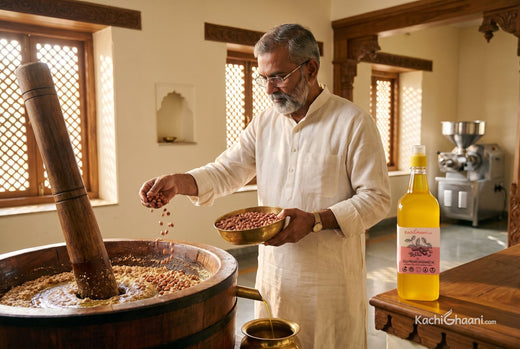
Our Truly Cold Pressed safflower oil is pressed slowly in a wooden ghaani from kardai seed and left unrefined, with nothing added. It is a kitchen oil first, best used raw or at low heat, so the same bottle can dress a salad and soften dry hands. Keep it away from light and heat, close the cap tightly, and use it within a few months of opening.
The bottom line
Safflower oil earns its place in creams because it is light, absorbs quickly and, in its high-linoleic form, supplies a fatty acid the skin uses for its barrier. Use a few drops on damp skin, patch test first, and be wary of anyone who promises it will clear acne.
Frequently asked questions
Can I leave safflower oil on my face overnight?
Yes. A few drops pressed into damp skin at night is the simplest way to use it. If you wake up with blocked pores or small bumps, cut down to one or two drops, use it every other night, or stop. Wash your face in the morning before sunscreen.
Is safflower oil better than coconut oil for the face?
For most faces it is the lighter choice. Coconut oil is mostly saturated fat, feels heavier and can trigger breakouts on some acne-prone skin, while high-linoleic safflower oil absorbs quickly. Coconut oil still suits very dry skin on the body, elbows and heels.
Does safflower oil lighten dark spots?
There is no good evidence that safflower oil fades dark spots or lightens skin. Oils can make skin look smoother and more even simply by softening dry, flaky patches. For dark spots, daily sunscreen matters most, and a dermatologist can suggest options that have been properly studied.
Can safflower oil be used under the eyes?
A tiny amount patted onto the bone below the eye is fine for most people, but keep it out of the eyes themselves. It will soften dry skin there. It will not remove dark circles or puffiness, which depend largely on genetics, sleep and the thinness of the skin.
How long does safflower oil last once opened?
High-linoleic safflower oil oxidises faster than most oils. Keep it tightly closed, away from light and heat, and use it within a few months of opening. If it smells like crayons or old paint, it has gone rancid and should not go on your skin or into your food.