Mysore Pak
Golden, porous, honeycombed, collapsing the moment it touches your tongue. Three ingredients, one hot kadhai, and one moment you cannot afford to miss.

Ingredients
Serves 16
- 1 cup (110 g) besan (gram flour), sieved twice
- 1¼ cups (250 g) sugar
- ½ cup (120 ml) water
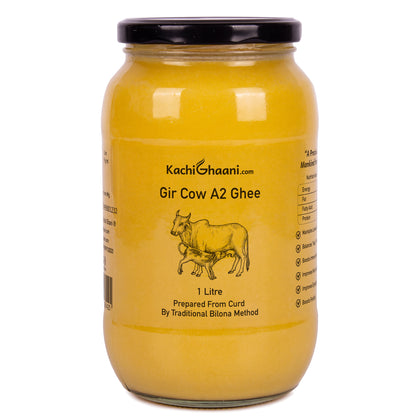
- 1¼ cups (250 g) Gir Cow's A2 Ghee, melted and kept hot
- 2 tbsp Gir Cow's A2 Ghee, to loosen the besan into a paste
- 1 tbsp Gir Cow's A2 Ghee, for greasing the tray
- ¼ tsp cardamom powder, optional
- 1 pinch salt, optional
- 1 square of banana leaf or butter paper, to line the tray, optional
Quantities are scaled up. Taste as you go and adjust the salt and spice.
Shop this recipe
Everything you need, from our press house
A sweet shop off Avenue Road in Bengaluru, late morning. The tray comes out of the back still warm and the man cuts it there and then, and you can see the tiny holes running right through each piece. It is so soft it barely survives being lifted. There are two Mysore paks in this country, the hard dense fudge and this one, the porous kind that gives way completely on the tongue. This is that one.
There are three things in it and one of them is ghee, so this is not the place to economise. Gir Cow's A2 Ghee is made the bilona way from Gir cow milk, and it is the entire flavour of the sweet. It goes in hot, one ladle at a time, each one fully absorbed before the next, and it is the ghee foaming through the besan that creates the honeycomb. Reduce the quantity and you get a dense slab instead.
The one moment that decides it: pour the instant the mixture froths up, small holes appear on the surface and ghee starts gathering at the sides. Not thirty seconds later. Have the greased tray standing right next to the stove before you begin, because there is no time to go looking for it.
How to make it
- Grease a steel tray or thali about 7 inches across with ghee and set it right beside the stove. Line it with a greased banana leaf or butter paper if you like, it makes lifting easier.
- Sieve the besan twice. Mix 2 tbsp of ghee into it to make a smooth, lump-free thick paste. This small step is what keeps the finished sweet free of raw flour lumps.
- Melt the 1¼ cups ghee in a small pan and keep it hot on the lowest flame. It must go in hot, or the mixture seizes.
- In a heavy-bottomed kadhai, preferably brass or thick steel and never non-stick, boil the sugar and water on medium. Cook 4 to 5 minutes to one-string consistency: lift a drop between finger and thumb and it should pull a single short thread.
- Lower the flame. Add the besan paste in 3 or 4 lots, whisking hard after each so no lumps form. The mixture will look glossy and thick.
- Now start adding the hot ghee, one ladle at a time, stirring without stopping. Wait until each ladle is fully absorbed before the next goes in. This takes 10 to 12 minutes in all. Keep the flame low throughout.
- Towards the end the mixture will start frothing, rising in the pan, and small holes will appear on the surface. Ghee will begin to gather at the sides. Stir in the cardamom.
- Pour the whole lot into the greased tray in one go, tilting the kadhai fast. Do not scrape and do not spread it flat, just tap the tray once on the counter to level it.
- Wait 5 minutes, then mark it into squares with a greased knife while it is still warm. Cool completely for 1 hour, then lift the pieces out.
Tips
- The commonest mistake and its fix: pouring too late. If it goes hard and dry, you cooked it half a minute too long. Judge it by the froth and the holes, not by the clock, and pour while it still looks slightly runny. It sets fast in the tray.
- Storage: keeps 1 week in an airtight box at room temperature, 2 weeks in the fridge. Bring it back to room temperature before serving so it melts properly.
- Sources differ on the syrup. Some sweet shops skip the string test and simply add the besan once the syrup boils. If you are unsure of your judgement, take it to one string. It is more forgiving.
- Any ghee that pools around the pieces once they set is normal and is a good sign. Drain it, keep it and use it for cooking.
- Do not use a non-stick kadhai. It cannot take the heat and the constant scraping, and the mixture will not read correctly on the base.