The black seed hadith: what it says and how scholars read it
Where the black seed hadith is recorded, how classical scholars understood it, what the seed is called from Dubai to Jakarta, how families use it, and what modern research can and cannot say.

The best-known black seed hadith is recorded in Sahih al-Bukhari (5688) and Sahih Muslim (2215). Abu Hurairah reported that the Prophet Muhammad, peace be upon him, said: "There is healing in black cumin for all diseases except death." Here 'black cumin' means the black seed, Nigella sativa, known in South Asia as kalonji.
For Muslims from Dubai to Lahore to Kuala Lumpur, this short saying is why a jar of black seed, or a bottle of its oil, sits in so many kitchens. This article sets out where the narrations appear, how classical scholars understood them, what the seed is called around the world and how families use it, and then says plainly what modern research does and does not show.
At a glance
- The narrations appear in Sahih al-Bukhari (5687 and 5688) and Sahih Muslim (2215).
- The one exception, 'as-sam', means death. The narrator Ibn Shihab al-Zuhri explained that the black seed is shuniz, the plant now called Nigella sativa.
- Classical scholars read 'every disease' in more than one way, and all stressed that any benefit comes by God's will.
- Families eat the seed on breads and cheeses, take it with honey and use the oil on hair and skin.
- Modern studies are interesting but small. Black seed is a food, not a substitute for medical care.
What does the black seed hadith say?
Two collections that Sunni Muslims hold in the highest regard record it, in nearly identical words. In Sahih al-Bukhari, Abu Hurairah's report quoted above sits in the Book of Medicine. Its Arabic reads fi al-habbati al-sawda'i shifa'un min kulli da'in illa al-sam. Sahih Muslim (2215), also from Abu Hurairah, carries the same saying in its Book of Greetings:
"Nigella seed is a remedy for every disease except death." (Sahih Muslim 2215, narrated by Abu Hurairah; English translation as given on Sunnah.com)
Within that report, the text itself explains that as-sam is death and that the black seed is ash-shuniz.
A second narration, Sahih al-Bukhari 5687, tells a small story. Khalid ibn Sa'd travelled with Ghalib ibn Abjar, who fell ill on the way. In Madinah, Ibn Abi Atiq advised black seed: five or seven seeds crushed, mixed with oil and dropped into the nostrils. He was passing on a saying Aishah had heard from the Prophet about black seed and as-sam; when she asked what as-sam was, he answered, "Death." This is an account from some fourteen centuries ago, shared here as history, not as a home method. Please do not put oils or crushed seeds into the nose without medical advice.
What does 'every disease except death' mean?
Scholars have understood the phrase in more than one way, but the classical commentators did not read it as a promise that the seed by itself would end every illness.
General words with a specific meaning
Al-Khattabi held that the wording is general but the meaning specific, pointing to illnesses linked to moisture in the medicine of his day. Ibn Hajar al-Asqalani, in his commentary Fath al-Bari, records the view that it refers to the illnesses the seed suits, the 'cold' conditions rather than the 'hot' ones, and notes that it may be used on its own or combined with other ingredients. Ibn al-Qayyim, in Zad al-Ma'ad, compared it with the Qur'an's description of a wind that would "destroy everything by the command of its Lord" (46:25), which destroyed everything it was sent against, showing that 'every' in Arabic can mean every one of its kind.
General words, with conditions
Other scholars kept the general meaning but added conditions, such as combining the seed with other remedies. Ibn Taymiyyah explained that means work only when their conditions are met and obstacles removed, all by God's will, and Ibn Baz reminded readers that recovery is in God's hand alone.
In the tradition, then, black seed is a blessed means, used with wisdom alongside other means. IslamQA's answer on the subject adds that how to use it for a particular condition should follow people of knowledge and experience, or modern medical research.
Is black seed oil sunnah?
The narrations speak of the seed itself, al-habbah al-sawda, rather than its oil. Ibn Hajar noted that it may be used ground or whole, eaten, drunk, sniffed or applied, and the account in Bukhari 5687 mixes crushed seed with oil. So many families see using the seed in any wholesome form, oil included, as honouring the Prophetic tradition. Whether a particular habit counts as sunnah in the technical sense is a good question for your own scholar. Ibn al-Qayyim's chapters on prophetic medicine (al-tibb al-nabawi) remain the best-known classical discussion of black seed.
Kalonji in Islam: is it the black seed of the hadith?
Yes, in the mainstream understanding. Ibn Shihab identified the black seed as shuniz, the plant botanists call Nigella sativa, and that is the seed sold as kalonji in India and Pakistan.
| Language | Name | Note |
|---|---|---|
| Arabic | al-habbah al-sawda | 'The black seed', the words used in the hadith |
| Arabic | habbat al-barakah | 'The seed of blessing' |
| Arabic, from Persian | shuniz | The name Ibn Shihab used |
| Persian | siyah daneh | 'Black seed' |
| Urdu and Hindi | kalonji | The everyday South Asian name |
| Malay and Indonesian | habbatus sauda | From the Arabic |
| Turkish | çörek otu | The seed scattered on breads |
| English | black seed, nigella, black cumin | Often sold as 'onion seed' in the UK |
Despite the English names, it is not related to cumin or onion; it belongs to the buttercup family. It is also not black sesame, nor the kala jeera (Bunium persicum) of Kashmiri cooking, although in Bengali, kalo jeere does mean nigella.
From kalonji to habbatus sauda: how families use black seed
Mostly as an everyday seasoning, with the oil kept for a spoonful here and there.
- Gulf and Levant: pressed into flatbreads and pastries, mixed into some white cheeses, and taken as a spoon of honey with a few seeds or a few drops of oil.
- Turkey: scattered with sesame over pide and other breads.
- South Asia: on naan and kulcha, in mango and lime achaar, in the Bengali five-spice panch phoron and in tadka for dal.
- Malaysia and Indonesia: habbatus sauda oil and capsules are sold widely.
- Hair and skin: the oil is massaged into the scalp and dry skin.
We have written separately about kalonji oil with honey and who should not take it and about kalonji oil for hair and scalp.
What does modern research show?
Interesting results, nothing settled. Most studies use extracts or thymoquinone, the seed's best-known active compound, in lab dishes and animals. Memorial Sloan Kettering's herb database notes that small clinical trials suggest possible benefits for asthma, rheumatoid arthritis, blood sugar and H. pylori, that blood pressure results conflict, and that black seed has not been shown to work against cancer in humans. Larger, better trials are still needed.
For Muslims, the hadith is a matter of faith. For science, black seed is a food with promising but limited evidence. Both can be held with respect, without using one to prove the other.
Who should be careful with black seed oil?
Food amounts are well tolerated by most people; concentrated oil and supplements deserve more care.
- Regular medicines: Memorial Sloan Kettering notes possible interactions with drugs processed by liver enzymes, and that thymoquinone inhibited warfarin activity in a study. Ask your doctor first.
- Diabetes or blood pressure medicine: black seed lowered blood sugar in animal studies, so check before taking more than food amounts.
- Skin: contact dermatitis has been reported. Patch test on the inner arm first.
- Pregnancy, breastfeeding and children: keep to food amounts and speak to your doctor.
- Nose and eyes: never put the oil into either.
If you would like to try kalonji oil
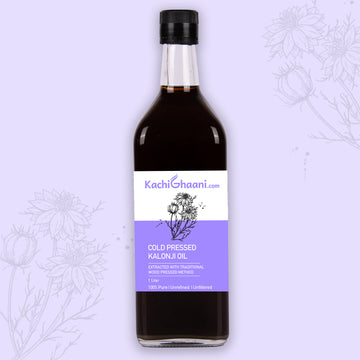
Our Truly Cold Pressed kalonji oil is pressed slowly in a wooden ghaani from black seed and left unrefined, with no preservatives. It is strong, peppery and a little bitter, so begin with a few drops in a spoon of honey or over warm (not hot) food, and keep it away from heat and light. Our guide to what kalonji oil is and how to use it has more ideas.
The bottom line
The black seed hadith, recorded in Sahih al-Bukhari and Sahih Muslim, is among the best-loved sayings on health in Islamic tradition, and classical scholars read it with care: a blessed means that works by God's will and suits many conditions, not all. Modern research is promising but limited, so enjoy black seed as food and keep your doctor's advice for illness.
Frequently asked questions
What is black seed called in Arabic?
In the hadith it is al-habbah al-sawda, 'the black seed'. It is also widely called habbat al-barakah, 'the seed of blessing', and shuniz, the name the narrator Ibn Shihab al-Zuhri used. In Malay and Indonesian it is habbatus sauda, which comes from the Arabic.
Does the hadith mention black seed with honey?
The narrations about black seed in Sahih al-Bukhari and Sahih Muslim do not mention honey. Honey is praised separately, in the Qur'an (Surah an-Nahl, 16:68 to 69) and in hadith. Families combine the two because both are cherished in the tradition, not because a narration prescribes the mix.
How much black seed do families usually eat?
These narrations give no fixed daily amount; the account in Bukhari 5687 mentions five or seven seeds for one particular use. In home cooking, a pinch of seeds on bread or in a tadka is typical, and a few drops to half a teaspoon of oil. Larger, supplement-style doses deserve a word with your doctor.
Can black seed oil replace my medicine?
No. Scholars describe black seed as a means that works by God's will, and they advise following people of knowledge and experience, which today includes your doctor. Keep taking prescribed medicine, and ask before adding more than food amounts, especially if you take blood thinners or diabetes medicine.
What is prophetic medicine?
Prophetic medicine, al-tibb al-nabawi, is the body of hadith about health, diet and remedies, gathered and explained by scholars such as Ibn al-Qayyim in Zad al-Ma'ad. Many Muslims hold it in deep reverence as part of the Sunnah, and classical authors discussed it alongside the medical knowledge of their own day.