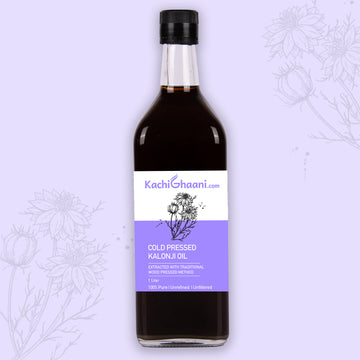
Kalonji oil for hair and scalp: how to use it, and what it will not do
Dilution, timing, the smell problem and washing it out — plus the honest answer to the reels promising kalonji oil stops hair fall in fifteen days.

A customer forwarded us a reel last week. Kalonji oil mixed with onion juice, rubbed on the scalp, hair fall gone in fifteen days. It had a large number of views and a comments section full of people asking where to buy the oil.
We sell kalonji oil. We would very much like to tell you that reel is true. It is not, and this page exists to say so — and then to tell you what kalonji oil is actually good for on a scalp, and how to use it without wasting an expensive bottle or ending up with a rash.
The honest verdict, first
Kalonji oil does not grow hair. It does not stop hair fall. It does not treat alopecia, and it will not reverse thinning. Hair fall has causes — thyroid, low iron, illness, a recent fever or delivery, medication, hormones, genetics — and none of those is addressed by anything you rub on the outside of your head.
What kalonji oil does is what other oils do: it coats the shaft, reduces friction between strands, and makes hair softer to comb. Hair that catches less breaks less, and hair that breaks less keeps the length it grows. On a scalp, a slow massage with a warm oil is pleasant and loosens flakes before a wash. That is the honest list, and it is the same list for almond and sesame — kalonji simply arrives with a stronger smell and a higher price.
You will find one small pilot study cited everywhere in support of the growth claim. It is worth knowing what it actually was: a formulated lotion containing Nigella sativa, not neat oil from a bottle, tested on a small number of people with a specific temporary shedding condition, over a short period. That is a starting point for research. It is not evidence that pouring this oil on your head will change anything, and anyone presenting it that way is stretching it well past what it can hold.
Dilute it — this is not optional
Kalonji is not a base oil. It is sharp, it is pungent, it costs several times what a bulk hair oil costs, and neat on a whole scalp it is both wasteful and unpleasant.
Use one part kalonji to three or four parts of a carrier. Almond is the light choice and rinses out easily; black sesame is the traditional choice and suits winter better. For shoulder-length hair that works out to roughly half a teaspoon of kalonji in two teaspoons of the carrier — enough for the whole scalp, with a little left for the lengths.
Mix it in a small steel katori, enough for that one sitting. Do not blend a big bottle in advance: mixed oils separate and age faster than either does alone, and the kalonji is the expensive half.
The method, step by step
- Patch test first, a day ahead. A drop of the diluted blend on the inner forearm, left for twenty-four hours. Read the section below before you skip this.
- Warm the katori by standing it in hot water for a minute. Never on a flame. Warm oil spreads further and feels better; hot oil is a burn risk and drives off the aroma.
- Part the hair in sections — four or five parts across the scalp — and put the oil on the parting line with your fingertips, not by pouring it on the crown.
- Massage with the pads of your fingers for eight to ten minutes. Small circles, moving section to section. Nails scratch and a scratched scalp is a sore scalp.
- Take whatever is left on your palms through the lengths, ends first.
- Leave it one hour. That is enough. Overnight is a habit, not a requirement, and with this oil it means a strong-smelling pillow.
- Wash it out properly. Two lathers, the first on dry-ish hair with almost neat shampoo. The full method is in how to wash hair oil out without stripping your hair.
Once a week is plenty. Twice if your hair is dry and the season is cold. For the massage technique itself in more depth, see how to do champi.
The smell, and what people actually do about it
Nobody warns you about this and everybody notices it. Kalonji smells of black pepper and oregano with a bite of onion underneath, and after an hour on a warm scalp it is noticeable across a room. It is not unpleasant — it is just strong, and it is not what most people expect a hair oil to smell like.
Three practical things help. Keep the dilution at one to four rather than one to two. Do it on an evening before a wash rather than a morning before an office. And if you want to soften it, the almond carrier does more to mute it than sesame does, because sesame brings its own strong smell to the party.
Patch testing, and why it matters more here
Nigella oil is one of the few plant oils with a genuine trail of published skin reactions behind it. Allergic contact dermatitis from topical use is documented in the dermatology literature, and there is at least one published case of a severe delayed reaction after topical application. These are rare events. They are also exactly the reason a patch test is not a formality with this oil.
Put one drop of your diluted blend on the inner forearm, leave it uncovered for twenty-four hours, and look at it before you put anything on your head. If there is redness, itching, bumps or burning, stop — do not scale up and hope. If a reaction appears anywhere after use, wash it off and see a doctor.
Skip kalonji on the scalp entirely if you have broken skin, an open scratch, or any inflamed patch a dermatologist is already treating.
What kalonji oil will not do for your hair
- It will not regrow hair from a follicle that has stopped. Nothing you buy in a grocery aisle does.
- It will not stop hair fall. Persistent shedding is a medical question and belongs with a dermatologist, who can test for the causes an oil cannot touch.
- It will not thicken individual strands. A coating makes hair feel fuller. That is a film on the outside, not new fibre.
- It will not fix dandruff. Flaking and itching are a condition, and the yeast involved actually lives on oils — oiling makes some people worse. If your scalp flares every time you oil it, that is your answer.
- It will not do more because you used more. Neat kalonji is not a stronger version of diluted kalonji. It is the same oil, spent faster, with a bigger smell.
Used sensibly, this is a good scalp oil with a distinctive character and a long history behind it. Used the way that reel suggested, it is an expensive disappointment. If your hair is genuinely falling, please see a doctor first — and read the wider comparison in which oil for your hair before you decide kalonji is the one you need.