Which oil for your hair: almond, castor, black sesame or kalonji
Four oils, four very different jobs. What each does to a hair shaft, who it suits, the blending ratios that work — and the claims none of them can carry.

A customer sent us a photograph last month: four of our bottles lined up on a bathroom shelf — almond, castor, black sesame, kalonji — with one line under it. "Bought all four. Now which one do I actually put on my head?"
Fair question, and nobody answers it. Every article online argues for one oil at a time, as though you were choosing a religion. In practice these four behave very differently on hair, and the right one depends on how thick your hair is, how much time you have before the wash, and how much patience you have with a slippery pillow. Here is the honest comparison.
First: what a hair oil can and cannot do
An oil sits on the outside of the hair. It coats the shaft, fills the gaps between the lifted scales of the cuticle, and makes strands slide past each other instead of catching. Less catching means less friction, and less friction means fewer strands snapping when you comb, tie or towel your hair. Hair that breaks less keeps the length it grows. In the mirror, over months, that looks a great deal like growth.
That is the real, repeatable effect, and it is worth having. What an oil does not do is reach into the follicle and start something that has stopped. Hair fall, thinning, alopecia and pattern baldness are medical matters with medical causes — thyroid, iron, illness, hormones, genetics — and no oil in this list, or any other list, addresses them. If your hair is falling in handfuls, see a dermatologist first and treat the oil as comfort, not treatment.
One more correction, because it is repeated everywhere: the well-known finding about an oil reducing protein loss from hair is specific to coconut oil and its particular fatty acid. It is not a general property of oils, and it does not transfer to almond, castor, sesame or kalonji. We will not borrow it.
The four oils, side by side
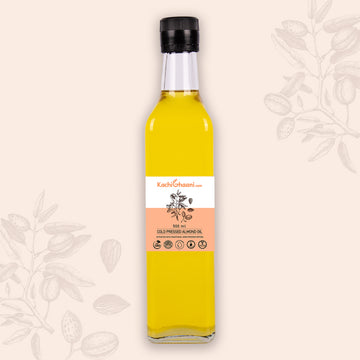
Almond oil — the light one
Pale gold, thin, spreads across a scalp in seconds and rinses out in one lather. It is the easiest of the four to live with, which matters more than people admit — an oil you actually use beats a better oil sitting unopened.
Suits: fine hair, oily scalps, anyone oiling on a weekday, anyone who has given up on heavier oils because of the wash. Skip if: you want the weight and slip of a proper winter oil, or there is a tree-nut allergy in the house. The long version is in almond oil benefits, honestly assessed.
Black sesame oil — the traditional one
Medium weight, dark, and unmistakably nutty. This is the oil of abhyanga and of the North Indian winter champi, and it has held that place for centuries for a practical reason: it is heavy enough to feel like something and light enough to come out. In the Ayurvedic reading it is warming and Vata-pacifying, which is why it is the cold-season default. We share that as tradition, not as medical advice.
Suits: dry or coarse hair, winter, anyone who wants the classical thing done the classical way. Skip if: you dislike a strong nutty smell that lingers, or you have a sesame allergy. See til, gingelly and nallennai for the full picture.
Castor oil — the heavy one
About ninety per cent ricinoleic acid, which is why it leaves the spoon in a slow rope rather than a stream. It clings. That clinging is the whole point: it coats a shaft more thoroughly than any of the others and it holds the coating through a night. It is also the reason it is the hardest to wash out and the one that has been named in published reports of hair matting badly enough to need cutting out.
Never use it neat. One part castor to two or three parts almond, sesame or coconut. Diluted, it does everything you want it to and still rinses. Suits: thick or coarse hair, dry ends, anyone with a Sunday to spare. Skip if: your hair is fine, you are short of time, or you have had matting trouble before. Details in castor oil for hair, honestly assessed.
Kalonji oil — the addition, not the base
This is not a bulk hair oil and it should not be treated as one. It is expensive per millilitre, sharply peppery, and strong enough that people notice it on you at the office. Use it as an addition: one part kalonji to three or four parts almond or sesame. That is enough to carry it into the blend without the smell taking over your day.
Suits: people who want to try it, on an occasional oiling. Skip if: you are sensitive to strong smells, or you have not patch tested — allergic contact dermatitis from this oil is documented in the medical literature, and one published case describes a severe reaction. Our full piece is kalonji oil for hair and scalp.
Blending, in plain numbers
- Everyday, light: almond alone. One to two teaspoons, depending on length.
- Winter champi: two parts black sesame to one part castor. Warm the bowl by standing it in hot water for a minute — do not put oil on a flame.
- Dry ends, thick hair: two parts almond to one part castor, worked mostly through the lengths.
- Trying kalonji: three parts almond to one part kalonji, on the scalp, an hour before a wash.
Mix in a small steel katori, enough for one sitting. Blended oil in a bottle separates and ages faster than either oil on its own.
How much, and how long
Most people use three times what they need, then blame the oil at the wash basin. A rough guide: one teaspoon for short hair, two for shoulder length, one tablespoon for hair past the waist. The scalp should feel damp, not wet. Work it in with the pads of the fingers for eight to ten minutes — nails scratch, and a scratched scalp is a sore scalp.
An hour is enough for the oil to do what it does. Overnight is a habit, not a requirement, and it costs you a pillowcase. If you do leave it overnight, a loose plait and an old cotton towel over the pillow save a lot of laundry. Then wash it out properly — that is its own skill, and we have written it up in how to wash hair oil out without stripping your hair. For the massage itself, see how to do champi.
What none of these oils will do
- Grow new hair. Not almond, not castor, not sesame, not kalonji. No oil restarts a follicle that has stopped.
- Make each strand thicker. Oil coats a strand, and a coated strand feels and looks fuller. That is a film on the outside, not new fibre.
- Stop hair fall. That is a medical question and it deserves a doctor, not a bottle.
- Suit everyone's scalp. If you have flaking and itching that a dermatologist has looked at, be careful — the yeast involved in seborrhoeic dermatitis lives on oils, and oiling makes some people worse rather than better. If your scalp reacts badly, stop.
Patch test any new oil on the inner forearm and leave it a day before it goes near your head. That applies to all four, and most of all to kalonji.