Til Oil, Gingelly Oil, Sesame Oil: One Oil, Many Names
Til oil, gingelly oil and nallennai are one oil - but cold pressed til oil is not dark toasted sesame oil. Which to buy, and how to cook with it.

Sesame oil has more names in India than any other oil on the shelf, and the names are the reason most people buy the wrong bottle. Til ka tel in the north. Gingelly oil in the export trade. Nallennai in Tamil Nadu, ellu enne in Karnataka, nuvvula nune in Andhra, tilachen tel in Maharashtra. Sesame oil in English, and — confusingly — also on a bottle of something quite different.
They are not different oils. Except when they are. Here is the whole thing sorted out, plus how to use the one you meant to buy.
First, the names
Til oil, gingelly oil, nallennai, ellu enne, nuvvula nune and sesame oil are all the same thing: oil pressed from the sesame seed. The word changes with the language and with who is selling it. Gingelly is the older English trade name, still standard across South India and in export paperwork; it has nothing to do with ginger.
What varies is not the name but the process, and that is where the money goes.
The confusion that actually matters: cold pressed til oil is not toasted sesame oil
Walk into a supermarket and you will find two very different bottles labelled sesame oil.
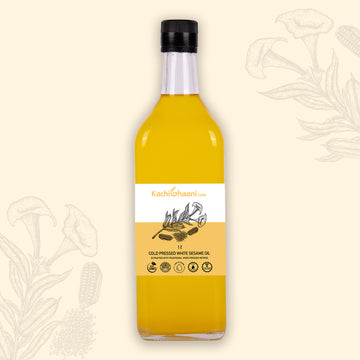
Cold pressed til oil is pale gold to amber, pressed from raw sesame seed without heat. It smells mildly nutty. It is the Indian cooking and massage oil, and it is what this article is about.
Toasted sesame oil is dark brown, almost mahogany, pressed from seed that was roasted first. It smells intensely of toasted sesame. It is an East Asian finishing oil, used by the teaspoon at the end of cooking, and it will bulldoze an Indian dish if you cook in it.
A great many people buy the dark bottle, use it for tadka, decide sesame oil is overpowering, and never come back to the category. If you have had that experience, you were using the wrong oil for the job.
There is a third: refined sesame oil, pale and odourless, stripped by bleaching and steam deodorisation at around 200°C. Cheap, high smoke point, no aroma. Whether that is a bargain or a waste depends entirely on why you wanted sesame oil in the first place.
White sesame or black sesame?
Both are cold pressed the same way; the seed is different, and so is the result.
White sesame oil is the everyday one. Amber, mildly nutty, mild enough to cook with daily without dominating. This is the standard South Indian kitchen oil and the one to reach for if you are buying a single bottle. It naturally carries sesamin and sesamol, the lignans sesame is known for and which refining largely removes.
Black sesame oil — krishna tila — is darker, deeper and distinctly nuttier. In the classical Ayurvedic texts black sesame is the sesame that is meant when sesame is named, and it is the traditional choice for oil pulling and for massage. It is also good in stir-fries and in til chikki, where you want the flavour forward.
Neither is a substitute for toasted sesame oil, and neither is trying to be.
Cooking with it
Cold pressed sesame oil has a smoke point of about 177°C (350°F) — the same as our coconut oil. That covers tadka, sautéing, shallow frying and everyday South Indian cooking comfortably. It is not a deep-frying oil; for a full kadhai, mustard has far more headroom, and the Rasoi Chart lays out which oil goes where.
Where it belongs:
- Tadka. Mustard seed, curry leaves and urad dal in hot til oil is the base note of an enormous amount of South Indian cooking. There is a whole piece on why tadka works if you want the mechanism.
- Idli podi and chutney podi. Spooned over, not cooked in.
- Pickles. The southern counterpart to mustard oil in the north — lemon, mango and gongura pickles are traditionally set in sesame.
- Rice. A teaspoon stirred into puliyodarai or a plain rice, which is where the nuttiness reads clearly.
It is not a neutral oil. If you want something that disappears into a dish, safflower is the one we press that comes closest.
Abhyanga — the oil the tradition names first
Sesame is the most-named oil in the classical massage literature, and the reason is straightforward: it is warming, it is heavy enough to stay where you put it, and it suits dry skin in cold weather better than anything else in the range.
The method, briefly. Warm two or three tablespoons by standing the bottle in hot water — never on a flame, never in a microwave. Start at the scalp if you are doing the full routine and work down. Long strokes along the limbs, circles at the joints, clockwise over the belly, and the feet last and longest, which is the part everyone skips and practitioners insist on. Sit for ten or fifteen minutes, then bathe in warm water and go easy on the soap.
Daily is the classical instruction. Two or three times a week is what most people manage, and that is not a failure. Our fuller guides: abhyanga dosha by dosha and champi, the head massage.
Sesame is held to be warming, which is why the tradition puts it in the winter bottle and moves to coconut in summer. We pass that on as tradition, because it is tradition — but the practical version holds up on its own: a heavier oil in dry cold weather, a lighter one in humid heat.
Oil pulling
Black sesame is the classical oil for gandusha and kavala. Coconut is the popular modern substitute because it tastes nicer, but if you are following the texts rather than the internet, krishna tila is the named one.
A tablespoon, swished for ten to fifteen minutes, spat into a bin. The step-by-step is here, and a comparison of the oils is here.
What is actually in it
Sesame oil is roughly 40% oleic acid and 40% linoleic acid, with the balance mostly saturated — an unusually even split, which is part of why it sits comfortably in the middle of the range for everyday use.
The distinctive part is the lignans: sesamin, sesamolin and sesamol, compounds essentially unique to sesame among common oils. They are naturally present in the seed and they survive cold pressing. Deodorising at high temperature does not treat them kindly, which is one concrete difference between an unrefined bottle and a refined one.
We state that as composition, not as a health promise. Sesame oil is fat, it carries the same calories per spoon as any other oil, and no cooking oil prevents, treats or cures anything.
How to buy a bottle worth the money
- Check the colour before you check the label. Pale gold to amber means cold pressed and raw. Dark brown means toasted. Water-clear means refined.
- One ingredient. Sesame oil. Nothing else.
- Smell it if you can. Mildly nutty is right. Aggressively toasted is the wrong bottle for Indian cooking. No smell at all means it was refined out.
- A short shelf life. Four to six months says nothing was added to extend it.
- A batch number and a lab report you can open. The certificates on a brand's page describe the factory. Only the batch report describes your bottle.
- Compare per litre. Pack sizes across brands are deliberately uneven.
Store it capped, out of sunlight, at room temperature. Sesame keeps better than flaxseed or walnut and does not need the fridge, but it is unrefined and it will not wait forever.
The short version: til oil, gingelly oil, nallennai, ellu enne and sesame oil are one oil under many names — but cold pressed til oil and dark toasted sesame oil are two genuinely different products, and buying the wrong one is the commonest mistake in the category. Cold pressed white sesame is the everyday cooking bottle; black sesame is the deeper one the classical texts name for massage and oil pulling. Cook up to about 177°C, warm it before it goes on skin, and judge any bottle by its colour, its ingredient list and its batch report.
Our cold pressed white sesame oil and black sesame oil are pressed from raw sesame seed in a slow wooden ghaani — one ingredient, unrefined, never roasted, never deodorised. Batch-numbered and lab-tested, FSSAI licence 10724999001232. White in 500 ml, 1 L and 5 L; black in 200 ml to 1 L. Both are in the five-oil trial pack if you would rather smell before you commit. See the full range.
Traditional-use references describe long-standing practice, not medical advice. Patch-test before first use on skin.