How is jaggery made? From cane juice to gur, step by step
How is jaggery made? Fresh cane juice is boiled down in open pans until it sets. Here is every step, from crushing and clarifying to the striking point and moulding, and where shortcuts such as bleaching creep in.

How is jaggery made? Fresh sugarcane is crushed, and the juice is strained and boiled in wide, open pans while the impurities are skimmed off, until it is thick enough to set. The hot syrup is then poured into moulds or stirred into powder. At heart, jaggery is simply cane juice with the water boiled away.
That simplicity is what people love about gur, and it is also where things can go wrong. Many shoppers prefer pale, golden jaggery, and some makers use chemicals to get that colour. Knowing how jaggery is made, step by step, tells you what to look for and what to question.
At a glance
- About 100 kg of cane gives roughly 12 to 13 kg of jaggery.
- The juice boils for about 2 to 2.5 hours, until it reaches about 116 to 118°C (241 to 244°F).
- Plant clarifiers, such as deola (a wild relative of okra) or okra mucilage, help lift impurities into a scum that is skimmed off.
- Very pale, uniform jaggery can be a sign of bleaching with hydros (sodium hydrosulphite).
- Jaggery is not brown sugar: most brown sugar is refined white sugar with some molasses added back.
What is jaggery made of?
Just sugarcane juice; nothing else is needed. Because the whole juice is boiled down and nothing is spun off, jaggery keeps the cane's molasses, its colour and a little of its minerals, which is why food scientists call it non-centrifugal cane sugar. Solid jaggery is typically 65 to 85 percent sucrose, 9 to 15 percent glucose and fructose, 3 to 10 percent moisture and less than 1 percent minerals.
It goes by many names: gur or gud in Hindi, gul in Marathi, bellam in Telugu, bella in Kannada, vellam in Tamil and sharkara in Malayalam. Latin America has close cousins in panela and piloncillo. Palm jaggery is a different product, made the same way from palm sap. Mishri, by contrast, starts from sugar syrup, as our guide to what mishri is made of explains.
How is jaggery made, step by step?
The traditional jaggery making process runs in nine steps, from the field to the finished block.
- Harvest. Mature, sweet cane is cut close to the ground and the leafy tops removed. Cut cane starts losing sugar soon after cutting, so good units crush it quickly.
- Crush. Roller crushers squeeze out the juice; power crushers recover about 60 to 70 percent of the cane's weight as juice. The fibrous leftover, bagasse, is dried and burned to fire the pans.
- Strain and settle. The juice is filtered and left to rest so soil and fibre settle out.
- Clarify. As the juice heats to about 70 to 80°C (158 to 176°F), a clarifier is added. Traditional plant clarifiers, such as the stems and roots of deola or okra mucilage, make impurities clump and rise as a grey-brown scum.
- Skim. The scum is lifted off with a perforated ladle, again and again, as the juice boils.
- Boil down. In wide, shallow iron pans, the juice boils for about 2 to 2.5 hours, thickening and darkening from green-brown to deep gold.
- Find the striking point. At about 116 to 118°C (241 to 244°F) the syrup is ready. Makers test it by dropping a little into cold water: if it forms a firm ball, it is done.
- Cool and mould. The thick syrup is poured into a wooden trough, cooled and worked for about 15 to 20 minutes, then pressed into moulds or buckets. For powder, it is boiled a little further, then stirred and crushed as it cools.
- Dry and store. Blocks and powder are dried and packed. Jaggery keeps best when its moisture is down to about 5 to 7 percent.
| Stage | What happens | Temperature or time |
|---|---|---|
| Crushing | Juice squeezed from fresh cane | Soon after harvest |
| Clarifying | Plant clarifier added; scum rises | About 70 to 80°C (158 to 176°F) |
| Boiling down | Water evaporates; juice thickens | About 2 to 2.5 hours |
| Striking point, blocks | Syrup ready to set | About 116 to 118°C (241 to 244°F) |
| Striking point, powder | Boiled further for granules | About 120 to 122°C (248 to 252°F) |
| Cooling and moulding | Worked in a trough, then moulded | About 15 to 20 minutes |
Why is lime added when making jaggery?
To reduce the juice's natural acidity. Fresh cane juice is mildly acidic, at a pH of about 5.6, and many units add a little lime (calcium hydroxide) to raise it to about 6.8. Less acidity slows "inversion", the breakdown of sucrose into glucose and fructose, which otherwise leaves jaggery soft and sticky, and it helps impurities separate.
Lime is a trade-off. Too much makes jaggery darker, because alkaline conditions speed up browning. Researchers at ICAR-CIPHET, an Indian government agricultural research institute, list lime, along with hydros and phosphoric acid, among the chemical clarificants whose traces in the final product are a concern, and they promote plant-based clarifiers instead.
Where shortcuts creep in: hydros, soda and colour
The biggest shortcut is chasing colour. Many buyers equate pale gold with purity, so some makers bleach the juice with hydros, sodium hydrosulphite, which releases sulphur dioxide and brightens the colour for a while. A 2023 scientific review describes hydros as dangerous for consumption, and notes that washing soda, added to improve colour, can cause stomach upsets such as diarrhoea and vomiting.
Natural jaggery ranges from golden to deep brown, depending on the cane variety, the soil, the season and how long it boils. So colour alone proves little, but very pale, very uniform blocks are worth questioning. Ask the maker how they clarify the juice, and trust a brand that answers plainly.
How long does it take to make jaggery?
A single batch, from fresh juice to set blocks, takes a few hours: about 2 to 2.5 hours of boiling, plus straining, clarifying and cooling. Most jaggery is made during the cane-crushing season, roughly from late autumn to spring in North and West India, when fresh cane is plentiful.
Is jaggery the same as brown sugar?
No. Brown sugar is usually made from refined white sugar crystals with a few percent of molasses added back, or from sugar that is only partly refined. Jaggery is the whole juice boiled down, with nothing separated out. They taste different too: brown sugar is mostly sweet with a caramel note, while jaggery has a deeper, almost smoky flavour.
A word on health
However carefully it is made, jaggery is still mostly sugar, and it raises blood sugar much like table sugar. Enjoy it in small amounts, count it as sugar if you have diabetes, and give no added sugar of any kind to children under two, as India's ICMR-NIN guidelines advise. Our article Is jaggery just sugar? looks at the health side honestly.
How our jaggery is made
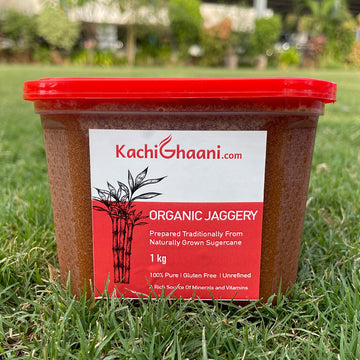
Our jaggery follows the open-pan method described here: cane juice reduced in open pans in small batches, with no sulphur, soda, bleach or chemical clarifiers. Its colour is whatever the cane and the boiling give it, so it can vary a little from batch to batch.
The bottom line
Jaggery is made by boiling fresh cane juice in open pans, skimming it clean and letting it set. Done well, it needs nothing added. Pale colour is not a mark of quality, so ask how your jaggery is clarified, and enjoy it as what it is: a less processed sugar, not a health food.
Frequently asked questions
Why is some jaggery dark and some golden?
Colour depends on the cane variety, the soil, the season, the juice's acidity, how much lime is used and how long the juice boils. Darker jaggery is often less processed, but not always. Very pale, uniform jaggery may have been bleached with hydros, so ask the maker how they clarify the juice.
Does jaggery contain chemicals?
It does not need any. Traditional jaggery is just cane juice, clarified with plant materials and boiled down. Some makers add lime, hydros or washing soda to clarify or brighten it, and traces can remain in the final product. Look for makers who state plainly what they use, and what they do not.
How do you store jaggery so it does not go soft?
Keep it in an airtight glass or steel container in a cool, dry cupboard, and always use a dry spoon or knife. Jaggery draws moisture from the air, especially in the monsoon, and turns soft and sticky. Blocks keep better than powder, so break off only what you need.
What is jaggery called in English?
Jaggery is the English name, borrowed long ago from Portuguese, which took it from the Malayalam word chakkara. Food scientists also call it non-centrifugal cane sugar. In Indian shops you will see it as gur or gud, and in Latin American shops its cousins are sold as panela or piloncillo.
Is palm jaggery made the same way?
Very similarly. Palm jaggery starts with sap tapped from palm trees, such as palmyra or date palms, instead of cane juice, and the sap is boiled down in open pans until it sets. It tastes deeper and more caramel-like than cane jaggery, but it is also mostly sucrose.
Sources
- NIFTEM, jaggery processing handbook for the PMFME scheme (accessed 2026)
- Mann and colleagues, ICAR-CIPHET, chemical-free jaggery processing, Indian Farming, 2025
- Venkatesh and colleagues, review of non-centrifugal cane sugar production, Sustainable Food Technology, 2023
- ICMR-National Institute of Nutrition, Dietary Guidelines for Indians, 2024