Why your cold pressed oil looks cloudy — and how to store it
Sediment, winter solidifying and a 4 to 6 month shelf life are all normal for an unfiltered oil. What is actually happening in the bottle, and how to keep it in good condition.

Two questions reach us more often than any others: why is the oil cloudy, and why has the coconut oil turned solid. Neither is a fault. Here is what is happening inside the bottle, and how to keep it in good condition.
Why does my cold pressed oil look cloudy?
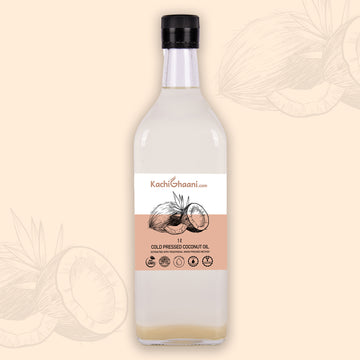
Because it is unfiltered. We press on a wooden ghaani and settle the oil rather than polishing it through industrial filters, so fine particles of the seed itself stay suspended and slowly drift downward. That haze, and the layer that collects at the bottom, are unrefined oil behaving exactly as it should.
A commercially refined oil is water-clear because bleaching earth and fine filtration have removed everything that is not fat. Clarity in an oil is a processing outcome, not a grade of quality. Ours is cloudy for the same reason it smells of the seed it came from.
Why has my coconut oil gone solid?
Temperature, and nothing else. Coconut oil sets below roughly 24°C, so across most of India it is liquid through summer and firm through winter — sometimes both within the same week. The same bottle will be white and solid in January and clear and pourable in May.
Do not melt the whole bottle to fix it. Stand it in warm water for a few minutes, or simply scoop out what you need. Repeated melting and resetting is handling the oil for no reason. Our Truly Cold Pressed coconut oil behaves this way by design.
How should you store cold pressed oil?
Cool, dark and closed. Light and heat are what age an unrefined oil, so keep the bottle out of direct sun and away from the stove. Dark glass is better than clear glass, and glass is better than plastic. Put the cap back on tight between uses rather than leaving it resting on top.
The most common mistake we see is a bottle parked on the counter beside the burner because it is convenient there. That spot is the hottest and brightest in the kitchen, and the convenience costs you weeks of shelf life.
How long does cold pressed oil last?
Four to six months from pressing, across our entire range. That is short compared with a supermarket oil, and it is deliberate. We press in small batches and add no preservatives and no antioxidants, so nothing is holding the oil stable except cool, dark storage and your finishing it in good time.
A refined oil will sit happily for a year or more because it has been stripped of the free fatty acids and aromatic compounds that age. Ours has not been. Buy the size you will genuinely finish in a season rather than the largest bottle on the page.
Why does a wet spoon ruin a bottle of oil?
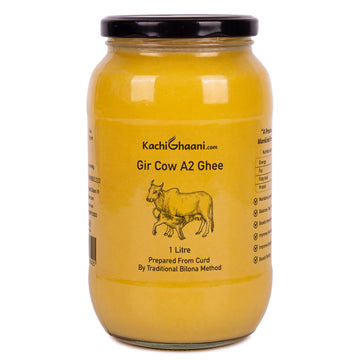
Because water is what lets spoilage begin. Oil and water do not mix, so a few drops from a wet spoon sit as separate droplets and give mould somewhere to take hold. It shows up most in ghee and in coconut oil, because those are the two that get handled with a spoon rather than poured.
Use a dry spoon every single time, or take the spoon out of the equation. A reusable dispenser that fits a glass bottle lets you pour a controlled stream straight into the pan, which is the simplest fix for any bottle in daily use.
Does cold pressed oil need to go in the fridge?
No, and mostly it should not. A cool dark cupboard is right for every oil we press, with one exception: flaxseed is fragile enough that refrigeration genuinely helps, and it should never be heated in any case.
Refrigerating coconut oil will simply set it rock hard and make it awkward to use. Ghee does not need it either — at room temperature, with a dry spoon, it keeps about twelve months.
How do you know when oil has actually turned?
Smell it. Oil past its life smells flat, sharp, or faintly of old crayon rather than of the seed, and it may taste bitter at the back of the tongue. Sediment, cloudiness and winter solidifying are not signs of spoilage. A changed smell is the signal that matters.
If you are still deciding which oils belong in your kitchen, our side-by-side oil comparison sets out smoke points, uses and shelf life together on one page.