Is ghee dairy free? Lactose, casein and who should skip it
Is ghee dairy free? No: it is made from milk, so it is dairy and not vegan. But clarifying removes nearly all the lactose and most of the milk protein. Here is who can enjoy it, and who should skip it.

Is ghee dairy free? No. Ghee is made from milk, so it is a dairy food, and it is not vegan. But clarifying butter removes almost all of its lactose and most of its milk protein, which is why many people with lactose intolerance enjoy ghee without trouble. A true milk allergy is different: then ghee is best avoided unless your allergist says otherwise.
The confusion is understandable. Ghee looks and behaves like an oil, and some diets that cut out dairy still allow it. Here is what is actually left in the jar, and what that means for you.
At a glance
- Ghee is dairy: it is the fat of milk. It is not vegan and not plant-based.
- Ghee is about 99% milk fat. The water and nearly all the milk solids, which carry the lactose and protein, are removed.
- Many people with lactose intolerance tolerate ghee well, because it contains almost no lactose.
- Traces of milk protein can remain, so ghee is not safe for a milk allergy without an allergist's advice.
- A2 ghee is still cow's milk ghee. "A2" does not make it suitable for a milk allergy.
Why is ghee not dairy free?
Because it is made from milk. Ghee is butter simmered slowly until its water evaporates and its milk solids separate, sink and turn golden, then strained off. What remains is almost pure milk fat. With so little water or milk solids left, there is little for microbes to grow on, which is why good ghee keeps for months without a fridge.
Butter is roughly four-fifths fat, with the rest mostly water and a small amount of milk solids: protein, lactose and minerals. Ghee keeps the fat and leaves nearly everything else behind. In the traditional bilona method, milk is first set as curd and churned into makkhan, a soft white butter, before it is simmered; our guide to the bilona method explains each step.
Cow's ghee is golden because of natural beta-carotene from the cows' feed; buffalo ghee, made from milk with little of it, is whiter. Because it comes from milk, food labelling laws in the US, the UK, the EU and elsewhere class ghee as a milk product, so its label should make clear that it contains milk.
Is ghee lactose free?
Not strictly, but very nearly: ghee holds only the faintest trace of lactose. Lactose, the natural sugar in milk, dissolves in the watery part of milk, not in the fat. Butter already holds very little, and simmering and straining remove most of the rest.
The bilona method adds one more step: when milk is set as curd, friendly bacteria feed on part of the lactose and turn it into lactic acid, the source of curd's sourness. So by the time the butter becomes ghee, there is very little lactose left to remove.
| Food | Lactose | Milk protein |
|---|---|---|
| Milk | High: about 12 g in a cup | High |
| Curd or yoghurt | Lower than milk | High |
| Hard cheese such as cheddar | Low | High |
| Butter | Very low | Low |
| Ghee | Almost none | Traces |
Can you eat ghee if you are lactose intolerant?
Usually, yes. Lactose intolerance means your gut makes too little lactase, the enzyme that digests lactose. It causes bloating, wind or loose stools, but it is not dangerous.
According to the US National Institutes of Health, many people with lactose intolerance can have about 12 g of lactose, the amount in a cup of milk, with mild symptoms or none. A spoon of ghee contains a tiny fraction of that.
How to try ghee if you are lactose intolerant
- Start with half a teaspoon to a teaspoon, cooked into a meal, not on an empty stomach.
- Keep the rest of that meal free of other dairy, so you can tell what caused any symptoms.
- Wait a day. If you feel fine, try a little more the next time.
- If you react to even small amounts, stop and speak to your doctor, as something other than lactose may be involved.
Some people with a sensitive gut react to rich, fatty food in general, which is a separate matter from lactose.
Is ghee casein free?
Not completely. Casein and whey, the two main milk proteins, are mostly removed with the milk solids, but small traces can stay in the fat. How much depends on how long the butter is simmered and how carefully it is strained. There is no simple way to check at home.
This is also where A2 comes in. "A2" describes the type of beta-casein in the milk from certain cows, such as Gir cows. It is about which protein, not whether protein is present. The Australasian Society of Clinical Immunology and Allergy states that A2 milk and formula are not suitable for people with cow's milk allergy and may cause anaphylaxis. The same caution applies to A2 ghee.
Is ghee safe with a milk allergy?
Not without your allergist's say-so. A milk allergy is an immune reaction to milk protein, and in some people a trace is enough to cause hives, vomiting or anaphylaxis, a severe, whole-body reaction.
Allergy specialists advise people with cow's milk allergy to avoid any food that contains milk unless their doctor advises otherwise, and ghee contains milk. Most people allergic to cow's milk also react to other animal milks, such as goat's and sheep's, and buffalo milk proteins are very similar to cow's, so other ghees are not a safe swap either.
Is ghee vegan?
No. Ghee comes from the milk of cows or buffaloes, so it is an animal product. Products sold as "vegan ghee" are plant fats made to look and taste similar; they are not ghee.
For a dairy-free tadka, use a plant oil instead. Coconut oil gives a similar richness in South Indian cooking, and sesame, groundnut and mustard oils all suit Indian dishes.
Who should skip ghee, or ask first?
- Anyone with a milk allergy, adults and children alike, unless an allergist has advised otherwise.
- Babies with cow's milk protein allergy: follow your paediatrician's feeding plan.
- Vegans and anyone avoiding animal foods.
- People told to limit saturated fat: ghee is roughly 60% saturated fat, and the World Health Organization advises keeping saturated fat below 10% of daily energy. Ask your doctor how much fits.
How to use our ghee, and a dairy-free option
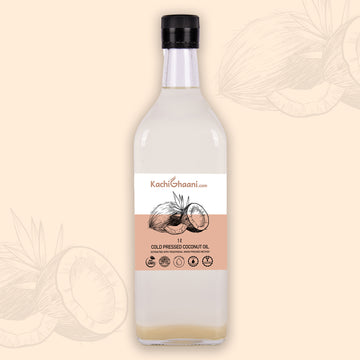
Our A2 Gir cow ghee is made by the bilona method: milk from Gir cows is set as curd, hand-churned into makkhan and slowly simmered, which leaves it golden and grainy. It is a dairy food, so it suits lactose-intolerant cooks far better than people with a milk allergy or a vegan diet. For them, our Truly Cold Pressed coconut oil, pressed from dried copra, is a plant-based choice for tadka and South Indian cooking; see how to use cold pressed coconut oil.
The bottom line
Ghee is dairy and not vegan, but it is almost free of lactose, so most people with lactose intolerance can enjoy it. Its traces of milk protein make it unsuitable for a milk allergy, A2 or not, unless an allergist advises otherwise.
Frequently asked questions
Is ghee better than butter for lactose intolerance?
Usually, yes. Butter already contains only a little lactose, and ghee contains even less, because the milk solids that hold it are simmered out and strained away. Many people who notice mild symptoms after butter find ghee easier. Start with a small amount cooked into a meal.
Why do some dairy-free diets allow ghee?
Some elimination diets avoid dairy mainly because of lactose and milk protein, and ghee has almost none of either, so they make an exception for it. Strict dairy-free, vegan and allergy diets do not. If you follow a diet for a medical reason, check with the doctor or dietitian who set it.
Does A2 ghee have less lactose than regular ghee?
No. A2 refers to the type of beta-casein protein in the milk, not to lactose. Any well-made ghee, A2 or not, has almost no lactose, because lactose is removed with the water and milk solids. A2 also does not make ghee safe for a milk allergy.
Can children with a milk allergy eat food cooked in ghee?
Not unless their allergist has said so. Even small traces of milk protein can trigger reactions in some children. Many families with a milk-allergic child cook with plant oils such as coconut, sesame or groundnut oil instead, and read every label for milk.
Does ghee have lactose if it is homemade?
Yes, a trace, and sometimes a little more than well-made shop ghee. Homemade ghee that is simmered only briefly, or strained through a coarse sieve, can keep more of the milk solids, which hold the lactose and protein. Simmer until the solids turn golden brown and sink, then strain through fine muslin.
Is buffalo ghee dairy free?
No. Buffalo ghee is made from buffalo milk, so it is a dairy food in exactly the same way as cow's ghee. It also contains traces of milk protein, and buffalo milk proteins are very similar to those in cow's milk, so it is not a safe swap for a milk allergy.
Sources
- US National Institute of Diabetes and Digestive and Kidney Diseases: eating and lactose intolerance
- Australasian Society of Clinical Immunology and Allergy: cow's milk (dairy) allergy, 2024
- US Food and Drug Administration: food allergies, what you need to know, 2024
- World Health Organization: healthy diet fact sheet, 2026