Is peanut oil healthy? Groundnut oil myths, checked
Is peanut oil healthy? Groundnut oil is mostly monounsaturated fat, with some omega-6 and little saturated fat. Here is what the evidence says about inflammation, weight and everyday cooking.

Is peanut oil healthy? Yes. For most people, peanut oil, which India calls groundnut oil, is a sound everyday cooking oil when used in sensible amounts. It is mostly monounsaturated fat, the kind olive oil is known for, with some omega-6 fat and little saturated fat. The popular claims that it is inflammatory or especially fattening do not hold up.
So is peanut oil bad for you in any way? No oil is a health food, and peanut oil has real caveats: its calories, its lack of omega-3, the quality of the kernels it is pressed from, and peanut allergy. Here is each claim, checked against the evidence.
At a glance
- Groundnut oil is roughly half monounsaturated fat, a third omega-6 polyunsaturated fat and a sixth saturated fat.
- Controlled trials in healthy adults have not found that omega-6 fat raises blood markers of inflammation.
- Like every oil, it has about 120 kcal per tablespoon. It is no more fattening than any other oil.
- The American Heart Association lists peanut oil among its recommended cooking oils.
- The caveats: almost no omega-3, kernel quality matters for unrefined oil, and it is not for anyone with a peanut allergy.
Why is peanut oil healthy for most people?
Because of its fats: it is mostly monounsaturated, with a good share of omega-6 and only a modest amount of saturated fat. The exact split depends on the peanut variety, so read these as rounded figures.
| Part of the oil | Share | Per tablespoon (about 13.5 g) |
|---|---|---|
| Monounsaturated fat (mostly oleic acid) | About half | 6 to 7 g |
| Polyunsaturated fat (almost all omega-6 linoleic acid) | About a third | 4 to 4.5 g |
| Saturated fat | About a sixth | 2 to 2.5 g |
| Omega-3 fat | A trace | Almost none |
| Energy | About 120 kcal |
It also carries a useful amount of vitamin E and, like all plant oils, no cholesterol. If the terms are new, our guide to MUFA, PUFA, omega-3 and omega-6 explains them simply.
Is peanut oil inflammatory?
There is no good evidence that it is. The claim rests on a theory, and the theory has not held up in trials.
The theory goes like this. Peanut oil is rich in linoleic acid, an omega-6 fat. The body can turn linoleic acid into arachidonic acid, which is used to make some signalling molecules involved in inflammation. So, the argument says, more omega-6 must mean more inflammation.
When researchers actually tested it, by feeding healthy adults more linoleic acid in controlled trials and measuring inflammation markers in their blood, reviews of those trials found no meaningful rise. The body tightly controls how much linoleic acid becomes arachidonic acid. In daily life, things like excess body fat, smoking and inactivity weigh far more on inflammation than the choice of cooking oil.
The fair point inside the myth is balance. Peanut oil has almost no omega-3, and many diets are short of it. Rotate in an oil with some omega-3, such as mustard oil, or use a spoon of flaxseed oil on cold food; see our four ways to use flaxseed oil without heating it.
Is peanut oil bad for your heart?
No. Used in place of saturated fats, oils like peanut oil are linked with better heart health, not worse.
The American Heart Association lists peanut oil among its recommended cooking oils and advises choosing oils with less than 4 g of saturated fat per tablespoon; peanut oil has about 2 to 2.5 g. A 2020 Cochrane review of 15 trials, covering about 59,000 people, found that cutting saturated fat lowered combined cardiovascular events by 21%, though it made little difference to overall deaths.
Is peanut oil fattening?
No more than any other oil. Every cooking oil is pure fat, with about 9 kcal per gram, or roughly 120 kcal in a tablespoon.
Weight follows the total calories you eat over time, not the type of oil. What makes a difference is how much you pour. A measured spoon instead of a free pour, and fewer deep-fried snacks, matter far more than switching oils. Our guide on how much cooking oil a family needs each month helps you check your own kitchen.
Is peanut oil better than vegetable oil?
Different, not magic. "Vegetable oil" usually means soybean oil or a blend. Compared with it, peanut oil has more monounsaturated fat and less polyunsaturated fat, which makes it a little more stable under heat, and it has more flavour when unrefined.
| Oil | Main type of fat | Good for |
|---|---|---|
| Groundnut (peanut) | Mostly monounsaturated, some omega-6 | Everyday Indian cooking, shallow frying |
| Soybean or blended "vegetable" oil | Mostly omega-6 polyunsaturated, a little omega-3 | General cooking |
| Mustard | Mostly monounsaturated, with some omega-3 | Tadka, pickles, Bengali and Punjabi dishes |
| Flaxseed | Mostly omega-3 | Cold food only, never heated |
All of these are acceptable by mainstream heart-health advice. No single oil does everything best, so many cooks keep two or three and rotate them by dish.
Is peanut oil good for you as an everyday cooking oil?
Yes, it is one of India's classic everyday oils. In Gujarat and across much of western and southern India, it has long been the family cooking oil. Unrefined groundnut oil smokes at about 180°C (356°F), which suits sabzi, dal tadka, upma, poha and shallow frying.
Two things matter more than the oil itself
- Do not keep reusing frying oil. Oil heated again and again breaks down. India's food regulator, FSSAI, limits the breakdown products, called total polar compounds, to 25% in frying oil; at home, use fresh oil and do not top up old oil.
- Kernel quality. Peanuts stored badly can grow moulds that make aflatoxins, which are harmful. Refining removes most of these, so unrefined oil depends on clean, well-sorted kernels. Buy from a maker you trust, and discard oil that tastes bitter or musty.
Who should be careful with peanut oil?
- Peanut allergy: unrefined, cold pressed peanut oil can carry peanut protein. Anyone with a peanut allergy should avoid it and follow their allergist's advice on any peanut oil.
- Anyone told to limit fat: for example after gallbladder or pancreas problems, or on a medical weight plan. Ask your doctor how much oil fits.
- Old oil: if a bottle smells sharp, paint-like or sour, it has gone rancid. Throw it out.
How to use our groundnut oil
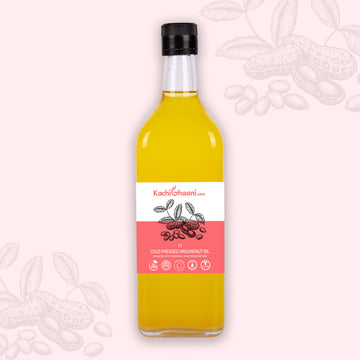
Our Truly Cold Pressed groundnut oil is pressed slowly in a wooden ghaani and left unrefined, so it keeps its nutty taste. Use it for everyday sabzi, dal and shallow frying up to about 180°C (356°F), measure with a spoon, and keep a second oil with some omega-3 in the rotation.
The bottom line
Peanut oil is a healthy everyday oil for most people when used in measured amounts. It is not inflammatory, not uniquely fattening and kinder to the heart than saturated fats. Balance it with some omega-3, never reuse it endlessly, and skip it entirely if you have a peanut allergy.
Frequently asked questions
Is peanut oil the same as groundnut oil?
Yes. Groundnut is the name used in India and Britain for the peanut, because the pods ripen underground. Peanut oil, groundnut oil and arachis oil all mean the same thing. What differs is how the oil is made: refined, or pressed and left unrefined.
Does peanut oil raise cholesterol?
Peanut oil contains no cholesterol, and it is low in saturated fat. Used in place of butter, ghee, coconut oil or palm oil, oils like it tend to lower LDL cholesterol. Your overall diet and genes matter most, so ask your doctor if your cholesterol is high.
Is cold pressed or refined peanut oil healthier?
Their fats are almost the same. Unrefined oil keeps more flavour and more of the natural vitamin E and plant compounds. Refined oil handles higher heat and has most of the peanut protein removed. Choose by the job, and buy unrefined oil from a maker who sorts kernels carefully.
Can I deep fry in cold pressed groundnut oil?
Now and then, yes, with care. Unrefined groundnut oil smokes at about 180°C (356°F), close to normal deep-frying heat, so keep the flame moderate, fry in small batches and use the oil once. For frequent deep frying, a refined oil is the more practical choice.
How much groundnut oil is too much?
There is no single number. The World Health Organization advises keeping total fat to 30% of daily energy or less, and cooking oil is only part of that. In practice, measuring oil with a spoon and cutting back on fried snacks keeps most families in a sensible range.