Is Refined Oil Bad for You? An Honest Answer
Is refined oil bad for health? An oil press answers honestly - what hexane, trans fat and nutrient loss really amount to, and what matters far more.

We press unrefined oil for a living, so you can guess which way we are inclined to answer this. Which is exactly why it is worth answering carefully, because the honest answer is less dramatic than the one our category usually gives — and the parts of it that are true matter more than the parts that are shouted.
Short answer: refined oil is not poison, and most of what circulates about it online is overstated. The real risks in Indian kitchens are elsewhere, and two of them apply to our oil just as much as to anyone's.
The claim: hexane residue
What is true: most refined oil in India is solvent-extracted with n-hexane, a petroleum-derived solvent. That is a fact about the process and we described it in detail in how refined oil is actually made.
What is overstated: the idea that you are drinking hexane. Hexane boils at 69°C. The oil then goes through desolventising, and later through deodorising at 200–250°C under vacuum, which is a far more aggressive stripping operation than anything hexane could survive. Residual solvent is regulated, routinely tested, and in properly run plants sits at or below the detection limit.
Our view: if the reason you avoid refined oil is that you dislike a petroleum solvent being part of your food's manufacture, that is a coherent preference and we share it. If the reason is that you believe there is measurable hexane in the bottle, the evidence does not support you, and we are not going to let you believe it just because it helps us sell oil.
The claim: trans fats
What was true: this used to be the strongest argument against industrial fats in India, and it was not about refining. It was about partial hydrogenation — the process that turns liquid oil into vanaspati — which creates trans fatty acids as a by-product. Trans fat has the clearest adverse evidence base of anything in this whole discussion.
What changed: the FSSAI capped industrial trans fatty acids in oils and fats at 3% from January 2021 and 2% from January 2022. That is one of the more effective food regulations India has passed, and it substantially closed the gap.
What is still true: ordinary refining generates small quantities of trans fat as a side effect of high-temperature deodorising — typically well under 1%, far below the regulatory cap. And vanaspati still exists, still appears in cheap bakery and street food, and is a different proposition from refined oil in a bottle.
Our view: if you are worried about trans fat, the bottle of refined sunflower oil in your kitchen is not where it is coming from. The commercially fried food you did not make yourself is a far more plausible source.
The claim: refining strips the nutrients
What is true, and not disputed by anyone: bleaching with activated clay and deodorising at 200–250°C remove most of the oil's tocopherols (vitamin E), a good share of its phytosterols, and essentially all of the aroma compounds. Refiners know this precisely, because they capture the deodoriser distillate and sell it as a commercial source of natural vitamin E.
What is overstated: the significance of it for your diet. Nobody eats cooking oil for its vitamin E. The quantities involved are small relative to what you get from food, and most refined oils in India are fortified with vitamins A and D anyway.
Our view: this is a real, verifiable difference between refined and unrefined oil, and it is the one we would point to if pressed. But it is a difference in composition, not a health outcome, and we will not dress it up as one. An unrefined oil keeps the seed's own compounds because nobody took them out. That is worth something. It is not worth a health claim.
The claim: refined oil causes disease
What is true: nothing you can attribute to refining as such.
There is a large and genuinely contested literature on dietary fat composition — on the balance of omega-6 to omega-3, on saturated fat, on seed oils generally. It is contested, it is confounded by the fact that people who eat a lot of refined oil are usually eating a lot of processed food alongside it, and it is about which fatty acids you eat, not about whether the oil went through a bleaching column.
Our view: no cooking oil prevents, treats or cures any disease, and no cooking oil causes one on its own. Any brand telling you either — including this one, in older copy we have since removed from our own site — is making a claim it cannot support. We took those claims down because we could not stand behind them, not because anyone made us.
The two things that actually matter — and they apply to us too
Here is the part the category does not talk about, because it is not a selling point for anybody.
1. Reusing frying oil. This is the genuine, well-evidenced problem in Indian kitchens and it has nothing to do with refining. Every time oil is heated past its smoke point and cooled, polar compounds accumulate. The FSSAI's RUCO framework sets a limit of 25% Total Polar Compounds, beyond which oil is deemed unfit for human consumption — and commercial fryers exceed it routinely.
At home the fix is simple: strain it, use it once or twice more at most, and throw it out when it darkens, thickens or smells sharp. This applies to our oil exactly as much as to refined oil. An unrefined oil with a lower smoke point degrades sooner under repeated frying, not later. We have written about disposing of used oil separately.
2. How much you are using. Every oil is roughly 9 calories a gram. Cold pressed, refined, ghee, olive — all of it. Indian household oil consumption has risen steadily for decades, and switching to a premium oil while using the same quantity changes very little that matters. If anything, paying more per litre is a reasonable prompt to use less of it. Our family fat calculator exists for exactly this.
So why buy unrefined at all?
Three reasons, and none of them is a health outcome.
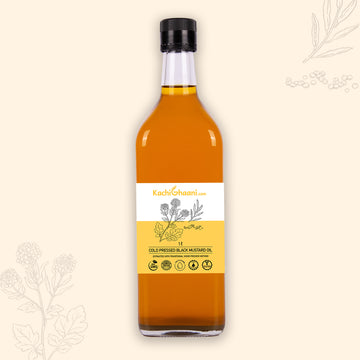
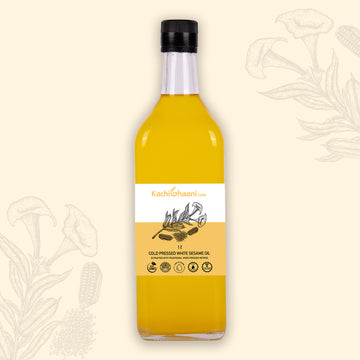
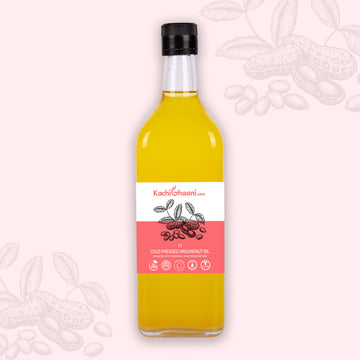
Flavour. This is the real one. Cold pressed mustard catches the back of your nose. Sesame smells toasted. Groundnut tastes like a peanut. Refining removes precisely these compounds on purpose. If you cook food where the oil is part of the dish — a tadka, an achaar, a coastal curry — you are buying the thing that makes it taste like itself.
A short and legible process. One ingredient, no solvent, no clay, no column. Not because the alternative is dangerous, but because some people would rather buy the version with fewer steps in it. That is a perfectly reasonable preference and it does not need to be justified with a disease.
The seed's own compounds staying where they were. Stated as composition, not as a promise.
And when should you not bother?
If you deep-fry frequently, refined oil is the more sensible choice for that specific job — higher smoke point, more tolerance of sustained heat, and cheaper to discard when it darkens. Buying a premium unrefined oil to fill a kadhai and then reusing it four times is the worst of both worlds.
If you will not finish a bottle in four to six months, do not buy unrefined. It has no preservative and it will go rancid, which is a waste of money and tastes like old crayons.
And if you are buying it because of something you read about disease, the reason is not sound, and no oil will deliver on it. We would rather lose that sale than land it dishonestly, because a customer who bought for the wrong reason is a customer who feels let down later.
The short version: refined oil is not poison. Hexane residue is regulated and typically undetectable; trans fat was a real problem and was largely regulated out of Indian oils in 2022; nutrient loss during refining is real but nutritionally minor. What genuinely matters in Indian kitchens is reusing frying oil past the point it should be thrown out, and using more oil than the food needs — and both of those apply to unrefined oil just as much as to refined. Buy cold pressed for flavour and for a process you can describe in one sentence. Do not buy it for a health outcome, because it does not sell one.
Our cold pressed oils are crushed slow in a wooden ghaani and bottled unrefined — one ingredient, no solvent, no bleaching, no deodorising, four to six months' shelf life. Batch-numbered and lab-tested, with the report published. FSSAI licence 10724999001232. If you want to work out which oil belongs in which pan, the Rasoi Chart is free.
This article discusses food regulation and composition. It is not medical or dietary advice; speak to a doctor or a registered dietitian about your own diet.