Mustard oil benefits and risks: is it good for your heart?
The real mustard oil benefits and risks for your heart and cholesterol, what the Indian evidence shows, why erucic acid is the honest caveat, and how to use sarson ka tel sensibly.

The main mustard oil benefits are in its fats: it is low in saturated fat (about 12%), rich in unsaturated fats and one of the few cooking oils with useful omega-3 (ALA). An Indian study linked it with lower heart-attack risk than sunflower oil. The honest caveat is erucic acid, so use it alongside other oils.
Sarson ka tel has been the everyday cooking fat of Punjab, Bengal, Bihar, Odisha, Assam, Nepal and Bangladesh for generations. Then came headlines about mustard oil being 'banned' abroad, and many families quietly switched. So is mustard oil good for health? In sensible amounts, yes, and this article weighs the benefits and risks for your heart and cholesterol; for the label story in the US and Europe, read mustard oil and the 'banned in America' story.
At a glance
- By USDA figures, mustard oil is about 12% saturated, 59% monounsaturated and 21% polyunsaturated fat, including about 6% omega-3 ALA.
- Like every plant oil, it contains no cholesterol, and it is low in the saturated fat that raises LDL ('bad') cholesterol.
- In a 2004 study in Delhi and Bangalore, cooking with mustard oil was linked with about half the heart-attack risk of cooking with sunflower oil. That is a link, not proof.
- Traditional mustard oil is high in erucic acid, which caused fat build-up in the heart muscle of rodents. Europe sets a tolerable intake of 7 mg per kg of body weight a day.
- The sensible approach: moderate amounts, a rotation of oils and pure oil from a trusted source.
What are the real mustard oil benefits?
Most of them come from its fats, with a few practical ones in the kitchen.
- A better fat profile: about 12% saturated fat by USDA figures, with the rest mostly unsaturated.
- Plant omega-3: about 0.8 g of ALA per tablespoon, more than most everyday cooking oils carry.
- High heat: unrefined mustard oil handles about 250°C (480°F), which suits tadka and frying.
- Flavour: its pungent bite, from a compound called allyl isothiocyanate, means a little seasons a lot, from achaar to fish curry.
- Tradition: it is a familiar winter massage oil in North and East India, used for dry winter skin.
Popular promises that it clears colds, thickens hair or protects against disease have no good evidence behind them.
Does mustard oil increase cholesterol?
Not by itself. Mustard oil contains no cholesterol and is low in saturated fat, the fat most strongly linked with raising LDL cholesterol.
Swapping saturated fats such as butter, vanaspati, palm oil and large amounts of ghee for liquid oils is standard heart advice, and mustard oil fits that pattern. It is still pure fat, though, at about 9 kcal per gram or roughly 120 kcal per tablespoon, so the amount matters as much as the type. Our plain-language guide to MUFA, PUFA, omega-3 and omega-6 explains these fats.
| Per 100 g (USDA) | Saturated | Monounsaturated | Polyunsaturated | Of which omega-3 ALA |
|---|---|---|---|---|
| Mustard oil | 11.6 g | 59.2 g | 21.2 g | 5.9 g |
| Groundnut oil | 16.2 g | 57.1 g | 19.9 g | Almost none |
| Sesame oil | 14.2 g | 39.7 g | 41.7 g | 0.3 g |
| Coconut oil | 82.5 g | 6.3 g | 1.7 g | Almost none |
Is mustard oil good for heart health?
The evidence is encouraging but not conclusive.
The best-known study, published in the American Journal of Clinical Nutrition in 2004 by Rastogi and colleagues, compared 350 people who had had a heart attack with 700 matched controls from eight hospitals in New Delhi and Bangalore. Compared with sunflower oil, using mustard oil for cooking was linked with a relative risk of 0.49, and for frying 0.29. The authors pointed out that mustard oil is rich in alpha-linolenic acid (ALA), the plant omega-3.
Two cautions. A case-control study shows an association, not cause and effect, and people who cook with mustard oil may differ in other ways. And the range of likely values for cooking (0.24 to 0.99) only just excludes no effect at all. Expert views also differ: a 2022 review in the Journal of Clinical Lipidology notes that the Lipid Association of India recommends mustard oil as heart-healthy, while its US authors call for a fresh look at erucic acid limits.
What about erucic acid?
It is the real caveat, and the main reason variety matters.
USDA figures list about 41 g of erucic acid per 100 g of mustard oil. In rodents, long-term high intake caused myocardial lipidosis, a temporary and reversible build-up of fat in the heart muscle. In 2016 the European Food Safety Authority set a tolerable daily intake of 7 mg per kg of body weight, about 420 mg for a 60 kg adult. A single teaspoon (about 4.5 g) of traditional high-erucic mustard oil can carry around 1.8 g, so on paper even a teaspoon a day passes that line.
That limit comes from animal data with wide safety margins, and there is little human evidence of harm from traditional cooking. Still, it is a good reason not to make mustard oil your only oil. Low-erucic mustard varieties also exist. Heating does not remove erucic acid.
Is mustard oil bad for health?
Pure mustard oil in sensible amounts is not. The real risks are adulteration, overheating and over-use.
- Adulteration: in 1998, mustard oil mixed with argemone oil caused an outbreak of epidemic dropsy in Delhi. Buy sealed, labelled oil with an FSSAI licence number; here is how to read an oil label in India.
- Overheating: heat it until it shimmers, not to heavy smoke, and do not reuse deep-frying oil again and again.
- Over-use: ICMR-NIN's 2024 guidelines suggest about 25 to 30 g of cooking oil per person a day. Our guide on how much cooking oil a family needs each month turns that into litres.
Which mustard oil is best for health?
There is no single best one, but there are better choices.
- Pure, single-source mustard oil, sealed and clearly labelled.
- Fresh oil, used within its best-before and stored away from heat and light.
- Black or yellow mustard oil by taste: black is sharper, yellow is usually milder.
- A weekly rotation with groundnut, sesame or another oil.
Who should be careful with mustard oil?
- Mustard allergy: mustard is a recognised major allergen in the EU, UK and Canada. Avoid the oil if you react to mustard.
- Young children: EFSA's main erucic acid concern was children up to 10 with high intakes, so use a mix of oils in children's food.
- Skin: mustard oil can irritate sensitive or broken skin. Patch test before a massage, keep it away from the eyes and ask your paediatrician before using it on a baby.
- Heart disease or high cholesterol: diet changes work alongside medicine, not instead of it. Speak to your doctor.
Using our mustard oils
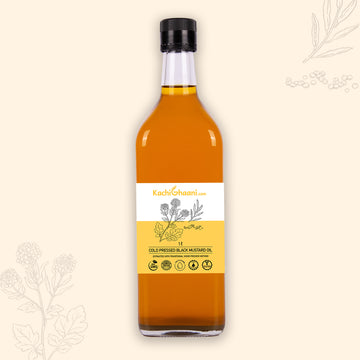
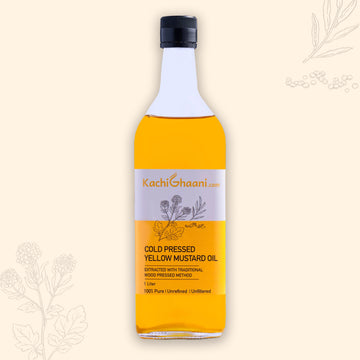
Our Truly Cold Pressed black mustard oil is pressed slowly in a wooden ghaani and left unrefined, so it keeps the full, sharp aroma for tadka, fish and achaar. Our Truly Cold Pressed yellow mustard oil, usually the milder of the two, suits everyday sabzi. Use them as one part of a rotation with groundnut or sesame oil, and keep the daily total sensible.
The bottom line
Mustard oil's benefits are real but modest: it is low in saturated fat, carries useful omega-3 and has encouraging, if limited, Indian heart evidence behind it. Its erucic acid is the honest caveat, so enjoy it in moderate amounts, rotate it with other oils and buy pure oil from a source you trust.
Frequently asked questions
Is mustard oil good for people with high cholesterol?
It can be part of a cholesterol-friendly diet when it replaces saturated fats such as butter, vanaspati or large amounts of ghee, because it is low in saturated fat. It still carries about 120 kcal per tablespoon, so keep amounts moderate, and never change or stop cholesterol medicine without your doctor.
Is mustard oil better than refined sunflower oil?
In the 2004 Indian study, cooking with mustard oil was linked with lower heart-attack risk than sunflower oil. Mustard oil also has far more omega-3, while sunflower oil is rich in omega-6. That is not proof, so the most sensible approach is to rotate a few oils rather than crown one.
Can I use mustard oil every day?
Most healthy adults can, as part of a rotation. Traditional mustard oil is high in erucic acid, and ICMR-NIN encourages choosing a variety of oilseeds, so use it for some dishes and groundnut, sesame or another oil for others, keeping the daily total moderate.
What are the benefits of mustard oil for skin and hair?
Mustard oil is a traditional winter massage and hair oil in North and East India, valued for its warming feel and as a moisturiser for dry skin and scalp. There is no good evidence that it makes hair grow or clears skin problems, and its pungency can irritate sensitive skin, so patch test first and keep it away from the eyes.
Why is mustard oil sold for external use only in the US?
The US Food and Drug Administration does not allow expressed mustard oil to be sold as a cooking oil because of its erucic acid, a decision based largely on animal studies, so it is sold for massage instead. Some US cardiologists have called for that position to be reviewed.
Does heating mustard oil remove erucic acid?
No. Heating mustard oil until it shimmers softens its sharp smell, because the pungent compounds are volatile, but erucic acid is part of the fat itself and stays put. Heating it to heavy smoke does not help either; it only starts to break the oil down.
Sources
- Rastogi et al., Diet and risk of ischemic heart disease in India, American Journal of Clinical Nutrition, 2004
- Poddar et al., Mustard oil and cardiovascular health: why the controversy?, Journal of Clinical Lipidology, 2022
- European Food Safety Authority, Erucic acid: a possible health risk for highly exposed children, 2016
- ICMR-National Institute of Nutrition, Dietary Guidelines for Indians, 2024