Why achaar is always made with cold pressed mustard oil
Pungency, allyl isothiocyanate and a sealing layer of oil — why Indian pickle has always been made in cold pressed mustard oil, and why the refined version does not do the same job.

Open any achaar jar in an Indian home and the oil on top is mustard. Not groundnut, not sesame, not refined. There are good reasons for that, and they are worth knowing before you make your next batch.
Why is achaar always made with mustard oil?
Because of pungency and body. Mustard oil carries a sharp, warming bite that no other Indian cooking oil has, and it is thick enough to sit as a sealing layer over the pickle. That bite is flavour and barrier at once — the oil covers the masala, keeps air off it, and adds the taste people recognise as achaar.
Groundnut and sesame are excellent oils, but they are comparatively mild and they do not give a pickle its characteristic nose. A mango or lemon achaar made in a neutral oil tastes like fruit sitting in oil. Made in cold pressed mustard oil, it tastes like achaar.
What gives mustard oil its bite?
A compound called allyl isothiocyanate. Mustard seed holds a precursor, sinigrin, and an enzyme, myrosinase, in separate compartments. Crush the seed and the two meet, and allyl isothiocyanate is what forms — the same compound behind the sting of wasabi and horseradish. It is the smell that reaches the back of your nose.
This matters for pickling because the reaction depends on how the seed is crushed. Our wooden ghaani turns slowly and at low temperature, which is exactly the condition that keeps those volatile compounds in the oil instead of driving them off as heat.
Why does refined mustard oil not work the same way?
Because refining is designed to remove precisely what a pickle needs. Refined mustard oil goes through bleaching earth and deodorisation at around 200°C, and deodorising does exactly what its name says — it strips volatile aromatic compounds. Allyl isothiocyanate is volatile. A great deal of the pungency leaves with it.
What is left is a pale, near-odourless oil. For someone who dislikes sharpness, that is a feature. For achaar it is a problem, because the pungency was the entire point. What refining actually does to an oil walks through each stage of the process.
Should you use black or yellow mustard oil for pickle?
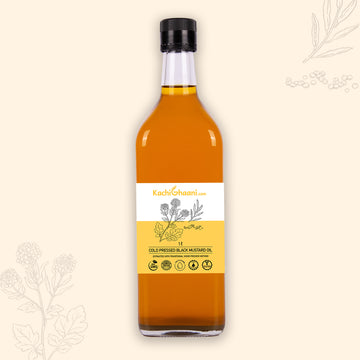
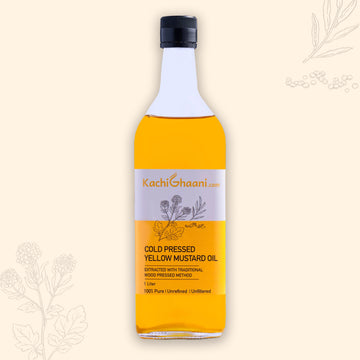
Black, for a traditional achaar. Truly Cold Pressed black mustard oil is the more pungent of the two and is the oil most Indian pickle recipes quietly assume you are using. Yellow mustard gives you the same 250°C smoke point with a rounder, gentler nose — the better choice if black mustard is too sharp for your table.
Both are pressed on the same wooden ghaani, both are unfiltered, and both carry their sediment.
Do all Indian pickles use mustard oil?
No, and the exception is worth knowing. North and East Indian achaar — mango, lemon, chilli, mixed vegetable — is mustard oil territory, and Andhra's avakaya is made with it too. But much of Tamil Nadu and Kerala pickles in gingelly, the local unrefined sesame oil, which gives a rounder, nuttier jar rather than a pungent one.
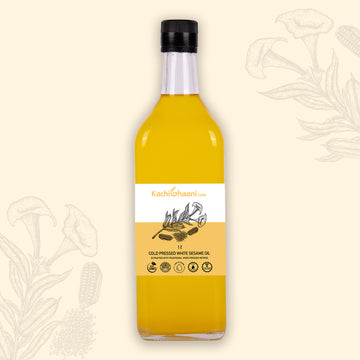
Neither tradition is wrong. They are two different regional palates, and if you grew up on one the other will taste unfamiliar in the mouth. Truly Cold Pressed white sesame oil is the one to reach for if it is a South Indian pickle you are making.
Why is mustard oil heated before it goes into the jar?
Two reasons, and only one of them is flavour. Heating mustard oil until it just smokes, then letting it cool completely, takes the raw green edge off the pungency — which is why almost every achaar recipe opens with that step. It also drives off any moisture in the oil, and moisture is what spoils a pickle.
Let it cool fully before it touches the masala. Warm oil poured onto spices will cook them and dull the whole jar.
How much oil should sit over the achaar?
Enough to cover it completely, with a clear layer standing on top — usually a centimetre or two. If any masala pokes through the surface it meets air, and that is where a pickle turns. Top up with more mustard oil as the level drops through the season, and always go in with a dry spoon.
Our oils are pressed in small batches with no preservatives, so the bottle itself carries a 4 to 6 month shelf life. Buy the size that matches the batch you are actually making.
Does the sediment at the bottom of the bottle matter?
No — it is meant to be there. We settle our oils rather than polishing them through industrial filters, so fine seed solids remain and gradually drop to the bottom. In a pickle jar it is invisible within a day. Why cold pressed oil looks cloudy explains what that sediment is and how to store the bottle it came in.