Thalipeeth
Patted thin by hand, cooked till the edges go dark and crisp, and eaten the minute a knob of white butter starts sliding off the top.

Ingredients
Serves 4
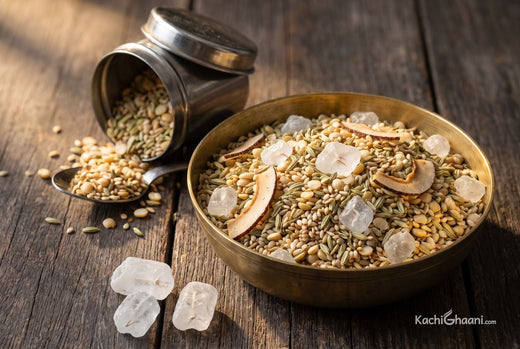
- 1.5 cups (180 g) thalipeeth bhajani, roasted multigrain flour (see tips to make your own)
- 1 medium onion (100 g), chopped very fine
- 1/4 cup coriander leaves, chopped
- 2 tbsp fresh methi leaves, chopped, optional
- 1 tsp Stone Ground Red Chilli Powder
- 1/2 tsp turmeric powder
- 1/2 tsp cumin seeds and 1/2 tsp coriander seeds, crushed coarse
- 1/4 tsp hing (asafoetida)
- 1 tsp salt, or to taste
- About 1/2 cup (120 ml) warm water, added a little at a time
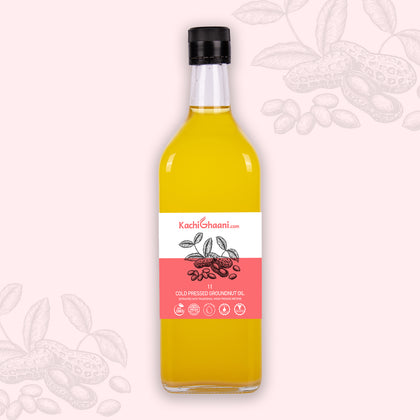
- 5 tbsp Wooden Cold Pressed Groundnut Oil, for the tawa
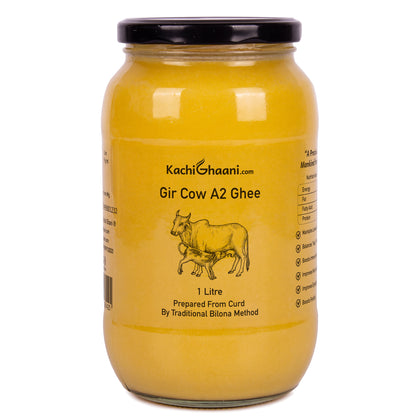
- 2 tsp Gir Cow's A2 Ghee, to finish
- White butter (loni), thick curd and green thecha, to serve
Quantities are scaled up. Taste as you go and adjust the salt and spice.
Shop this recipe
Everything you need, from our press house
A cold morning in Kolhapur, and there is a woman patting dough on a wet square of banana leaf with her fingertips, turning it as she goes until it is a rough circle the size of her palm. She pokes a hole in the middle with one finger, flips the whole leaf onto a hot tawa and peels it away. A spoon of oil goes into the hole and it runs out under the dough. Five minutes later it comes off dark brown and speckled, smelling of roasted jowar and cumin, and a knob of white butter goes on top and starts sliding.
Thalipeeth cooks with oil going in around the edge and through that centre hole, so the oil is in direct contact with a hot tawa for six or seven minutes. Wooden cold pressed groundnut oil handles that steadily and gives the crust a savoury, roasted edge that suits bhajani, which is itself a flour of roasted grains. To finish, a spoon of Gir Cow's A2 Ghee on the hot thalipeeth does what butter does in a Maharashtrian kitchen, and its smell carries. Both are pressed and made in small batches without heat or refining, so what you taste is the groundnut and the milk.
The whole dish rests on the patting. Thalipeeth is never rolled with a belan, it is pressed out with wet fingers, and the dough must be soft, almost sticky, softer than roti dough. Keep a bowl of water beside you and wet your palm before every push. A stiff dough will crack at the edges and give you a hard, dry thalipeeth. A soft one spreads thin and comes off the tawa crisp at the rim and tender in the middle.
How to make it
- Mix the bhajani, chilli powder, turmeric, crushed cumin and coriander seeds, hing and salt in a wide plate. Add the onion, coriander and methi and rub everything through with your fingers for a minute so the onion releases a little water into the flour.
- Add warm water a few spoons at a time and bring it to a soft, slightly sticky dough, noticeably softer than roti dough. Do not knead hard, just gather and press. Cover and rest 10 minutes.
- Cut a square of banana leaf, or use a plastic sheet or a clean wet cloth, and wet it well. Take a lemon-sized ball of dough and put it in the centre.
- Wet your fingers and pat the ball outward from the middle, turning the sheet as you go, into a rough circle about 15 cm across and 5 mm thick. Wet your hand again whenever the dough starts sticking. Make a hole in the centre with your finger.
- Heat a tawa on medium until a drop of water dances. Lift the sheet, flip it dough-side down onto the tawa and peel the sheet away slowly from one corner.
- Pour 1 tsp oil into the centre hole and 1 tsp around the edge. Cover with a lid and cook on medium-low for 3 to 4 minutes. The top will lose its wet shine and the edges will lift.
- Flip it. Press the edges down with a spatula and cook uncovered for another 3 minutes until both sides are brown with dark speckles and the rim feels crisp.
- Slide it onto a plate, put a spoon of ghee or a knob of white butter on the hot surface and let it melt into the hole. Cook the rest the same way, wetting the sheet each time.
- Serve immediately with thick curd and green thecha. Thalipeeth stiffens as it cools, so it is a dish you eat standing next to the tawa.
Tips
- Make your own bhajani. Dry roast separately, on low, until each smells nutty: 500 g jowar, 250 g bajra, 250 g rice, 250 g chana dal, 100 g urad dal, 100 g moong dal and 3 tbsp coriander seeds with 1 tbsp cumin. Cool completely, grind fine at the mill, and it keeps 3 months in an airtight jar.
- No banana leaf? A cut-open plastic bag or a thick zip bag works just as well, and comes off cleaner than foil.
- The hole in the middle is not decoration. It lets oil reach the centre and steam escape, so the thalipeeth cooks evenly instead of puffing up in the middle and staying raw.
- If the edges crack while patting, the dough is too dry. Wet your hand and press the cracks shut, and add a spoon of warm water to the rest of the dough.
- White butter is bought or churned at home from malai. We do not sell it. A spoon of A2 ghee on the hot thalipeeth does the same job on a busy morning.