Almond Oil Benefits for Skin and Hair, Honestly Assessed
Badam oil for face, hair and baby malish - what cold pressed almond oil actually does, what it probably does, and what it does not. Plus five ways to spot a diluted bottle.

Badam oil is one of those things every Indian household has an opinion about. A spoon in warm milk before bed. A few drops worked into a baby's scalp on a Sunday. A bottle of roghan badam on the dressing table that has been there since someone's wedding.
Most of what gets written about badam oil benefits is either advertising or wishful thinking. This is what the oil actually does, what it probably does, and what it does not do — written by people who press it.
What is actually in the bottle
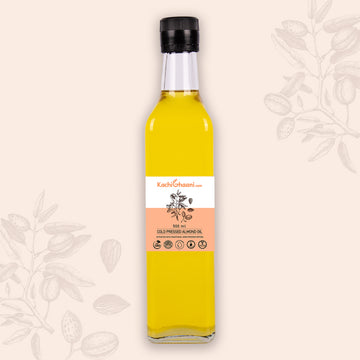
Cold pressed almond oil is sweet almond kernels put through a wooden ghaani and nothing else. No heat step, no solvent, no bleaching, no deodorising. What comes out is pale gold, smells faintly of almond, and is roughly:
- 62–70% oleic acid, a monounsaturated fat — the same family that makes olive oil sit well on skin
- 20–26% linoleic acid, an omega-6 essential fatty acid
- Vitamin E (alpha-tocopherol) — almonds are among the richest common food sources
- Small amounts of phytosterols and squalene
That fat profile is the whole story. Oleic acid is emollient and occlusive: it sits on the surface and slows water loss. Linoleic acid is smaller and absorbs faster. Vitamin E is an antioxidant that also keeps the oil itself from going rancid quickly.
Refined almond oil has most of the vitamin E stripped out during deodorising. If the label does not say cold pressed or unrefined, assume it has been through heat.
Badam oil for face and skin
Almond oil for face is the use people ask about most, and it is also where the claims get loudest. Here is the honest split.
What it reliably does: almond oil is an emollient. Applied to clean, slightly damp skin it reduces transepidermal water loss — the plain-language version is that it keeps moisture in rather than adding any. For dry skin, winter skin, and the patch of skin that goes tight after a bath, this is genuinely useful and it is the least controversial claim anyone can make about it.
What it probably does: the vitamin E content makes it a mild antioxidant on the surface. Traditional use for scars, stretch marks and under-eye darkness is long-standing and widely reported, though the clinical evidence is thin and mostly from small studies. Massage itself improves local circulation, so some of what people notice may be the massage rather than the oil.
What it does not do: it will not lighten your skin tone, remove a scar that has fully formed, or replace sunscreen. Anyone telling you otherwise is selling something.
Using badam oil for skin: three or four drops, warmed between the palms, pressed into damp skin at night. It is comedogenic rating 2 — low, but not zero. If your skin is oily or acne-prone, patch-test on the jawline for a few nights before committing to the whole face.
Almond oil for hair
Using almond oil on hair works on the hair shaft, not the follicle. Oleic acid coats the strand, which reduces friction, cuts frizz and makes combing easier — that is a real, immediate, physical effect you can feel.
The claim that almond oil causes hair growth is where honesty is needed. There is no good evidence that any oil grows hair from the follicle. What oiling does do is reduce breakage, and hair that breaks less looks like hair that grows more. That is a worthwhile outcome; it is just not the same claim.
For champi: warm two tablespoons, work it into the scalp with the pads of the fingers for five to ten minutes, leave for an hour or overnight, wash out with a mild shampoo. Almond is lighter than coconut and does not solidify in winter, which is why a lot of people switch to it once the weather turns.
Mixing almond with castor oil, roughly two parts almond to one part castor, gives you something thick enough to stay put but light enough to wash out. Castor alone is difficult to rinse.
Badam rogan and the milk ritual
Roghan badam is simply the Unani name for almond oil — we have written separately on what real badam rogan is and how to spot a diluted bottle — and the tradition of a spoon in warm milk at night is older than any of the brands selling it. Almonds carry vitamin E, magnesium and healthy fats, and a spoon of the oil carries the fat and the vitamin E but very little else — you are not getting the protein or the fibre of the nut.
Take it because it is a pleasant, calorie-dense, warming thing on a cold night, and because tradition holds it as balya and nourishing. Do not take it expecting a supplement. If you want the full nutrition of the almond, eat the almond.
A note on mamra badam: mamra is a variety, not a grade of processing. Mamra almonds have a higher oil content and are pressed by some producers into a more expensive oil. Whether the difference survives into the bottle is genuinely debatable, and we do not make that claim.
Almond oil for baby massage
This is the use we get asked about most. Almond oil is light, absorbs reasonably fast, does not solidify below 24°C the way coconut does, and has almost no smell — all of which suit an infant.
Two things matter more than the oil itself. Patch-test first, on the inside of the forearm, twenty-four hours before a full malish, and stop at any redness. And be aware of nut allergy — almond is a tree nut, and if there is a family history, ask your paediatrician before you start. We would rather lose the sale than have you skip that conversation.
Warm the bottle in a bowl of hot water, never directly on a flame or in a microwave.
How to tell real almond oil from a diluted bottle
Almond oil is expensive to press — it takes a lot of almonds to fill a bottle — which makes it one of the most commonly adulterated oils on the Indian market. Five checks:
- Price. If a litre costs about what a litre of refined sunflower costs, it is not almond oil.
- Smell. Faint, nutty, slightly sweet. Strong marzipan smell usually means added fragrance; no smell at all usually means refined.
- Colour. Pale gold. Water-clear suggests heavy refining or dilution with a cheap neutral oil.
- Feel. It should absorb, not sit greasy on the skin for hours.
- The label. Look for cold pressed or wood pressed, and an FSSAI licence number. Ours is 10724999001232, and we publish a lab report for every batch.
Storing it
Almond oil is high in unsaturated fat, which means it oxidises. Keep it capped, out of sunlight, away from the stove. Four to six months from pressing is the honest window for a cold pressed bottle — buy the size you will actually finish rather than the size that looks like better value.
If it smells sharp, like old paint or crayons, it has gone. Do not put it on your skin.
The short version: almond oil is an excellent emollient for dry skin, a genuinely good conditioner for hair, a sensible choice for baby massage with a patch test first, and a pleasant traditional addition to warm milk. It is not a hair-growth treatment, a skin-lightener or a supplement. Bought cold pressed and used for what it actually does, it earns its place.
Our cold pressed almond oil is pressed from sweet almonds in a wooden ghaani, unrefined, with a lab report published for every batch. 100 ml, 200 ml and 500 ml.
Dosha and traditional-use references describe long-standing practice, not medical advice. Patch-test before first use on skin, and speak to a doctor about any allergy concern.