Expeller pressed vs cold pressed vs solvent extracted oil
Expeller pressed vs cold pressed: the first means no solvent, not low heat; the second should mean both. Solvent extraction uses hexane and is followed by refining. Here is how each method works and what labels promise.

Expeller pressed oil is squeezed out by a steel screw press with no chemical solvent, though friction can make it hot. Cold pressed oil is also pressed mechanically, but without added heat. Solvent-extracted oil is dissolved out of the seed with hexane, a petroleum solvent, and then refined.
The short version of expeller pressed vs cold pressed: expeller pressed tells you no solvent was used, not how hot the oil got, while cold pressed should tell you both. The terms sit side by side on shelves in the US, Canada, the UK and Australia, yet they promise different things, and solvent-extracted oil rarely says so on the label at all. Here is how each method works and what to look for.
At a glance
- Expeller pressed: a steel screw squeezes the seed; no solvent, but no promise about temperature.
- Cold pressed: mechanical pressing without added heat, as the Codex standard defines it; US small-press guidance uses under 49°C (120°F).
- Solvent extracted: hexane dissolves the oil out of seed or press cake, leaving under 1% oil in the meal; the oil is then refined.
- The EU limits hexane residues to 1 mg per kg of oil, and EFSA is re-evaluating hexane's safety.
- A wooden ghaani is a slow, traditional cold press: a wooden pestle turning in a wooden mortar.
How is oil extracted from seeds?
In one of three ways, and many large mills use two of them in a row: a press first, then solvent to recover what the press left behind.
| Method | How it works | Heat | Solvent | Oil left behind | Usually sold as |
|---|---|---|---|---|---|
| Wooden ghaani | A wooden pestle turns slowly in a wooden mortar, crushing the seed | No added heat; a slow, gentle press | None | Some stays in the cake, which goes to cattle feed | Unrefined, often unfiltered |
| Expeller (screw press) | A steel screw forces seed through a tight barrel | Friction and pressure; seed is often steam-cooked first in large mills | None | Pressed cakes keep about 3 to 15% | Refined or unrefined |
| Solvent extraction | Hexane washes the oil out of seed flakes or press cake | Heat is used to drive off and recover the solvent | Hexane | Under 1% in the meal | Refined |
Expeller pressed vs cold pressed: what is the difference?
Both are mechanical, and neither uses solvent. The difference is heat: expeller pressed describes only the machine, while cold pressed adds a promise about temperature.
The Codex Alimentarius standard for named vegetable oils, the international reference for food standards, defines cold pressed oils as obtained by mechanical procedures only, such as expelling or pressing, "without the application of heat". It allows virgin oils to be made mechanically with "the application of heat only". Neither definition gives a number. Penn State Extension, writing for small US oil pressers, uses below 49°C (120°F) as the line for cold pressed. For olive oil alone, the EU sets 27°C (81°F) for the labels "first cold pressing" and "cold extraction".
So an expeller run slowly, or cooled, can make cold pressed oil, and a cold pressed label from a careful maker means something. An expeller pressed label on its own tells you that no solvent was used, nothing more. Our explainer on what cold pressed actually means, and how to check the bottle goes deeper.
What is expeller pressed oil, and how hot does it get?
Expeller pressed oil is oil squeezed out of seed by an expeller, a steel screw press, with no solvent. How hot it gets depends on the seed, its moisture, the screw speed and whether the seed was heated first, so there is no single number. Penn State Extension notes that faster screw speeds and drier seed raise the temperature of the oil and meal, and that for hard nuts such as Brazil nuts the press barrel may need heating to about 93°C (200°F) for pressing to work. In large mills, seed is often cooked with steam before pressing so that more oil flows.
Labels rarely state a temperature. If it matters to you, ask the maker how the oil is pressed and how warm it gets.
What is hexane extraction?
It is a way of dissolving oil out of seeds with hexane, a solvent made from petroleum. Large seed-oil plants use it because it recovers almost all of the oil; pressed cake still holds several per cent, while solvent-extracted meal usually holds less than 1%.
- Seeds are cleaned, cracked and flaked, or pressed first to remove part of the oil.
- The flakes or press cake are washed with hexane, which dissolves the oil.
- The oil and hexane mixture is heated and steam-stripped to drive off the hexane, which is recovered and reused.
- The meal is heated to remove the remaining solvent and is sold for animal feed.
- The crude oil is refined: degummed, neutralised, bleached and deodorised.
Each refining step is explained in our guide to how refined oil is actually made.
Does solvent-extracted oil contain hexane?
Only traces, at most. Desolventising and refining remove almost all of it, and the law sets limits: in the EU, hexane used to produce fats and oils may leave no more than 1 mg per kg in the finished oil, under Directive 2009/32/EC. That is one part per million, and regulators allow hexane-extracted oils within these limits.
Questions remain, though. In 2024 the European Food Safety Authority (EFSA) published a technical report that identified the need to re-evaluate hexane as an extraction solvent, and that re-evaluation is now under way. Many buyers simply prefer oil made without any solvent, which is why hexane-free and expeller pressed labels exist.
Is expeller pressed oil healthy?
The press matters less than two other questions: which oil it is, and whether it was refined. An expeller pressed oil can be sold unrefined, or refined until it is neutral. Refining strips most of the aroma and colour and part of the natural antioxidants, such as vitamin E, much of it in the deodorising step. And every oil, pressed or extracted, still carries about 884 kcal per 100 g.
For a balanced view of refined oils, see is refined oil bad for you? An honest answer.
How do you read these labels?
- Cold pressed: mechanical, with no added heat. Ask how the maker keeps the temperature down.
- Expeller pressed: mechanical and solvent-free; it may have run hot, and it may be refined.
- Hexane-free: no solvent; it says nothing about heat or refining.
- Unrefined or crude: not bleached or deodorised, so it keeps its colour, aroma and some sediment.
- Refined: neutral in taste and colour, with a higher smoke point; often, though not always, made from solvent-extracted oil.
- Wood pressed: pressed in a wooden ghaani, a slow, traditional cold press.
Where our oils fit
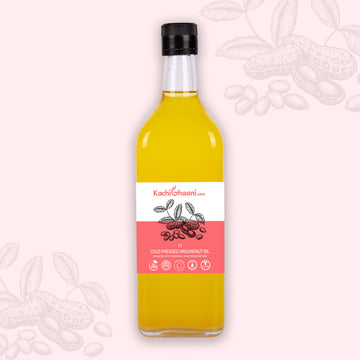
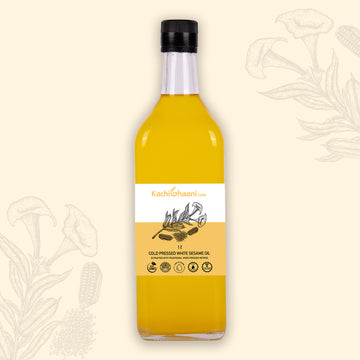
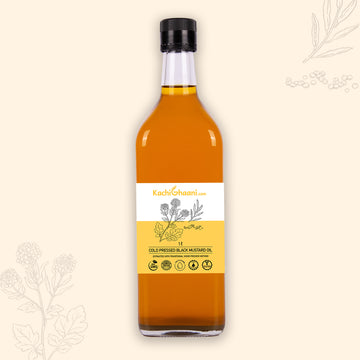
Our oils are Truly Cold Pressed: pressed slowly in wooden ghaanis, with no solvent and no refining, and bottled unfiltered, so a little sediment, and some cloudiness in the cold, is normal. If you want to taste the difference, our groundnut oil, white sesame oil and black mustard oil are good everyday places to start.
The bottom line
Expeller pressed means no solvent; cold pressed should mean no solvent and no added heat; solvent extracted means hexane and, almost always, refining. Read the label for the method and the word unrefined, and, if you can, ask the maker how warm the oil gets.
Frequently asked questions
Is hexane-free oil always cold pressed?
No. Hexane-free only means no solvent was used. The oil may still have been pressed hot in an expeller and then refined. If low heat matters to you, look for cold pressed, ideally with a note on how the maker controls temperature, and look for unrefined if you want the natural flavour.
Why does solvent extraction cost less?
Because it gets more oil from the same seed and runs at a huge scale. Even strong screw presses leave several per cent of the oil in the cake, while solvent extraction leaves under 1% in the meal. Pressing alone leaves more oil behind, which is one reason pressed oils cost more.
Is expeller pressed oil refined?
It can be either. Some expeller pressed oils are sold unrefined, keeping their colour and flavour; many are refined afterwards to make them neutral and longer lasting on the shelf. The front label often does not say, so look for the word unrefined, or ask the maker.
Is wood pressed oil the same as cold pressed oil?
Wood pressing is one kind of cold pressing. A wooden ghaani crushes seed slowly between a wooden pestle and mortar, with no added heat or solvent. Cold pressed oil can also come from a slow or cooled steel press. Both should be mechanical and low in heat; wood pressing is the traditional Indian way.
Which is better for deep frying?
Refined oils have higher smoke points and a neutral taste, so many cooks use them for long deep frying. Unrefined pressed oils such as mustard and groundnut are also traditional frying oils in India. Whichever you use, never let the oil smoke, and avoid reusing it again and again.
Sources
- Codex Standard for Named Vegetable Oils (CODEX-STAN 210-1999), FAO
- Penn State Extension, Oilseed Presses, 2025
- Encyclopaedia Britannica, Fat processing: pressing, accessed 2026
- Directive 2009/32/EC on extraction solvents, Annex I, via legislation.gov.uk
- European Food Safety Authority, Extraction solvents, 2025