What 'Cold Pressed' Actually Means — and How to Check the Bottle
Cold pressed means mechanically pressed with no heat applied - but friction heat is not applied heat, and every maker knows it. Six checks you can run on any bottle yourself.

"Cold pressed" is printed on a great many bottles now, including ours. It is a description of a process, and processes can be verified. Yet almost nobody checks, because almost nobody has been told what to check for.
Here is what the phrase is supposed to mean, where the wiggle room is, and the handful of tests you can run in your own kitchen in about a minute.
What the words mean
Cold pressed oil is oil pushed out of the seed by mechanical pressure alone, with no heat applied and no solvent used. Seed goes in. Pressure crushes it. Oil comes out. That is the whole method, and it is the oldest one there is.
Two things are deliberately absent. There is no roasting or steaming step to soften the seed and loosen more oil. And there is no chemical extraction afterwards — no hexane wash to strip the last few percent out of the leftover cake.
Both of those absences cost the maker money, which is the single most useful thing to understand about the whole category. Roasting raises yield. Solvent raises yield further. Refusing both means less oil from the same seed, and someone has to pay for that.
Where the wiggle room is
Here is the part the marketing never mentions, and it matters.
The phrase turns on heat being applied — not on the temperature the oil actually reached.
A modern screw expeller applies no external heat whatsoever. It does not need to: it turns fast enough that friction alone drives the temperature well past the point where aroma compounds start to go. Nothing was heated. The oil got hot anyway.
That is not a hypothetical loophole, it is the mainstream of the industry. And it is precisely why the speed of the press matters more than the label on the front. A slow wooden ghaani turns at a fraction of an expeller's RPM, which is a mechanically boring fact with a very unboring consequence: the oil never gets hot, so nothing is cooked out of it before you meet it.
So when you read "cold pressed", the useful follow-up question is not was it heated — every maker will say no. It is how fast was it pressed.
Cold pressed, wood pressed, lakdi ghani, kolhu — are these different things?
Mostly they are the same claim in different words.
Cold pressed describes the temperature condition. Wood pressed, lakdi ghani and kolhu all name the press itself — a wooden mortar-and-pestle at architectural scale, historically turned by bullocks walking a slow circle, now usually by a motor at a similarly slow speed. Every wood pressed oil is cold pressed. Not every cold pressed oil is wood pressed.
The regional names differ and the object does not: ghaani across the north, kolhu through the Hindi belt, and its own name in every other oil-pressing region of the country. We have laid the two terms out side by side on the cold pressed versus wood pressed page if you want the longer comparison.
Six checks you can run yourself
The label is the least reliable thing on the bottle. These are all harder to fake.
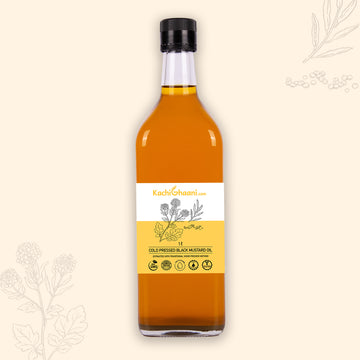
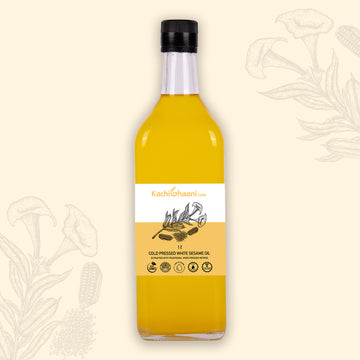
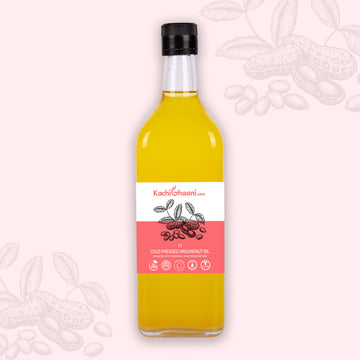
- Smell it. This is the fastest test and the most decisive. Real cold pressed mustard should prickle the back of your nose. Sesame should smell toasted. Groundnut should smell like a peanut. An oil that smells of nothing has been deodorised, whatever the front label says, because the smell is the first casualty of heat.
- Look at the colour. Unrefined oil carries the seed's own colour — mustard amber, sesame a deep gold, coconut clear-to-white. Water-clear is the signature of bleaching earth, not of purity. Pale does not mean clean here; it means processed.
- Look for sediment. A little settled matter at the base is normal in an unfiltered oil and is nothing but fine seed particles. A perfectly polished, sediment-free bottle has been filtered hard, which is a choice, not a fault — but it is worth knowing which you are holding.
- Read the ingredient list, not the front. It should be one line long. "Mustard oil." Then nothing. Any second ingredient, any "blended with", any "antioxidant (INS 319)", answers your question.
- Check the shelf life. This one surprises people. A genuinely unrefined oil with no added antioxidant has a short life — four to six months is honest. A twelve- or eighteen-month date on an oil sold as cold pressed means either a preservative or a refining step. Long shelf life is not a feature here; it is a tell.
- Ask for the lab report. Not a certificate hanging in a frame — the actual batch report, with a batch number that matches your bottle. Any maker doing this properly can show you one. The evasive ones have their reasons. Ours is published for every batch, under FSSAI licence 10724999001232.
The price test
If a litre of "cold pressed" oil costs roughly what a litre of refined sunflower costs, the arithmetic has already answered you.
Slow pressing gets meaningfully less oil out of the same quantity of seed than a hot expeller does, and no amount of good intention closes that gap. When the price does not reflect the lost yield, something else in the chain has made it up — usually speed, usually heat, occasionally a blend.
Expensive does not prove honest. But cheap does disprove it, and that is a genuinely useful asymmetry.
Does the phrase on our bottle guarantee anything by itself?
No — and we would rather say so.
Our name and our label are marketing real estate exactly like everyone else's. What is not marketing real estate is the batch number, the published lab report, the four-to-six-month shelf life we accept rather than extend, the single-line ingredient list, and the sediment that settles at the bottom of every bottle because we do not filter it out.
Judge us on those, not on the words. That is the whole point of writing this down.
The short version: cold pressed means mechanically pressed with no heat applied and no solvent used. The phrase alone guarantees very little, because friction heat is not "applied" heat and every maker knows it. Smell the oil, look at the colour, read the ingredient line, check the shelf life, and ask for the batch report. Five of those six take under a minute, and together they are worth more than any claim on any front label — ours included.
Every oil in our cold pressed range is pressed slow in a wooden ghaani, bottled unrefined and unfiltered, and lab-tested batch by batch with the report published. FSSAI licence 10724999001232.