Castor oil for nails and cuticles: the two-minute night habit
What actually makes nails brittle, what an oil can and cannot change, the nightly two-minute routine, and why you judge the results in months rather than weeks.

Nails that peel in fine layers at the tip. Nails that bend before they break. A ragged strip of skin beside the thumbnail that you pick at all day. Usually these belong to the same pair of hands: the ones that do the washing up, the ones that wash twenty times a day, the ones that had gel polish scraped off in a hurry last month.
Two minutes of oil at night helps that, and it is worth knowing exactly how it helps, because the reason is not the one on most nail-oil bottles.
What actually makes nails brittle
A nail plate is layers of keratin held together by a small amount of fat and water. Brittleness is mostly a water problem. When the plate loses water, the layers stop sliding against each other and start separating and snapping.
What drives that:
- Wetting and drying, over and over. Dishes, laundry, mopping, and washing your hands many times a day. The plate swells with water and shrinks as it dries, and repeated swelling and shrinking is what splits the layers apart.
- Detergents and cleaning chemicals, which strip the fats holding the layers together.
- Acetone remover, and gel or acrylic removal, which is soaking in acetone followed by scraping.
- Dry air. Winter, and months of air conditioning.
- Age. Brittle nails become more common past sixty.
- Trauma. Using nails as tools, typing hard on long nails, picking at the free edge.
One thing to separate out. If your nails changed suddenly, if one nail is different from all the others, if they thicken, crumble, lift away from the nail bed, change colour, or develop pits or ridges you have not seen before, that is a question for a doctor. Nail changes can reflect a fungal infection or a medical condition, and neither of those is something an oil addresses.
What an oil can and cannot change
An oil sits on the plate and on the skin around it. It slows the water leaving the nail, and it keeps the nail folds and the cuticle soft. Nails that hold their water stay flexible, and flexible nails bend where brittle nails split.
That is the honest mechanism, and it is a genuinely useful one. Almost every nail that looks bad at the tip got there by splitting, peeling and snapping rather than by growing badly. Stop the splitting and the nail simply reaches the length it was always going to reach.
What oil does not do: it does not make nails grow faster, it does not thicken the plate, it does not add strength to keratin, and it does nothing for a fungal nail infection.
The two-minute night habit
- Last thing at night, on clean, dry hands. Bare nails work best. Oil will not get through nail polish, so on polished nails you are only treating the surrounding skin.
- One drop of castor oil on the back of your hand. One. It goes further than you think, and a bottle lasts months at this rate.
- Pick it up with the pad of the opposite thumb and press it into the base of the nail, where the nail comes out of the skin. That strip is the part that matters most, because that is where the new nail is being made.
- Ten small circles per finger. Firm enough to feel it, gentle enough to be pleasant.
- Draw the oil down over the plate and run a fingertip along the underside of the free edge, which is the driest part of the whole nail and the part everyone forgets.
- Do the sides too, along both nail folds, where hangnails start.
- Both hands, about two minutes. Do not wash it off. Sleep with it on.
If you want a daytime version, keep a small bottle by the kitchen sink and put a trace on after washing up. Wet work is the main cause, so a little oil straight after it is the highest-value moment of the day.
Oil the cuticle, do not cut it
The cuticle is the thin, almost transparent film that grows out attached to the nail plate. It is not dead decoration. It seals the gap between the nail plate and the skin fold above it, and that seal is what keeps water, dirt and bacteria out of the space where the new nail is formed.
Cutting it breaks the seal. That is why cut cuticles are so often followed by a red, swollen, sore nail fold. If a salon offers to cut them, say no.
The safe version is simple. Oil the area every night. After a bath, when everything is soft, gently push the cuticle back with a towel wrapped over your fingertip. That is the whole technique. Hangnails should be trimmed flush with clean nail scissors, never pulled.
Castor or almond?
Castor oil is thick and tacky. It stays on the nail all night instead of disappearing into the bedsheet, which is what makes it the better choice for the night habit. Its drawback is that it feels heavy, and some people dislike that on their fingers.
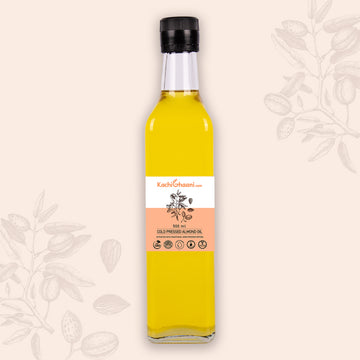
Cold pressed almond oil is much lighter and absorbs quickly. It is the better daytime option, the better one if you keep a bottle at the kitchen sink, and the obvious one if you cannot tolerate how castor feels.
Mixed half and half you get most of both: enough body to stay put, light enough to be comfortable. Neither oil is better for the nail itself. They differ only in how they behave on your hands, so pick the one you will actually use every night. Consistency beats the choice of oil by a wide margin.
How long before you can judge it
This is where most people give up too early, so it is worth being precise.
A fingernail grows around half a millimetre to a millimetre a week. Call it three millimetres a month. That means a fingernail takes roughly four to six months to grow out completely from base to tip. A toenail takes a year or more.
So the split, peeling nail you are looking at today was made months ago, and no amount of oil rewrites it. It has to grow out. What you are watching for is the new growth near the base: is it smoother, is it less likely to peel, does it bend instead of snapping?
Judge this at three months, looking at the base. Anybody promising you transformed nails in two weeks is promising something the nail’s own growth rate cannot deliver.
What it will not do
- It will not make nails grow faster. Growth rate is not something a topical oil sets.
- It will not strengthen the nail plate itself or add thickness.
- It will not treat a fungal nail infection. Thick, crumbling, yellow or discoloured nails need a doctor and a proper diagnosis, because several other conditions look the same.
- It will not fix nails that are brittle because of a medical condition or a medicine.
- It will not survive nail polish. Bare nails, or accept that you are only treating the skin.
The things that help as much as the oil
- Wear rubber gloves for dishes and cleaning. This is the single biggest change available to most people.
- Use an acetone-free remover, and stop scraping gel polish off.
- Keep nails short while they recover. Long brittle nails have more leverage and break more.
- File in one direction with a fine file, rather than sawing back and forth.
- Moisturise your hands after every wash, not only at night.
If you want to know more about how this oil behaves and why it is so much thicker than the others, our guide to castor oil, what it does and how to use it explains the chemistry in plain language.