Jaggery vs brown sugar vs coconut sugar: the real differences
Jaggery vs brown sugar vs coconut sugar: they look alike and are all mostly sucrose. Here is how each is made, what really differs, and how to swap one for another in your recipes.

Jaggery vs brown sugar comes down to how each is made. Jaggery is whole cane juice boiled down until it sets, while brown sugar is usually refined white sugar with a little molasses added back. Coconut sugar is the boiled-down sap of coconut palm flowers. All three are mostly sucrose with similar calories, so the real differences are flavour, moisture and how each behaves in a recipe.
All three carry a health halo, and each is sold as the "better" sugar. The honest picture is more modest. Each is a different route to the same sweet molecule, with small differences that matter far more to a cook than to your health. Here is what really separates them, and how to swap one for another.
At a glance
- All three are mostly sucrose and give close to 4 kcal per gram.
- Jaggery keeps all of the cane's molasses because nothing is spun off; brown sugar has some molasses added back; coconut sugar comes from palm sap, not cane.
- Jaggery and coconut sugar keep small amounts of minerals, but a normal portion adds very little to your day.
- Low glycemic index claims, especially for coconut sugar, rest on limited testing, and published figures differ.
- For most recipes, swap them 1:1 by weight and adjust for moisture and flavour.
Jaggery vs brown sugar: are they the same?
No, though they look alike. The difference is in how they are made.
- Jaggery is fresh cane juice, clarified, boiled in open pans and left to set. Nothing is separated out, so food scientists call it non-centrifugal cane sugar.
- Brown sugar starts in a sugar factory, where cane or beet juice is crystallised and spun in a centrifuge to separate white crystals from dark molasses. Most brown sugar is those white crystals with a few percent of molasses added back; some is simply less refined.
- Coconut sugar is made from the sap that drips from cut coconut palm flower buds. The sap is boiled until thick, then stirred as it cools so it crystallises into granules.
| Jaggery | Brown sugar | Coconut sugar | |
|---|---|---|---|
| Made from | Sugarcane juice | Refined cane or beet sugar plus molasses | Coconut palm flower sap |
| How | Whole juice boiled down, nothing removed | Crystals separated, molasses added back | Sap boiled down and granulated |
| Form | Blocks, powder or liquid | Soft, moist crystals | Dry, free-flowing granules |
| Flavour | Deep, mineral, slightly smoky | Caramel, toffee | Mild caramel, faintly nutty |
| Main sugar | Sucrose, plus some glucose and fructose | Sucrose | Sucrose, plus some glucose and fructose |
| Energy | Close to 4 kcal per gram | Close to 4 kcal per gram | Close to 4 kcal per gram |
Which is healthier, jaggery or coconut sugar?
Neither, in any way that matters much. Both are free sugars in the World Health Organization's definition, which covers sugars added to food by a manufacturer, cook or consumer. The WHO advises keeping free sugars below 10 percent of daily energy, and ideally below 5 percent, about 25 g or 6 teaspoons a day. India's ICMR-NIN guidelines suggest 20 to 25 g a day for adults, whatever the sugar. Mishri, the crystallised sugar many families keep for prasad, falls in the same group, as our guide to what mishri is made of explains.
Minerals are where jaggery can claim a small edge over refined sugar. A 2023 review lists about 11 mg of iron per 100 g of solid jaggery, against almost none in refined sugar. But a 10 g piece gives only about 1 mg of iron, with 35 to 40 kcal of sugar. Dal, leafy greens and millets are far better sources. Our article Is jaggery just sugar? goes deeper into the health question.
What is the glycemic index of jaggery?
There is no reliable, standard figure. The glycemic index (GI) measures how fast a food raises blood sugar compared with pure glucose, and it needs careful testing in groups of volunteers. Look up the jaggery glycemic index online and you will find numbers that disagree, and few come from standardised tests. Since jaggery is mostly sucrose, expect it to behave much like table sugar.
Coconut sugar is often sold as low GI, but that claim rests on limited testing, and other measurements have come out higher. Brown sugar behaves like white sugar. If you have diabetes, count all three as sugar.
Can I use brown sugar instead of jaggery?
Yes, in most recipes. Swap 1:1 by weight. Dark brown sugar is the closest everyday match for colour and depth; muscovado, a less refined brown sugar, comes closer still. Where jaggery's own character matters, the swap shows:
- Chikki and laddoo: jaggery syrup sets hard and chewy in a way brown sugar does not quite copy, so keep jaggery for these.
- Payasam and kheer: either works. Add jaggery after the milk has cooled a little, because it can curdle very hot milk.
- Chutneys, sambar and dal: brown sugar works well, with a little less depth.
What is a good jaggery substitute?
| Instead of jaggery, use | Ratio | What changes |
|---|---|---|
| Dark brown sugar | 1:1 by weight | Slightly less depth; a softer set in sweets |
| Muscovado | 1:1 by weight | Closest flavour; very moist |
| Panela or piloncillo | 1:1 by weight | Practically the same product, from Latin America |
| Coconut sugar | 1:1 by weight | Drier and milder; add a spoon of water or milk |
| White sugar plus molasses | About 200 g sugar to 1 tablespoon (20 g) molasses | Close in colour, plainer in taste |
Baking with jaggery, brown sugar and coconut sugar
- Jaggery carries more moisture and some glucose and fructose, which brown faster in the oven. Grate it finely or melt it into the liquid ingredients, and watch the colour; a cake may need covering towards the end.
- Brown sugar is the easiest swap for white sugar in cookies and cakes, giving a softer, chewier result.
- Coconut sugar is drier, so bakes can turn out a little crumbly. Add a spoon of liquid or an extra egg yolk.
Who should be careful
- People with diabetes or prediabetes: all three count as sugar, so agree any sweets with your doctor.
- Babies and toddlers: ICMR-NIN advises no added sugar of any kind for children under two.
- Anyone watching their weight or teeth: these sugars carry the same calories and the same risk of tooth decay as white sugar.
Our jaggery
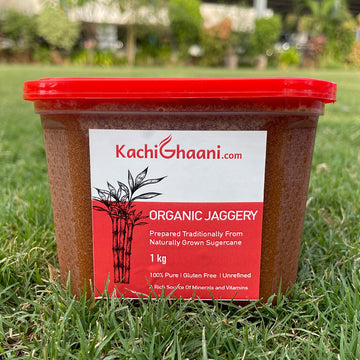
If you want to bake or cook with jaggery, our jaggery is cane juice reduced in open pans in small batches, with no sulphur, soda, bleach or chemical clarifiers. Grate it straight into a bowl for baking, or melt it gently into warm milk, water or ghee for Indian sweets.
The bottom line
Jaggery, brown sugar and coconut sugar are three routes to the same sweet molecule. None is a health food, and none is a disaster in small amounts. Choose by flavour and by how each behaves in your recipe, swap them by weight, and enjoy whichever one makes the dish taste right.
Frequently asked questions
Is brown sugar just white sugar with molasses?
Most brown sugar sold today is exactly that: refined white sugar crystals coated with a few percent of molasses, more for dark brown than for light. Some less refined brown sugars, such as muscovado and demerara, keep some of their own molasses from the start. Nutritionally, all of them are very close to white sugar.
Is coconut sugar the same as palm jaggery?
They are cousins. Both come from palm sap boiled down until it sets. Coconut sugar uses sap from coconut palms and is usually sold as dry granules. Palm jaggery in India is more often made from palmyra sap, as karupatti in Tamil Nadu, or from date palm sap, as nolen gur in Bengal.
Does jaggery have more iron than brown sugar?
Yes, per 100 g, because nothing is removed from the juice. A 2023 review lists about 11 mg of iron per 100 g of solid jaggery. But a normal 10 g portion gives only about 1 mg, so jaggery is not a sensible way to meet your iron needs. Dal, greens and millets do it far better.
Can I use jaggery in tea or coffee?
Yes, many people do. Stir it in after the tea or coffee is off the heat and has cooled for a moment, because jaggery can make very hot milk curdle. Grated or powdered jaggery dissolves fastest. It gives a rounder, slightly smoky sweetness, with the same calories as sugar.
Is panela the same as jaggery?
Practically, yes. Panela, from Colombia and much of Latin America, and piloncillo, from Mexico, are made like jaggery: cane juice boiled down in open pans and set in moulds. The cane, the climate and the method differ a little, so the flavour varies, but they swap 1:1 in recipes.