Mustard oil vs olive oil: which suits Indian cooking?
Mustard oil vs olive oil for Indian kitchens, side by side: what is in each, how they handle tadka and frying, why one is restricted in the US, and when to reach for which.

Mustard oil vs olive oil is an easy call for everyday Indian cooking: mustard oil usually suits better. It handles high-heat tadka and frying, its bold flavour belongs in Indian food, and it contains far more omega-3. Extra virgin olive oil shines raw and in gentle cooking. Mustard oil's honest caveat is erucic acid, so neither oil should be your only one.
Many Indian families switched to olive oil because it was sold as the healthy, international choice, while families abroad find mustard oil labelled 'for external use only'. Both oils have real strengths. The useful question is not which is healthiest in the abstract, but which one suits the dish in front of you.
At a glance
- Olive oil is about 73% monounsaturated fat, almost all of it oleic acid. Mustard oil is about 59% monounsaturated, but most of that is erucic acid (USDA).
- Mustard oil has about 6% omega-3 ALA; olive oil has under 1%.
- Unrefined mustard oil handles high heat, about 250°C (480°F). Extra virgin olive oil smokes at about 177 to 210°C (350 to 410°F), depending on quality.
- Extra virgin olive oil is imported into India and usually costs more, and its fruity flavour suits salads more than tadka.
- Rotate oils and keep the total sensible: ICMR-NIN suggests about 25 to 30 g a day.
Mustard oil vs olive oil: which is better?
Neither is better across the board. Mustard oil wins on omega-3, high-heat Indian cooking and flavour; olive oil wins on the depth of research behind it and carries no erucic acid question.
| Per 100 g (USDA) | Mustard oil | Olive oil |
|---|---|---|
| Saturated fat | 11.6 g | 13.8 g |
| Monounsaturated fat | 59.2 g | 73.0 g |
| of which oleic acid | 11.6 g | 71.3 g |
| of which erucic acid | 41.2 g | Essentially none |
| Polyunsaturated fat | 21.2 g | 10.5 g |
| Omega-3 ALA | 5.9 g | 0.8 g |
| Smoke point | About 250°C (480°F), unrefined | About 177 to 210°C (350 to 410°F), extra virgin |
| Flavour | Pungent and sharp | Fruity, grassy, peppery |
Olive oil's reputation rests largely on research into Mediterranean diets. Mustard oil's rests on fewer studies, the best known being a 2004 Indian case-control study in which cooking with mustard oil was linked with about half the heart-attack risk of cooking with sunflower oil. That shows a link, not proof.
Is olive oil good for Indian cooking?
Yes, for gentle cooking, but it is not the natural choice for high-heat tadka or deep frying.
Extra virgin olive oil is lovely raw over kachumber or a chaat-style salad, or for softly sautéing vegetables. Its grassy, peppery taste can sit oddly with hing and curry leaves, and heating it hard throws away the very flavour that makes it special. The 'light' and 'pomace' olive oils sold in India for everyday cooking are refined: pomace oil is extracted with solvents from the olive pulp left after pressing, then refined, much as described in how refined oil is made.
Mustard oil, by contrast, was made for this food: mustard-seed tadka, fish curries, achaar and pakoras. Heat it until it shimmers and the raw bite mellows. Our guide to 5 everyday tadka combinations shows which oil each one wants.
Mustard oil smoke point vs olive oil: which takes more heat?
Mustard oil. Unrefined mustard oil handles about 250°C (480°F), while extra virgin olive oil smokes at about 177 to 210°C (350 to 410°F), according to the North American Olive Oil Association.
Smoke point is not the whole story. Olive oil's high monounsaturated content and natural antioxidants make it reasonably stable for everyday sautéing. But for a tadka where mustard seeds must crackle, or a kadai of puris, mustard oil is the practical choice. See the full table in smoke points of Indian cooking oils.
Which oil has more omega-3?
Mustard oil, by a wide margin: about 0.83 g of ALA per tablespoon against about 0.10 g in olive oil, roughly eight times as much.
That makes mustard oil one of the few everyday cooking oils that contributes meaningful plant omega-3, alongside canola and soybean oil. If omega-3 is your main goal, though, flaxseed oil used raw carries far more, about 7.3 g per tablespoon.
Why is mustard oil restricted in the US but olive oil is not?
Because of erucic acid. Olive oil has essentially none, while traditional mustard oil can be around 40% erucic acid.
In rodents, long-term high intake of erucic acid caused fat to build up in the heart muscle. On that basis, the US Food and Drug Administration does not allow expressed mustard oil to be sold as a cooking oil, which is why it appears there 'for external use only'. The European Food Safety Authority sets a tolerable intake of 7 mg per kg of body weight a day. A 2022 review in the Journal of Clinical Lipidology notes that the Lipid Association of India recommends mustard oil as heart-healthy, and its US authors call for the erucic acid limits to be reviewed. The full story is in mustard oil and the 'banned in America' story.
Mustard oil vs olive oil for hair
Both are used, and neither has strong evidence for hair growth.
Mustard oil is the traditional champi oil of many North Indian homes, valued for its warming feel, but it can irritate a sensitive scalp, so patch test first. Olive oil feels softer and heavier, and is often used as a pre-wash conditioner. Whichever you choose, use a little, massage gently and wash it out well.
Who should be careful?
- Mustard allergy: mustard is a recognised major allergen in the EU, UK and Canada.
- Children: EFSA's main erucic acid concern was children up to 10 with high intakes, so use a mix of oils in their food.
- Skin and eyes: patch test mustard oil before a massage, keep it away from the eyes, and ask your paediatrician before using it on a baby.
- Heart conditions: diet changes work alongside your medicines, not instead of them. Talk to your doctor.
Using our mustard oils
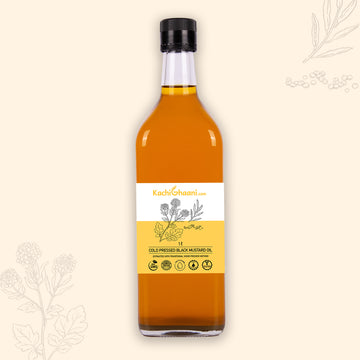
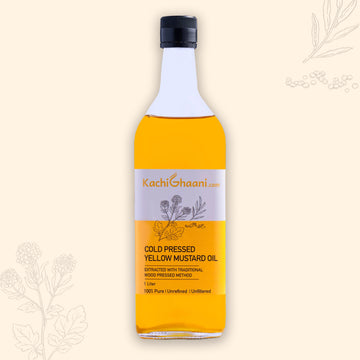
Our Truly Cold Pressed black mustard oil is pressed slowly in a wooden ghaani and left unrefined, for tadka, fish curries and achaar where the bite matters. Our Truly Cold Pressed yellow mustard oil, usually the milder of the two, suits everyday sabzi and dal. Keep your olive oil for salads and gentle cooking, and let the two share the work.
The bottom line
Mustard oil suits high-heat Indian cooking better and brings far more omega-3, while extra virgin olive oil is at its best raw or over gentle heat. Because of mustard oil's erucic acid, the wisest kitchen uses both, alongside other oils, in sensible amounts.
Frequently asked questions
Is olive oil healthier than mustard oil?
Each has strengths. Olive oil has the larger body of research, mostly from Mediterranean diets, and no erucic acid. Mustard oil has far more omega-3 and some encouraging Indian evidence. The healthiest approach is to rotate oils and keep the total to about 25 to 30 g a day.
Can I deep fry in olive oil?
You can with refined or 'light' olive oil, which tolerates higher heat. Extra virgin olive oil is better kept for gentle cooking and raw use, where its flavour shows. For Indian deep frying of puris or pakoras, mustard or groundnut oil is the more practical, traditional choice.
Can I mix mustard oil and olive oil?
Yes, at home, for a dressing or for gentle cooking. Remember that the mix is limited by the lower smoke point of the olive oil, so keep the heat moderate. For a sharp tadka or deep frying, use mustard oil on its own.
Is raw mustard oil too strong for salads?
Raw mustard oil is sharp and nose-tingling, which suits dishes such as jhal muri, aloo bharta and chokha, but it can overpower a delicate green salad. Yellow mustard oil is generally milder and works in a dressing. For a classic leafy salad, olive oil is usually the better fit.
Which oil is better for pickles?
Mustard oil, by tradition and by taste. Its sharp flavour stands up to months in the jar, and North Indian achaar recipes are built around it. Olive oil is used for Mediterranean preserves such as sun-dried tomatoes, but it does not give an Indian pickle its familiar bite.
Sources
- European Food Safety Authority, Erucic acid: a possible health risk for highly exposed children, 2016
- Poddar et al., Mustard oil and cardiovascular health: why the controversy?, Journal of Clinical Lipidology, 2022
- Rastogi et al., Diet and risk of ischemic heart disease in India, American Journal of Clinical Nutrition, 2004
- ICMR-National Institute of Nutrition, Dietary Guidelines for Indians, 2024
- North American Olive Oil Association, Olive oil smoke point, accessed 2026