Benefits of ghee: why Indian meals start with a spoon of it
The honest benefits of ghee, told through the Indian habit of a spoon on rice and roti: vitamins, flavour, satiety, blood sugar and smoke point, and how much ghee per meal is sensible.

The real benefits of ghee are modest but genuine: it carries flavour, helps the body absorb the fat-soluble vitamins A, D, E and K from a meal, makes food more satisfying and handles high heat well. It is also mostly saturated fat, so the benefits come from a spoon, not a ladle.
That is exactly how Indian meals have always used it. In Tamil and Telugu homes, the first handful of rice is mixed with plain dal and a spoon of ghee before anything else is served. In the North, hot phulkas come off the flame and are brushed with ghee, and khichdi everywhere is finished with a spoonful on top. Grandparents say ghee makes a meal "sit well". Here is what that wisdom gets right, and where it needs a measuring spoon.
At a glance
- Fat slows how quickly the stomach empties. In the words of Harvard's nutrition experts, meals with fat or acid are turned into sugar more slowly.
- The effect is modest. Ghee does not turn a large plate of white rice into a low-sugar meal.
- A level teaspoon of ghee has about 40 kcal and nearly 3 g of saturated fat; a tablespoon has about 110 kcal and 8 g.
- WHO advises keeping saturated fat to 10% of daily energy or less, and suggests oils rich in polyunsaturated fat in place of ghee and butter.
- About a teaspoon per meal, on rice, roti or dal, is a sensible amount for most healthy adults.
What are the benefits of ghee?
Honestly listed, the benefits of ghee are about cooking and eating well, not medicine. Here is what holds up.
- It carries fat-soluble vitamins. Vitamins A, D, E and K, and plant pigments such as beta-carotene, need some fat to be absorbed, so a little ghee with vegetables or dal helps the body take them up. Cow ghee also contains some vitamin A of its own.
- Flavour and satisfaction. Its nutty aroma makes plain rice, dal and roti taste fuller, and fat makes a meal more filling, so a small amount goes a long way.
- It handles heat well. With the water and milk solids cooked away, ghee has a smoke point of about 250°C (482°F), well above butter, so it suits tadka and roasting.
- Very little lactose. Clarifying leaves only traces of milk sugar and protein, so many people who are sensitive to lactose manage small amounts. Anyone with a milk allergy should still ask a doctor.
- A long place in Ayurveda. The classical texts prize ghee as a food and as a base for herbal preparations. That is tradition, not clinical proof.
The honest limit is that ghee is about 60% saturated fat. Its benefits come with a small spoon; beyond that, the calories and saturated fat start to outweigh them. Many online lists of ghee benefits go much further, promising weight loss, lower cholesterol or glowing skin, and good evidence for those claims is lacking.
Why do South Indians add ghee to the first mouthful of rice?
It is a custom of welcome and order: the meal opens with the most prized food, ghee, mixed with plain dal, before sambar, rasam and curd rice follow.
In a traditional South Indian meal, served on a banana leaf at weddings and festivals and on steel plates at home, rice with paruppu (dal) and nei (ghee) comes first. Ayurveda gives the custom a reason. It describes ghee as kindling agni, the digestive fire, and as a carrier that draws out the qualities of whatever it is mixed with, and it advises starting a meal with sweet, heavier foods, a group in which it places ghee. You can read more about that thinking in our piece on ghee in Ayurveda.
Modern food science adds two plain explanations. Aroma compounds dissolve in fat, which is the same reason tadka works, so a little ghee makes plain rice and dal taste fuller. And fat at the start of a meal slows the stomach slightly, so the meal feels more satisfying.
Does adding ghee to rice lower its glycaemic index?
Not exactly. The glycaemic index (GI) describes a food eaten on its own. What ghee can do is lower the glycaemic response of the whole meal, so blood sugar rises a little more slowly.
The GI measures how quickly a carbohydrate food raises blood glucose. White rice is quick: Harvard's nutrition guide lists a cup of cooked white basmati rice among high glycaemic load foods. Fat slows the emptying of the stomach, so the starch reaches the small intestine more gradually and the sugar peak is gentler. That is real, but the effect is modest, and portion size, fibre and protein matter far more.
| What you change | Effect on the blood sugar rise | Note |
|---|---|---|
| A teaspoon of ghee | Slightly gentler | Adds about 40 kcal |
| A bowl of dal or sambar | Gentler | Protein and fibre |
| Vegetables such as poriyal or sabzi | Gentler | Fibre, few calories |
| Curd or a squeeze of lemon | Slightly gentler | Acid slows digestion |
| Brown or hand-pounded rice | Gentler | More fibre than white rice |
| A smaller portion of rice | Much gentler | The biggest single lever |
Is it healthy to put ghee on roti?
A thin smear on a phulka is fine for most people. Ghee adds flavour, keeps rotis soft and makes the meal more satisfying; the only real question is how much.
Whole wheat rotis already bring fibre. A level teaspoon of ghee spread over two phulkas adds about 40 kcal. But three rotis, each brushed with a heaped teaspoon, plus ghee in the dal, can add 150 to 200 kcal and 10 to 14 g of saturated fat to a single meal. Brush thinly, or ghee only the first roti, and the habit stays light.
Is ghee better than oil on chapati?
For flavour and tradition, many people prefer ghee. For heart health, unsaturated oils have the edge, which is why WHO suggests replacing butter, lard and ghee with oils rich in polyunsaturated fat.
Ghee is about 60% saturated fat, while groundnut, mustard and sesame oils are mostly unsaturated. The American Heart Association goes further than WHO and suggests keeping saturated fat below 6% of calories, about 13 g a day on a 2,000-calorie diet. A tablespoon of ghee alone holds around 8 g. A sensible split for most homes is to cook everyday sabzi and parathas in unsaturated oils, and save ghee for the finishing spoon you will actually taste. Our guide to how much cooking oil a family needs each month helps you see the whole picture.
How much ghee per meal is reasonable?
For most healthy adults, about a teaspoon per meal, or two to three teaspoons across the day, fits comfortably within WHO's saturated fat limit and leaves room for other foods.
| Amount of ghee | Energy | Saturated fat | Share of WHO daily limit* |
|---|---|---|---|
| 1 teaspoon (about 4.5 g) | About 40 kcal | About 2.8 g | About 13% |
| 1 tablespoon (about 13 g) | About 110 kcal | About 8 g | About 36% |
| 2 tablespoons (about 26 g) | About 225 kcal | About 16 g | About 72% |
*WHO advises saturated fat at or below 10% of daily energy, about 22 g on a 2,000-calorie diet. Remember that milk, curd, paneer, biscuits and fried snacks count towards the same limit.
Who should go easy on ghee
- High cholesterol or heart disease. Ask your doctor how much saturated fat suits you; you may be advised to use less than a teaspoon a meal.
- Diabetes. A little fat can soften the sugar rise, but it adds calories. Your doctor or dietitian can fit ghee into your meal plan.
- Weight loss, fatty liver or gallbladder trouble. Keep portions small and follow medical advice.
- Milk allergy. Ghee can carry traces of milk protein, so check with your doctor.
Making the first spoon count
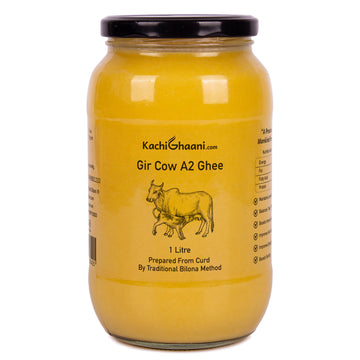
If you enjoy that first spoon, make it a good one. Our A2 Gir cow ghee is made the bilona way: Gir cow milk set as curd, hand-churned into makkhan (butter) and slowly simmered, so it is naturally golden and grainy with a deep, nutty aroma. Because the flavour is strong, a small spoon on hot rice or a phulka goes a long way.
The bottom line
The benefits of ghee are real but modest, and a spoon on rice or roti is a sound tradition: it adds flavour, makes the meal satisfying and softens the blood sugar rise a little. It is not a licence for a ladle. Keep it to about a teaspoon a meal, fill the plate with dal and vegetables, and use unsaturated oils for most everyday cooking.
Frequently asked questions
Is ghee rice good for weight loss?
Ghee does not cause weight loss. A teaspoon on rice adds about 40 kcal and can make a modest portion feel more satisfying, which may help some people eat less overall. A large plate of rice drenched in ghee does the opposite. Portion size matters most.
Is it good to eat ghee every day?
For most healthy adults, yes, in small amounts. A teaspoon or two a day, spread across meals rich in dal, vegetables and whole grains, fits within WHO's saturated fat limit. If you have high cholesterol, heart disease or diabetes, ask your doctor how much suits you.
Can people with diabetes eat ghee with rice?
Many can, in small amounts, but it is a question for your doctor or dietitian. A little fat can soften the blood sugar rise after rice, yet it adds calories and saturated fat. Smaller rice portions, more dal and vegetables, and regular monitoring matter far more than the ghee.
Should ghee go on hot rice or be cooked into it?
For flavour, pour it on hot rice just before eating, so its aroma comes through. Cooking rice in ghee, as in ghee rice or pulao, works too but usually uses more. Either way, the effect on blood sugar comes from the fat being in the meal, not from when it is added.
Is it better to eat ghee in the morning or at night?
There is no good evidence that timing matters for ghee. What matters is the total amount across the day and the rest of your diet. Ayurveda recommends lighter dinners, which is sensible advice for most people, so a smaller spoon at night is a reasonable habit.
Why does ghee keep rotis soft?
Fat coats the surface of a hot roti and slows the loss of moisture as it cools, so it stays soft and pliable for longer. A thin smear is enough; a thick layer adds calories without making the roti much softer. Wrapping rotis in a cloth helps too.