Black sesame vs white sesame: seeds, oil and taste compared
Black sesame vs white sesame: one plant in two coats. How the seeds differ in hull, taste and calcium, how their oils differ, and which one each traditional use calls for.

Black sesame vs white sesame is mostly a story about the hull, because both come from the same plant, Sesamum indicum. Black seeds usually keep their hull, so they taste stronger, earthier and slightly bitter, and carry far more calcium; white seeds are often hulled and taste milder and nuttier. As oils, the difference is mainly flavour and tradition.
Til is one of the oldest oilseeds in the world, and India grows both colours. White til goes into laddoos and chikki for Makar Sankranti, black til into rituals and winter sweets, and both are pressed for oil. Here is how they compare as seeds, as oils and in the kitchen. There is no "better" or "worse", just different jobs.
At a glance
- Same species, different seed coats. Sesame hulls can be white, cream, brown or black, and the colour sits in the hull.
- Black sesame is usually sold unhulled. White sesame is often hulled, which removes most of the calcium; the fibre, gram for gram, stays much the same.
- Black seeds taste stronger and slightly bitter; white seeds are milder, sweeter and nuttier.
- The oils have broadly similar fats. Black sesame oil is the classical Ayurvedic choice for oil pulling and massage; white sesame oil is the everyday til oil for cooking.
- Both are sesame, a major food allergen, so anyone with a sesame allergy should avoid both.
What is the difference between black and white sesame seeds?
Mostly the hull. Both come from the same species; varieties differ in seed-coat colour, and black seeds are usually eaten with the hull on, while white seeds are often hulled.
Hulled vs unhulled sesame seeds
The hull is the thin outer skin of the seed. Removing it, by soaking and rubbing the seeds, gives the bright white sesame you see on burger buns and in tahini. Unhulled white sesame, sometimes sold as "natural", is creamy beige and a little duller. Black sesame is almost always sold unhulled, because the hull is where its colour lives.
| Black sesame | White sesame | |
|---|---|---|
| Plant | Sesamum indicum | Sesamum indicum |
| Usual form | Unhulled | Often hulled; unhulled also sold |
| Taste | Stronger, earthy, slightly bitter | Milder, nutty, slightly sweet |
| Texture | Crunchier, with a chewy hull | Softer, creamier when ground |
| Calcium | High, thanks to the hull | Much lower when hulled |
| Typical Indian uses | Laddoos, rituals, chutneys, winter sweets | Laddoos, chikki, gajak, garnishes |
| Typical East Asian uses | Black sesame paste, sweet soups, ice cream | Garnishes, dressings, toasted sesame oil |
| Traditional oil use | Oil pulling, massage, Ayurvedic oils | Everyday cooking oil (til, gingelly) |
Black sesame vs white sesame: which is more nutritious?
Unhulled black sesame has far more calcium than hulled white sesame, because most of the calcium sits in the hull. Compared with unhulled white sesame, the difference is small.
Whole sesame is often praised as a plant source of calcium, but hulling strips most of it away. USDA figures put whole toasted sesame at about 990 mg of calcium per 100 g, against about 130 mg for hulled toasted kernels, while the fibre is much the same in both. There is a catch even with whole seeds: the hull is rich in oxalate, a plant compound that binds calcium. The US National Institutes of Health notes that oxalic and phytic acids can reduce how much calcium the body absorbs, although in a varied diet this matters little. A spoonful of sesame is a good addition to a meal, not a calcium supplement.
The black colour comes from pigments in the hull that researchers study as antioxidants. That is interesting chemistry, but it has not been shown to make black sesame meaningfully healthier than white.
Do black sesame seeds taste different?
Yes. Black sesame tastes deeper, earthier and slightly bitter, with more crunch; white sesame is milder, sweeter and nuttier, especially when toasted.
Both taste better after a gentle dry roast in a heavy pan over low heat. White seeds turn golden, which makes them easy to judge. Black seeds do not change colour, so go by smell: take them off the heat as soon as they smell nutty and start to pop. Ground black sesame makes the dramatic grey-black pastes and sweet soups loved in China and Japan; hulled white sesame makes the smoothest tahini-style pastes.
Is black sesame oil better than white sesame oil?
Not better, different. Both oils are mostly unsaturated fat in broadly similar proportions; the differences are flavour, colour and traditional use.
Oil pressed from black seeds tends to be stronger in taste. White sesame oil is lighter and milder, which is why it serves as the everyday til or gingelly oil in many Indian kitchens, for tadka, sabzi and pickles. Our guide to til, gingelly and sesame oil covers the many names. Unrefined sesame oil has a smoke point of about 177°C (350°F), so it suits everyday Indian cooking rather than long, hot deep-frying.
One more difference matters when you shop. The dark, smoky sesame oil used in Chinese, Korean and Japanese cooking is pressed from toasted seeds and is used as a finishing oil. Untoasted sesame oils, black or white, are pale to golden and mild by comparison.
Why is black sesame oil preferred for oil pulling?
Because the classical Ayurvedic texts name it. Black sesame, krishna tila, is ranked as the finest sesame in Ayurveda, and its oil is the traditional choice for gandusha and kavala, the two forms of oil pulling.
Ayurveda describes sesame oil as warming and nourishing, and when the old texts grade sesame by colour, black comes first and white second. That is why black sesame oil is also a favourite for daily massage; see our guide to abhyanga at home. Modern research on oil pulling is limited and mostly small, so think of it as a traditional habit alongside brushing and flossing, never instead of them. Our step-by-step oil pulling guide shows how to do it.
Who should be careful with sesame?
- Sesame allergy. Sesame is one of the nine major food allergens in the United States, with labelling required since January 2023, and it is a major allergen in the UK and EU too. Avoid black and white sesame, seeds and oils alike. Unrefined oils are not suitable for anyone with a sesame allergy.
- Young children. Whole seeds can be hard for small children to chew; ground seeds or smooth pastes are easier. Ask your paediatrician about introducing sesame if allergies run in the family.
- Kidney stones. If you have been told to limit oxalate, ask your doctor how much whole sesame suits you.
Our two sesame oils
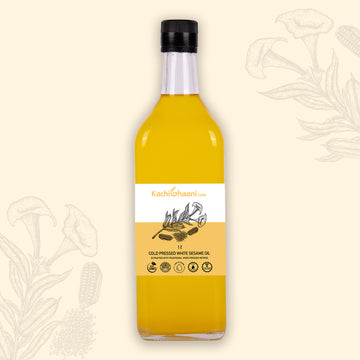
Our Truly Cold Pressed white sesame oil is the everyday til oil, mild enough for tadka, sabzi and South Indian cooking. Our Truly Cold Pressed black sesame oil is the one to reach for when tradition asks for it, for oil pulling and massage. Both are pressed slowly in wooden ghaanis from untoasted seeds and left unrefined.
The bottom line
Black and white sesame are one plant in two coats. Black seeds keep their hull, bringing a stronger taste and far more calcium; white seeds are often hulled and milder. As oils, choose white for everyday cooking and black where tradition asks for it, such as oil pulling and massage.
Frequently asked questions
Are white sesame seeds hulled?
Often, but not always. The bright white seeds on buns and in tahini are usually hulled. Unhulled white sesame, sometimes sold as natural sesame, is creamy beige with a slightly duller look and more crunch. The pack should say whether the seeds are hulled or unhulled.
Can black and white sesame be swapped in recipes?
Usually, yes. Black sesame gives a stronger, slightly bitter taste and a striking colour, so it suits desserts, dressings and garnishes where you want contrast. White sesame is milder and blends in. For tahini-style pastes, hulled white seeds give the smoothest, least bitter result.
Which sesame is used for til laddoos on Makar Sankranti?
Both, depending on the family and region. Many homes make til laddoos and chikki with white sesame and jaggery, while black sesame laddoos are traditional in some communities and for certain rituals. Either way, roast the seeds gently until fragrant before mixing them into the melted jaggery.
Is toasted sesame oil the same as black sesame oil?
No. Toasted sesame oil, common in East Asian cooking, is pressed from roasted seeds, usually white or brown, and has a dark colour and smoky flavour. Black sesame oil is pressed from black seeds and can be untoasted, like ours. Use toasted oil as a finishing drizzle, not for frying.
Does black sesame turn grey hair black again?
There is no good evidence that black sesame seeds or oil restore hair colour. Greying depends mainly on genetics and age. Black sesame is a traditional food for hair in both Chinese and Indian practice, and it is nourishing, but it will not undo grey hair.