Does jaggery contain iron? The anaemia myth, checked
Does jaggery contain iron? Yes, a little: a typical piece gives about 3% of a day's need, along with plenty of sugar. Here are the real numbers per piece, and what actually helps low iron.

Does jaggery contain iron? Yes, but only a little. India's food composition tables list about 4.6 mg per 100 g of cane jaggery, so a typical 10 g piece gives roughly 0.5 mg, about 3% of the 18 mg a day that women aged 19 to 50 need, along with about 8 g of sugar. Anaemia needs a blood test and a doctor's advice, not more gur.
The belief runs deep in Indian homes. Gur-chana is handed to children after school, new mothers are given jaggery sweets, and "eat gur, it has iron" is advice most of us have heard. The tradition has warmth, but the numbers tell a more modest story, and anaemia is too common and too serious to leave to a sweet.
At a glance
- Does jaggery have iron? Yes: about 4.6 mg per 100 g on average in India's food tables (IFCT 2017). An older 1971 table listed 11.4 mg, a figure still repeated online.
- A 10 g piece gives about 0.5 mg of iron, with about 8 g of sugar and 35 kcal.
- To get a woman's daily 18 mg from jaggery alone, you would need almost 400 g a day, about 1,400 kcal, nearly all of it sugar.
- Iron from plant foods is absorbed less well than the haem iron in meat, fish and poultry.
- Low haemoglobin needs a blood test and a doctor's advice, not home remedies.
Does jaggery contain iron, or is that a myth?
It does contain some, so the belief is not baseless; the myth lies in the word rich. The Indian Food Composition Tables 2017, from the National Institute of Nutrition, list cane jaggery at about 4.6 mg of iron per 100 g on average. The 1971 edition gave 11.4 mg, and that older figure still circulates online.
Jaggery earned its reputation mostly by comparison with white sugar. Refined sugar and mishri, which is crystallised sugar, are almost pure sucrose with practically no iron. Next to them, jaggery, which keeps some of the minerals of the cane juice, looks rich. Next to a bowl of dal, which you eat in far larger amounts and without the sugar, it does not. Figures also vary with the cane, the soil and the pans used, so one batch can differ from the next.
Add gur's place in festive sweets and Ayurvedic home recipes, and it is easy to see how "jaggery is good for the blood" became common wisdom. For a wider look at what jaggery is and is not, read is jaggery just sugar? An honest answer.
Jaggery iron content: how much does a piece give?
Less than most people think. Using the IFCT 2017 average of about 4.6 mg per 100 g, here is what everyday amounts give, set against the 18 mg a day that the US National Institutes of Health (NIH) recommends for women aged 19 to 50. Men of the same age need 8 mg.
| Amount of jaggery | Iron | Share of 18 mg | Sugar | Calories |
|---|---|---|---|---|
| 1 teaspoon grated (about 5 g) | about 0.2 mg | about 1% | about 4 g | about 18 kcal |
| A small piece (about 10 g) | about 0.5 mg | about 3% | about 8 g | about 35 kcal |
| A large piece (about 25 g) | about 1.2 mg | about 6% | about 21 g | about 88 kcal |
| Enough for 18 mg (about 390 g) | 18 mg | 100% | about 330 g | about 1,380 kcal |
Iron from plant foods, called non-haem iron, is also absorbed less well than the haem iron in meat, fish and poultry, so the body keeps only part of even these small amounts. NIH notes that vegetarians who eat no meat, poultry or seafood need almost twice as much iron for this reason.
Then there is the sugar. The World Health Organization advises keeping free sugars, which include jaggery, below 10% of daily calories, about 50 g on a 2,000 kcal diet, and says going below 5%, about 25 g, may bring extra benefits. A single 25 g piece of jaggery uses up most of that lower figure.
Does jaggery increase haemoglobin?
There is no good evidence that eating jaggery raises haemoglobin in people with anaemia. Haemoglobin, the iron-carrying protein in red blood cells, falls for many reasons, and low iron is only one of them.
Heavy periods, pregnancy, a poor diet, gut problems, worm infections and a lack of vitamin B12 or folate can all lead to anaemia, and inherited conditions such as thalassaemia trait can look similar on a basic test. Each needs a different answer, which is why guessing is risky. Mayo Clinic advises against diagnosing iron deficiency anaemia yourself and against starting iron supplements without talking to a health professional, because excess iron can build up and damage the liver and other organs.
Is gur-chana good for anaemia?
Gur-chana is a good snack, not an anaemia remedy. Roasted chana brings protein, fibre and some iron of its own, and the gur makes it a sweet reward.
If you want the snack to do more for your iron, change the company it keeps. Have it with a vitamin C fruit such as guava, orange or amla, which helps the body take up plant iron, and keep tea and coffee away from it for an hour or so, since they reduce how much plant iron you absorb.
Is jaggery good for women with low iron?
Not as a fix. Women lose iron every month through their periods, and pregnancy raises the daily need to 27 mg, according to NIH. A woman with low iron needs a proper diagnosis, usually a planned course of iron from her doctor, and an iron-rich diet. A little jaggery can stay on the plate as a sweetener, but it should not stand in for either.
What are better everyday sources of iron?
Ordinary meals do far more than a sweet. Half a cup of boiled lentils gives about 3 mg of iron, according to NIH, as much as roughly 65 g of jaggery and without the sugar. Here are the foods that count, with a simple tip for each.
| Food | Type of iron | Tip |
|---|---|---|
| Fish, chicken, mutton | Haem, well absorbed | Even small amounts help the body absorb plant iron eaten at the same meal |
| Dals, rajma, chana, lobia, soybean | Non-haem | Add lemon, tomato or amla to the meal |
| Leafy greens such as palak, methi, sarson and chaulai | Non-haem | Finish with a squeeze of lemon; skip tea with the meal |
| Bajra, nuts and raisins | Non-haem | Good snacks and rotis for the iron-conscious |
| Iron-fortified flour, cereals and double-fortified salt | Non-haem, added | Check the label for "fortified with iron" |
Who should be careful
- Diabetes or prediabetes: jaggery raises blood sugar much like white sugar, so count it.
- Pregnancy: follow your obstetrician's advice on iron and the blood tests that go with it.
- Children: a pale, tired child needs a paediatrician, not extra gur.
- Iron tablets: never start them on your own; too much iron can harm the liver.
Enjoying our jaggery
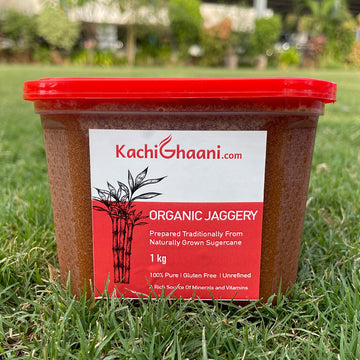
If you enjoy gur, our jaggery is made from cane juice reduced in open pans in small batches, with no sulphur, soda, bleach or chemical clarifiers. Enjoy it for what it is: a sweetener with a deep, caramel taste, a small piece after a meal or with roasted chana. Just do not count on it for your iron.
The bottom line
Jaggery does contain a little iron, but a piece after lunch gives only a few per cent of a day's need, with a spoonful of sugar. Enjoy it as a sweetener, eat real iron foods with a squeeze of lemon, and if you feel tired, breathless or pale, ask your doctor for a blood test.
Frequently asked questions
Is jaggery better than sugar for iron?
Slightly, but it changes little. Jaggery keeps some minerals from the cane juice, while white sugar has almost none, so gram for gram jaggery has more iron. Yet a small piece still gives only about 0.5 mg, and both are sugars that count towards your daily sugar limit.
How much jaggery can I eat in a day?
Count it as sugar. WHO advises keeping free sugars, which include jaggery, below 10% of daily calories, about 50 g on a 2,000 kcal diet, and says staying under 5%, about 25 g, may bring extra benefits. One or two small pieces fit easily; a couple of jaggery sweets can take you over.
Can jaggery replace iron tablets?
No. You would need several hundred grams of jaggery a day just to reach a normal daily iron need, let alone a prescribed dose, and that much sugar brings problems of its own. If your doctor has prescribed iron, take it as advised and enjoy jaggery only as a sweetener alongside.
Is jaggery good during periods?
Many women find a piece of gur comforting during their period, and that is a fine reason to enjoy it. It will not replace the iron lost each month, though. If your periods are heavy, or you often feel tired, dizzy or breathless, see a doctor, as heavy periods are a common cause of iron deficiency.
Does jaggery help with anaemia in pregnancy?
Not in any meaningful way. Pregnancy raises the daily iron need to 27 mg, and many pregnant women are advised to take iron by their obstetrician. Follow that advice and the blood tests that come with it. Keep jaggery to small amounts, too, because blood sugar can run high during pregnancy.
Sources
- Longvah and others, Indian Food Composition Tables 2017, National Institute of Nutrition (ICMR)
- NIH Office of Dietary Supplements, Iron fact sheet for health professionals, accessed 2026
- Mayo Clinic, Iron deficiency anemia: symptoms and causes, accessed 2026
- World Health Organization, Healthy diet fact sheet, 2026