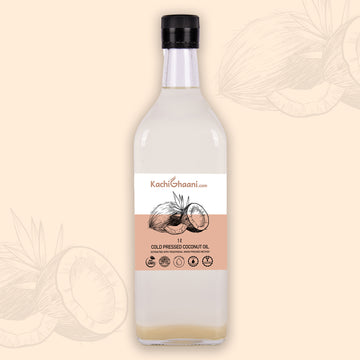
What is fractionated coconut oil? The coconut MCT myth
What is fractionated coconut oil? The liquid, MCT-rich part of coconut oil, with the lauric acid taken out. How it differs from regular coconut oil, and what weight studies really found.

What is fractionated coconut oil? It is coconut oil with its main fat, lauric acid, and its longer fats taken out, leaving mostly caprylic and capric acids, the medium-chain fats sold as MCT oil. That is why it stays liquid. Regular coconut oil is not MCT oil: only about 13 to 14 per cent of it is these shorter fats.
This matters because a lot of coconut oil marketing borrows from MCT research. The idea that a spoonful in your coffee melts away weight rests on studies of a different oil, and even those found small effects. Here is how the two differ, and which suits cooking, skin and hair.
At a glance
- Fractionated coconut oil is mostly caprylic (C8) and capric (C10) fat, essentially MCT oil. On skincare labels it often appears as caprylic/capric triglyceride.
- Regular coconut oil is nearly half lauric acid (C12), which the body handles largely like a long-chain fat.
- In a meta-analysis of 13 trials, swapping other fats for MCTs led to about 0.5 kg more weight loss. Coconut oil itself has no such evidence.
- Coconut oil raises LDL cholesterol compared with unsaturated oils, so it is neither a slimming nor a heart food.
- Use regular coconut oil for cooking and hair, and fractionated oil as a light carrier for skin and massage blends.
What is fractionated coconut oil?
It is coconut oil separated into parts, keeping the fraction with the shortest fats. The result is a clear, odourless oil that stays liquid even in the fridge.
Fractionation separates fats by melting point: the oil is warmed until fully liquid, then cooled so the higher-melting fats turn solid and can be removed. Commercial fractionated coconut oil is mostly caprylic and capric acid, with little or no lauric acid. Sold as a food supplement, much the same oil is called MCT oil.
What is MCT oil?
MCT oil is made of medium-chain triglycerides: fats built from shorter fatty acids than most fats in food. Commercial MCT oil is mostly caprylic (C8) and capric (C10) acid, usually separated from coconut or palm kernel oil, so food-grade MCT oil and fractionated coconut oil are close cousins. These shorter fats are absorbed differently, travelling straight to the liver, where most is used for energy.
Why does fractionated coconut oil stay liquid?
Because the fats that make coconut oil set have been taken out. Lauric acid and the longer saturated fats melt at higher temperatures, which is why regular coconut oil turns solid below about 24°C (75°F). Caprylic and capric acids have much lower melting points, so the oil left behind stays runny.
Coconut oil vs MCT oil: are they the same?
No. Regular coconut oil contains some MCTs, but it is mostly lauric acid and longer fats.
| Fat | Regular coconut oil | Fractionated coconut oil or MCT oil |
|---|---|---|
| Caproic, caprylic and capric (C6, C8, C10) | About 13.6% (C8 7.6%, C10 5.5%, C6 0.5%) | Nearly all of it, mainly C8 and C10 |
| Lauric (C12) | About 48% | Little or none |
| Longer fats (C14 and up) | About 39%, mostly myristic and palmitic | Little or none |
| At 20°C (68°F) | Solid | Liquid |
| Typical use | Cooking, hair, skin | Carrier and massage oil; food-grade MCT oil in drinks |
The lauric acid question
Lauric acid has 12 carbons, and some sources count it as a medium-chain fat, which is how coconut oil gets marketed as 'rich in MCTs'. But the body does not handle it like the shorter ones. Only about 20 to 30 per cent of lauric acid goes straight to the liver to be used for energy; the rest is packaged and carried like long-chain fat. Counting that, one nutrition researcher estimated that only about 23 per cent of coconut oil behaves like MCT oil.
Does coconut oil help you lose weight?
There is no good evidence that it does. The weight-loss claim borrows from MCT research, and even there the effect is small.
A 2015 meta-analysis of 13 randomised trials with 749 people found that replacing long-chain fats with MCTs led to about 0.51 kg more weight loss, with small drops in waist and hip size. The authors called the effect modest, detected commercial bias and noted that many trials lacked enough detail to judge their quality. A 2024 meta-analysis in people with overweight or obesity found a similar picture: MCT-enriched diets gave about 1.5 per cent more weight loss than diets with long-chain fats.
Coconut oil has not been shown to do even that. A review of the evidence found no consistent sign that it improves fullness or helps weight loss, and a 2020 meta-analysis of 16 trials found no significant effect on body weight, while coconut oil raised LDL cholesterol by about 10 mg/dL compared with non-tropical vegetable oils. A tablespoon also adds about 120 kcal. For the fats worth eating more of, see MUFA, PUFA and omega fats in plain language.
Can you cook with fractionated coconut oil?
Only if the label says it is food-grade MCT oil, and then only for low-heat uses. Fractionated coconut oil sold for massage, hair or aromatherapy is a cosmetic product and should not be eaten.
Food-grade MCT oil goes into drinks, smoothies and dressings, and is best kept away from high-heat frying. Larger amounts often cause stomach cramps, bloating or diarrhoea, so people who take it usually start with a teaspoon. For a tadka or a stir-fry, regular coconut oil is the better fit: unrefined coconut oil smokes at about 177°C (350°F), which suits medium-heat Indian cooking.
What is fractionated coconut oil used for?
Mainly as a light, non-greasy carrier oil for skin, massage and diluting essential oils. It absorbs quickly, has no smell and stays liquid.
| Job | Better choice | Why |
|---|---|---|
| Tadka, thoran, medium-heat cooking | Regular coconut oil | Flavour and a cooking-grade smoke point |
| Pre-wash hair oiling | Regular coconut oil | The lab evidence on hair protein loss involves lauric acid |
| Massage blends, essential oil dilution | Fractionated coconut oil | Light, odourless and always liquid |
| Body moisturiser | Either | Regular feels richer; fractionated feels lighter |
If you like the idea of a light oil on your face, our guide to taking off makeup with oil covers who it suits and who it does not.
Who should be careful?
- Digestion: MCT oil often causes cramps or diarrhoea in larger amounts, so start small.
- Health conditions: if you have liver disease, diabetes or high cholesterol, ask your doctor before taking MCT oil or eating more coconut oil.
- Cosmetic grade: do not swallow fractionated coconut oil sold for skin or massage, and keep it out of children's reach.
- Skin: patch test any new oil, and remember that essential oils diluted in it can still irritate.
- Allergy: coconut allergy is uncommon but real; avoid both oils if you react to coconut.
Our coconut oil, and what it is not
Our Truly Cold Pressed coconut oil is regular coconut oil, cold pressed from dried copra in a wooden ghaani and left unrefined, so it keeps its coconut aroma and sets solid in cool weather. It is not fractionated and it is not MCT oil, so it is not a weight-loss aid. It is a flavourful cooking fat to use in moderation and a good oil for hair and skin; our guide to how copra oil differs from fresh-kernel oil explains more.
The bottom line
Fractionated coconut oil is the liquid, MCT-rich part of coconut oil, useful as a light carrier for skin and massage. Regular coconut oil is mostly lauric acid, not MCT oil, there is no good evidence that it helps weight loss, and it raises LDL compared with unsaturated oils. Use each for what it does well, and enjoy coconut oil for its flavour, in moderation.
Frequently asked questions
Is fractionated coconut oil good for skin?
It is a light, non-greasy moisturiser that suits many skin types and absorbs quickly, which is why it is a popular carrier oil. It contains little or no lauric acid, so it behaves differently from regular coconut oil. Patch test first, especially if you add essential oils.
Does fractionated coconut oil go rancid?
Very slowly. Its fats are saturated, so it resists the oxidation that makes oils smell stale, and it usually keeps much longer than unrefined oils. Store it closed, away from heat and sunlight, and go by the date on the bottle.
Is liquid coconut oil the same as fractionated coconut oil?
Often, yes. Oils sold as 'liquid coconut oil' for cooking are usually made by removing the fats that set, so they are very similar to MCT oil. Check the label: if it stays liquid in a cool kitchen, it is not ordinary coconut oil.
Can I use fractionated coconut oil on hair?
Yes, as a light leave-in or to tame frizz on the ends, because it does not weigh hair down. For pre-wash oiling, regular coconut oil is the better choice, since the lab evidence on reduced protein loss from hair links the effect to lauric acid.
Sources
- Medium-chain triglycerides and weight loss: a meta-analysis, Journal of the Academy of Nutrition and Dietetics, 2015
- MCTs and weight loss in overweight or obesity: a meta-analysis, Clinical Nutrition, 2024
- Clegg, coconut oil and weight loss, European Journal of Clinical Nutrition, 2017
- Neelakantan et al., coconut oil and cardiovascular risk factors, Circulation, 2020
- Fractionated coconut oil, Healthline (accessed 2026)