Raw linseed oil for a cricket bat: how to oil and knock it in
Raw linseed oil for a cricket bat, step by step: how much to use, where it goes, how to dry it, how to knock in, and why plain cold pressed flaxseed oil does the same job.

Raw linseed oil keeps a cricket bat's willow from drying out, but only in small amounts. Rub a light coat, no more than about a teaspoon, into the face, edges, toe and back, keeping it off the splice, handle and stickers. Lay the bat flat for a day, add one or two more thin coats, then knock it in.
Plain, cold pressed flaxseed oil is raw linseed oil, because flax and linseed are the same seed. Willow is a soft, stringy wood, and a little oil keeps its surface from drying out and cracking while you harden it by knocking in. Too much oil does the opposite: it soaks deep, adds weight and leaves the bat feeling dead. The word every bat maker repeats is "light".
At a glance
- Flaxseed oil and linseed oil come from the same plant, Linum usitatissimum. Cold pressed flaxseed oil with nothing added is raw linseed oil.
- Use raw linseed oil only. Boiled linseed oil contains drying agents and is meant for furniture, not bats.
- A new bat needs two or three thin coats, each about half a teaspoon to a teaspoon (2.5 to 5 ml), dried flat for about a day.
- Keep oil off the splice, handle and stickers, and never stand a freshly oiled bat on its toe.
- Knocking in protects a bat far more than oil does. Plan on several hours with a mallet before you face a new leather ball.
Is flaxseed oil the same as linseed oil?
Yes. Flax and linseed are two names for one plant and its seed. In everyday English, "flaxseed" is used for food and "linseed" for wood, paint and cricket bats, but the oil is the same.
What matters is what happens after pressing. Raw linseed oil is simply pressed oil. Boiled linseed oil has been heated or, more often today, mixed with metal-based drying agents so that it sets hard within a day. That film suits a garden bench, but a bat face needs to stay springy. A food-grade flaxseed oil that is cold pressed and unrefined (here is what cold pressed actually means) is pressed seed with nothing added, so it works as raw linseed oil for a cricket bat.
| Oil | What it is | Use on a bat? |
|---|---|---|
| Raw linseed oil | Pressed linseed oil, no drying agents | Yes. Bat makers recommend it |
| Cold pressed flaxseed oil (food grade) | Pressed flax seed, unrefined, nothing added | Yes. It is a clean raw linseed oil |
| Boiled linseed oil | Linseed oil with drying agents, sometimes solvents | No. It sets into a hard surface film |
| Coconut oil and most kitchen oils | Oils that set slowly or not at all | Not advised. They can leave the face greasy |
Why does a cricket bat need oil at all?
Oil keeps the outer fibres of the willow from drying out, so the face is less likely to crack when a hard ball hits it. It does not make the bat hit harder.
Leather-ball bats are usually made from English willow; many junior and practice bats use the harder, heavier Kashmir willow. Both are full of fine fibres. When those fibres dry out they turn brittle, and a fast leather ball opens small cracks, most often along the edges and at the toe. A thin film of raw linseed oil keeps the outer layer slightly supple, so the fibres compress rather than split. It is conditioning, not waterproofing, so keep the bat away from rain and puddles.
How to oil a cricket bat, step by step
For a new bat, you need raw linseed oil, a soft, lint-free cloth or clean fingertips, and a flat, shaded spot where the bat can lie for a day.
- Check the face. If it has a clear anti-scuff sheet, oil only the bare wood: the edges, toe and back.
- Pour a coin-sized pool, about half a teaspoon to a teaspoon, onto the cloth or your fingertips, never straight onto the bat.
- Rub it into the face along the grain, then along both edges and around the toe, which drinks up moisture from the ground.
- Wipe a thinner film over the back of the blade.
- Keep oil off the splice (the V-shaped joint where the handle is glued into the blade), the handle and the stickers.
- Lay the bat flat, face up, somewhere cool for about 24 hours. Do not stand it on its toe, or oil will run down the grain and pool there.
- Repeat once or twice, for two or three thin coats in all. If the surface still feels tacky, wait longer.
Some makers suggest three or four very light coats instead. Either way, the total is a few teaspoons spread over a week, not half a bottle.
How much linseed oil goes on a cricket bat?
Less than most people think. Each coat should vanish into the wood within a few minutes, leaving no wet shine.
Over-oiling is the most common mistake, and it is hard to undo. Watch for dark, damp-looking patches, a sticky surface or a bat that feels heavier and sounds dull when tapped. If you see these signs, stop, wipe the surface and leave the bat flat in a cool, airy room for several days. Heavily oiled willow dries out slowly.
How to knock in a cricket bat
Knocking in means tapping the face and edges with a mallet over several hours, so the soft fibres compress into a firm, springy layer that can take a hard ball. It matters more than oiling.
- Start once the last coat has dried, with a wooden bat mallet or an old leather ball in a sock. Never use a new ball.
- Tap the middle of the face gently at first, then increase the force slowly over the following days.
- Work the edges with glancing blows at about 45 degrees. Never hit an edge square at 90 degrees.
- Tap the toe lightly, and never knock the bat on its toe against the floor.
- Spread it out: 20 to 30 minutes a day for a week or two suits most people.
- Test with gentle throwdowns using an old ball. If the seam leaves deep marks, keep going before you take the bat to the nets.
How often should a cricket bat be oiled?
After the first coats, oil only when the face looks pale and dry or fine hairline cracks appear. For most players that means once or twice a season, plus one light coat before the bat is put away.
| When | What to do |
|---|---|
| New bat, first week | Two or three thin coats, each dried flat for about a day |
| Weeks one and two | Knock in with a mallet; test with an old ball |
| First net sessions | Old balls and short sessions only |
| During the season | A light coat if the face looks dry; sand fine surface cracks lightly first |
| End of season | Wipe clean, one light coat, store in a cover in a cool, dry room |
Do pre-knocked bats still need oiling?
Bats sold as "pre-knocked" or "ready to play" still benefit from a light coat on any bare wood and some extra mallet work before they meet a new ball. The factory does most of the job; you finish it.
Safety: oily rags and storage
Linseed oil dries by reacting with the air, and that reaction gives off heat. A crumpled, oil-soaked rag can trap the heat until it smoulders and catches fire, sometimes hours later. Fire services warn that this applies to raw as well as boiled linseed oil.
- Lay used rags flat outdoors on concrete until fully dry, or seal them in a metal tin with a tight lid, kept outside, until you throw them away.
- Never leave an oily rag in a kit bag, a pocket or a pile of laundry.
- Keep the bottle closed and away from small children, and the bat away from heaters and hot car boots.
- If you are allergic to flax seed, wear gloves or let someone else do the oiling.
Using our flaxseed oil on your bat
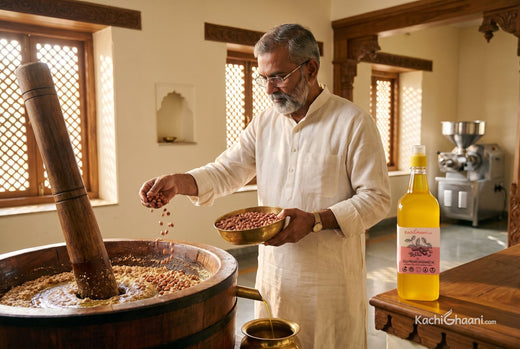
If you want a clean raw linseed oil, our Truly Cold Pressed flaxseed oil is simply flax seed pressed slowly in a wooden ghaani, unrefined and with nothing added. A bat uses only a few teaspoons a season, and the rest of the bottle is food. Keep it cool and dark, as our guide to storing cold pressed oil explains, never heat it, and try our four real ways to use flaxseed oil without heating it.
The bottom line
Use raw linseed oil, or a plain cold pressed flaxseed oil, and use very little: two or three thin coats on a new bat, then a light coat whenever the face looks dry. Keep oil off the splice and handle, dry the bat flat, and put your real effort into knocking in.
Frequently asked questions
Can I use coconut or mustard oil on a cricket bat?
Bat makers recommend raw linseed oil because it is a drying oil that slowly sets in the outer fibres of the willow. Coconut oil never sets, and most kitchen oils set far more slowly than linseed, so they can leave the face greasy and dirty. One coat will not ruin a bat, but linseed is the right choice.
Should I oil a bat that has an anti-scuff sheet?
Yes, but only the bare wood. Oil cannot soak through the clear sheet, so give the edges, toe and back a light coat and leave the covered face alone. If the sheet starts to peel, trim or replace it, because damp and grit can collect underneath.
Do tennis-ball cricket bats need oiling?
Bats made for tennis or tape balls face a much softer ball, so they do not need the long knocking-in that a leather-ball bat does. A light coat of raw linseed oil once a season still helps keep bare willow from drying out and cracking, especially in hot, dry weather.
Is the flaxseed oil in my kitchen safe to use on a bat?
Yes, if it is plain cold pressed flaxseed oil with nothing added, because that is raw linseed oil. Avoid flavoured oils and blends. Use only what the bat needs and keep the rest for eating. If the oil smells sharp or like old paint, it has gone stale and should be replaced.