Piloncillo, panela, rapadura and jaggery: one sugar, many names
Mexico's piloncillo, Colombia's panela, Brazil's rapadura and India's jaggery are all cane juice boiled down in open pans. Here is how they differ, how each is used and how to swap them.

Piloncillo is Mexico's unrefined cane sugar: sugarcane juice boiled down in open pans until it turns thick and dark, then poured into cone-shaped moulds to set. Nothing is spun out, so the molasses stays in. Colombian panela, Brazilian rapadura, Peruvian chancaca and Indian jaggery are made the same way, and in most recipes one can stand in for another.
Knowing this saves a trip across town when a recipe for café de olla asks for something your shop does not stock. It also helps to know what these sugars are not: they taste deeper than white sugar, but your body still handles them as sugar.
At a glance
- Piloncillo, panela, rapadura, chancaca, kokuto and jaggery are one family, called non-centrifugal cane sugar: the juice is boiled down and the molasses is never spun away.
- What changes from country to country is the shape, the depth of the cook and the name, not the method.
- Jaggery can replace piloncillo or panela gram for gram in most recipes, though the flavour varies from batch to batch.
- They are still sugar: about 383 kcal per 100 g, against about 398 kcal for white sugar.
What is piloncillo made of?
Piloncillo is made of one thing: the juice of sugarcane. The cane is crushed, and the juice is strained and boiled in wide, open pans. The froth is skimmed off as it rises, and the juice slowly darkens and thickens into a heavy syrup. When it is ready, it is poured into moulds and left to harden.
The name comes from its shape, a small cone with a flat top. In parts of northern Mexico it is called panocha. Darker cones have usually been cooked longer and taste more of caramel and smoke.
Why "non-centrifugal" matters
In a sugar factory, boiled cane syrup is spun in a centrifuge, a fast-turning drum that throws the molasses away from the sugar crystals. Piloncillo and its cousins skip that step. The Food and Agriculture Organization of the United Nations (FAO) lists them as a separate product, non-centrifugal sugar, and that is why they keep their colour, moisture and deep flavour.
Not every traditional sugar belongs here. Indian mishri is a clear crystal sugar grown slowly on thread; see how mishri is made for the difference.
Panela, rapadura, chancaca, jaggery: what is the difference?
Mostly the name, the shape and the way each country uses it. Panela usually comes as round cakes, blocks or granules and piloncillo as cones, but the method is the same everywhere: crush, boil, skim, set. Colour and flavour vary more between batches than between names, so one replaces another weight for weight.
| Country | Name | Usual shape | How it is used |
|---|---|---|---|
| Mexico | Piloncillo (panocha in parts of the north) | Small cones | Café de olla, champurrado, capirotada, atole |
| Colombia | Panela | Round cakes, blocks, granules | Aguapanela, hot or iced, often with lime |
| Brazil | Rapadura | Hard bricks | Eaten in pieces as a sweet; melted into desserts and drinks |
| Peru, Chile, Bolivia | Chancaca | Discs or blocks | Syrup for Peruvian picarones and Chilean sopaipillas pasadas |
| Venezuela | Papelón | Blocks or cones | Papelón con limón, a lime drink |
| Japan (Okinawa) | Kokuto | Lumps and blocks | Nibbled as a snack, used in sweets |
| India | Jaggery, gur | Blocks, cubes, powder | Chai, laddoos, chikki, festive sweets, a little in Gujarati dal |
One tip for travellers: in Mexico, panela is also the name of a fresh white cheese. If you want the sugar there, ask for piloncillo.
Is jaggery the same as piloncillo?
Yes, it is the same kind of sugar made in a different place. Both start as cane juice boiled in open pans, both keep their molasses, and both set into solid pieces. The differences come from the cane, the soil, how long the pan sits on the fire and how the juice is cleared. Some makers add chemical clarifiers to get a lighter, golden block; others use plant-based ones or simply skim by hand.
So colour alone says little about quality; a darker block has often just been cooked longer. In flavour, good jaggery sits right beside piloncillo: caramel, a little smoke, a faintly bitter edge.
Piloncillo substitute: what can I use instead?
The closest piloncillo substitute is another non-centrifugal sugar, swapped 1:1 by weight. Failing that, dark muscovado comes close, and dark brown sugar will do in a pinch.
- Panela, rapadura or chancaca: the nearest match, gram for gram.
- Jaggery (gur): also 1:1 by weight. Taste a crumb first, as a pale jaggery is milder than a dark one.
- Dark muscovado: moist and deep. Use the same weight.
- Dark brown sugar: usually refined sugar with some molasses added back, so it tastes lighter. A spoonful of molasses brings it closer.
Go by weight, not by cup or by cone. Cones come in many sizes, and grated sugar packs down unevenly.
How do you grate or melt a hard cone of piloncillo?
Often you do not need to. If the sugar is going into a hot liquid, add it in chunks and let it dissolve over low heat.
- To dissolve: put the cone in the pot with the recipe's water or milk, keep the heat low and stir until no lumps remain.
- To break: wrap it in a clean kitchen towel and tap firmly with a rolling pin.
- To grate: use the coarse side of a box grater, or shave slivers from the edge with a serrated knife.
- To soften: warm a rock-hard cone for 10 to 15 seconds in the microwave, or on a plate over a pan of steaming water, then cut.
Store it in an airtight jar in a cool, dry cupboard. These sugars pull moisture from the air and turn sticky in a humid kitchen.
Can jaggery be used for café de olla?
Yes. Jaggery dissolves just as well and gives café de olla, Mexican coffee simmered with cinnamon and piloncillo in a clay pot called an olla, the same dark, rounded sweetness.
Café de olla with jaggery (serves 4)
- Pour 1 litre (about 4 cups) of water into a pot. Add 1 stick of soft Ceylon cinnamon, sold in Mexico as canela, and 60 to 80 g (2 to 3 oz) of jaggery.
- Simmer gently and stir until the jaggery has dissolved, about 5 minutes.
- Take the pot off the heat and stir in 4 to 5 tablespoons of coarsely ground dark-roast coffee.
- Cover, steep for 5 minutes and strain. A strip of orange peel or a clove in the first step is a common addition.
Other places to use it
- Aguapanela (Colombia): jaggery dissolved in hot water with a squeeze of lime, drunk hot or iced.
- Champurrado and capirotada (Mexico): a thick chocolate drink made with masa (corn dough), and a Lenten bread pudding soaked in spiced sugar syrup.
- Chai (India): stir jaggery in after the pan comes off the heat. Added to boiling milk, it can make the milk split.
Is piloncillo healthier than white sugar?
Only slightly. Piloncillo, panela and jaggery keep a little of the cane's minerals and plant compounds, but they are still mostly sucrose and carry nearly the same calories as white sugar.
| Per 100 g | Solid non-centrifugal cane sugar | Refined white sugar |
|---|---|---|
| Sucrose | 65 to 85 g | 99.5 g |
| Glucose and fructose | 9 to 15 g | Almost none |
| Total minerals | 0.6 to 1.0 g | 0.05 g |
| Energy | About 383 kcal | About 398 kcal |
Figures from a 2023 scientific review; real batches vary. A teaspoon of jaggery carries only a few hundredths of a gram of minerals.
The World Health Organization counts all of these as free sugars and advises keeping free sugars below 10% of daily energy, ideally below 5%, roughly 25 g or 6 teaspoons a day for an adult. For more, read our honest look at whether jaggery is just sugar.
Who should be careful with piloncillo and jaggery?
- People with diabetes or prediabetes: count these exactly as you would white sugar, and speak to your doctor or dietitian.
- Babies and toddlers: many child-health guidelines advise no added sugar before the age of two, jaggery and panela included.
- Anyone minding their teeth: sticky sugars cling, so rinse or brush after sweets.
- Cooks using small-batch sugar: you may find a fleck of cane fibre now and then, so strain syrups through a fine sieve.
How to use our jaggery
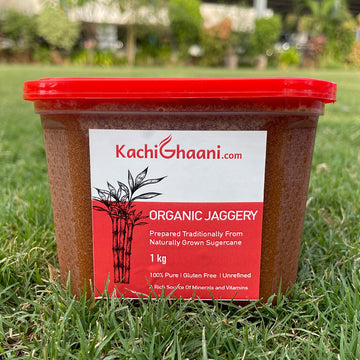
Our jaggery is made the way this whole family is made: cane juice reduced in open pans in small batches, with no sulphur, soda, bleach or chemical clarifiers. Use it gram for gram wherever a recipe asks for piloncillo, panela or rapadura, and taste as you go, since every open-pan batch is a little different.
The bottom line
Piloncillo, panela, rapadura, chancaca and jaggery are one sugar wearing many names: cane juice boiled in open pans and set with its molasses. Swap them by weight and enjoy the deeper flavour, remembering that they are still sugar.
Frequently asked questions
Is rapadura the same as panela?
Yes, in practice. Rapadura is the Brazilian name for the same boiled-down cane juice that Colombians call panela. Outside Latin America, rapadura sugar is often sold granulated, which is simply the dried syrup ground into grains instead of set in blocks.
What is aguapanela?
Aguapanela, or agua de panela, is a Colombian drink of panela dissolved in water. It is served hot on cool mornings and iced with lime on warm days; some families drop a piece of fresh cheese into the hot cup. Jaggery works the same way.
Is piloncillo the same as brown sugar?
No. Most brown sugar is refined white sugar with a measured amount of molasses added back for colour and flavour. Piloncillo is the whole cane juice boiled down, so its molasses was never taken out. It tastes deeper and less uniform, and it comes as a solid cone instead of loose grains.
Does piloncillo go bad?
Kept dry, piloncillo and jaggery last for many months. Their enemy is moisture: in a damp kitchen they turn sticky, and if they stay wet they can grow mould. Store them airtight in a cool cupboard, and throw away any piece that smells sour or shows fuzzy spots.
Is piloncillo better than sugar for people with diabetes?
Not really. Piloncillo, panela and jaggery are mostly sucrose and raise blood sugar much as white sugar does; their small mineral content does not change that. If you have diabetes, count them as sugar and ask your doctor or dietitian how much fits your plan.