Mohanthal
Deep honey brown, grainy under the teeth, the ghee and roasted besan reaching you a second before the sugar does. One square is never one square.

Ingredients
Serves 20
- 2 cups (250 g) coarse besan (ladoo besan, not fine besan)
- 3 tbsp Gir Cow's A2 Ghee, hot, for the dhabo
- 3 tbsp (45 ml) full fat milk, for the dhabo
- 1 cup (225 g) Gir Cow's A2 Ghee, for roasting
- 1/2 cup (100 g) mawa (khoya), crumbled, bought separately
- 1/4 cup (60 ml) full fat milk, to add while roasting
- 2 cups (400 g) sugar
- 1 cup (250 ml) water, for the syrup
- 1 tsp green cardamom powder
- A generous pinch of saffron, crushed into 1 tbsp warm milk
- 2 tbsp pistachios and almonds, slivered, to finish
Quantities are scaled up. Taste as you go and adjust the salt and spice.
Shop this recipe
Everything you need, from our press house
A Gujarati wedding, the sweets counter, and there is a tray of dark squares under a green cover of pistachio slivers. Mohanthal does not shine like barfi. It looks matte and dense, the colour of dark honey, and when you press a piece it gives slightly and then breaks with a soft grain. In the mouth it is not smooth at all. It is faintly sandy, the way properly roasted besan should be, and the ghee reaches you a full second before the sugar does.
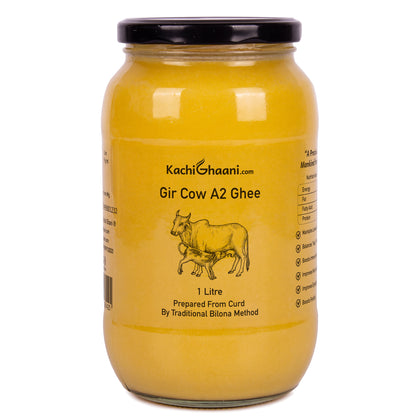
This is a sweet made almost entirely of ghee and besan, so there is nowhere for a poor fat to hide. Gir Cow's A2 Ghee carries the half hour of low roasting that mohanthal needs without ever catching, and the milk solids in it are exactly what turn the besan from yellow to that deep brown. It is made the bilona way from Gir cow milk in small batches, and you will smell it in the kitchen long before the barfi sets.
Colour decides mohanthal. The besan must go from pale yellow to the brown of an old copper vessel, and that takes twenty-five to thirty minutes on a low flame with the spoon never stopping. Pull it off early and the barfi tastes raw and stays pasty. Push it too far and it turns bitter. Watch for the moment the mixture loosens, stops clinging to the sides and starts to run off the spoon in a thick sheet. That is the moment.
How to make it
- Make the dhabo first. Put the besan in a wide plate, pour over 3 tbsp hot ghee and 3 tbsp milk, and rub it through with your fingertips for 3 to 4 minutes until it looks like damp breadcrumbs. Cover and rest 20 to 30 minutes.
- Push the rested besan through a coarse sieve, the kind with holes big enough for a mustard seed. What comes through is grainy and irregular, and that grain is the whole texture of mohanthal. Never use a fine flour sieve here.
- Grease a 20 cm square tray or a steel thali with ghee and keep it ready near the stove. Once the barfi is done you will have about a minute to pour.
- Heat 1 cup ghee in a heavy kadhai on low. Add the sieved besan and start stirring. Keep the flame low and the spoon moving, scraping the base and sides every few strokes. For the first 10 minutes nothing much happens.
- At around 15 minutes it will start to smell nutty and darken. Sprinkle in the 1/4 cup milk, a little at a time, standing back because it will bubble up hard. Keep roasting.
- At 25 to 30 minutes the besan will be the colour of dark honey, the ghee will look separated at the edges, and the mixture will loosen and fall off the spoon in a thick sheet. Add the mawa and roast 7 to 8 minutes more, breaking up any lumps. Take it off the heat.
- While the besan roasts, boil the sugar with 1 cup water on medium for 12 to 15 minutes to one-thread consistency. Test it: a cooled drop pulled between thumb and forefinger should draw one short thread before it snaps, around 110C. Stir in the cardamom and saffron milk.
- Pour the hot syrup into the warm besan in a steady stream, stirring the whole time. It will hiss and go loose and soupy. Put it back on low and stir for 4 to 6 minutes until it thickens, pulls away from the sides and leaves a clean trail behind the spoon.
- Pour into the greased tray at once, level the top with the back of a greased spoon, and scatter the slivered nuts. Press them in lightly.
- Cool at room temperature for 20 minutes, then mark into squares with a greased knife while it is still warm. Leave it 4 to 5 hours to set fully before you lift the pieces out. Do not refrigerate it to hurry it up, the grain goes hard.
Tips
- Use coarse besan. Ask for ladoo besan or magaj besan. Fine besan gives you a smooth, dense, halwa-like block, not the sandy grain that makes mohanthal what it is.
- The dhabo is not an optional step. That rest of 20 to 30 minutes lets the ghee and milk grip the flour so it sieves into grains. Skip it and you are just roasting loose besan.
- If the mohanthal will not set, the syrup was short of one thread. Scrape it back into the kadhai and cook on low, stirring, for another 3 to 4 minutes until it leaves the sides.
- If it set hard and crumbly, the syrup went past one thread. Next time take it off the flame a shade earlier, and remember syrup keeps cooking in a hot pan.
- Mawa is bought separately from a good sweet shop or made at home by reducing full fat milk. We do not sell it. You can leave it out and the mohanthal still works, it is simply a little less rich.
- Storage: keeps 8 to 10 days in an airtight box at room temperature. In the fridge it turns hard, so bring a piece back to room temperature before eating.