Which Oil for Vata, Pitta and Kapha — an Ayurvedic Massage Oil Guide
Sesame and ghee for Vata, coconut and groundnut for Pitta, mustard for Kapha - plus the simpler seasonal rule, and how to do abhyanga step by step. Shared as tradition, not medical advice.

Everything below describes Ayurvedic tradition and long-standing Indian household practice. It is shared as tradition and as practical guidance for cooking and massage. It is not medical advice, and nothing here claims that any oil prevents, treats or cures any condition.
Ayurveda does not classify oils the way a nutrition label does. It has no interest in grams of monounsaturated fat. It sorts them by what they are held to do in the body — warming or cooling, heavy or light, drying or unctuous — and then matches those qualities against the person, the season and the complaint.
You do not have to believe the framework to find it useful. Underneath the Sanskrit it is a fairly sensible system for choosing an oil by weather and by skin, and it has been road-tested in Indian homes for a very long time.
Why oil sits at the centre of it
The Sanskrit word for oil is sneha. It is the same word the language uses for love and affection. That is not a coincidence and it tells you how the tradition regards the stuff.
Oil appears in the classical daily routine more often than almost anything else: abhyanga, the self-massage before a bath; gandusha and kavala, the two forms of oil pulling; nasya through the nostrils; karna purana in the ears; the tadka that carries spice into food; and the lamp in the puja room.
One condition runs through all of it: the oil should be as close to the seed as possible. An oil that has been through bleaching earth and a deodorising column at 200°C is not the substance the texts were describing, whatever the seed on the label.
The three doshas, briefly and honestly
Vata — air and space. Described as dry, cold, light, mobile, irregular. Associated with dry skin, cold hands, restlessness, and with winter.
Pitta — fire and water. Described as hot, sharp, intense, oily. Associated with heat, sensitivity, inflammation, and with summer.
Kapha — earth and water. Described as heavy, slow, cool, oily, stable. Associated with congestion, sluggishness, and with the damp end of winter and early spring.
Most people are a mix, most people shift with the season, and self-assessment is unreliable. Our two-minute dosha quiz is a starting point rather than a diagnosis, and if you would rather skip the whole question, the seasonal rule further down works perfectly well on its own.
Which oil for which dosha
For Vata — warming, heavy, deeply unctuous.
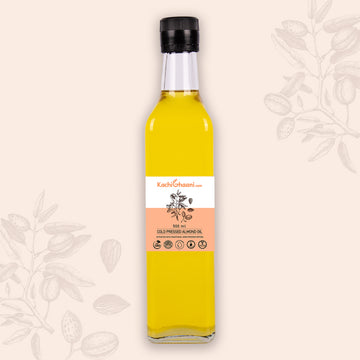
Black sesame is the classical answer and the most-named oil in the abhyanga literature. It is warming, it is heavy enough to stay where you put it, and it suits dry skin in cold weather better than anything else we press. A2 Gir cow ghee is held highest of all the snehas in the texts, for internal use. Almond is the lighter alternative for anyone who finds sesame too heavy or too aromatic.
For Pitta — cooling, sweet, calming.
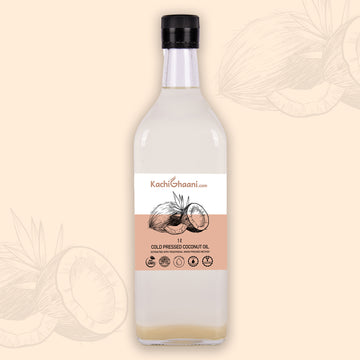
Coconut is the classical cooling oil and the reason coastal and summer practice reaches for it. Groundnut is traditionally regarded as roughly Pitta-neutral, which makes it the safe everyday cooking choice when heat is the concern. Almond again works for anyone who wants something mild and unaggressive on sensitive skin.
For Kapha — light, warming, stimulating.
Black mustard is the pungent, warming, classically Kapha-pacifying oil, and the North Indian winter malish is built on it. Yellow mustard does the same job with the edge taken off. Sesame appears here too, used more sparingly than for Vata.
The seasonal rule, which is easier and works just as well
If the dosha framework is not for you, the tradition has a simpler instruction called ritucharya — routine by season. It is the version most Indian households actually follow, whether or not they would name it.
Warming oils in the cold months. Cooling oils in the hot months.
Sesame and mustard in winter. Coconut in summer. Almond most of the year, because it is light enough not to matter much either way. That is the entire rule, and it is why your grandmother switched bottles in October without consulting a single text.
How to actually do abhyanga
Abhyanga is not a spa treatment. It is roughly ten minutes before a bath, and the method matters as much as the oil.
- Warm the oil. Stand the bottle in a bowl of hot water for a minute or two. Never on a direct flame and never in a microwave. Warm oil spreads; cold oil drags.
- Start at the scalp if you are doing a full abhyanga, and work down. Fingertips, not nails, in slow circles.
- Long strokes along the limbs, circles at the joints. The rule in the texts is straight lines over the long bones and circular motion wherever a joint turns.
- Circular over the belly, clockwise, lightly.
- The feet last and longest. This is the part everyone skips and the part practitioners insist on. Sesame into the soles, a few minutes each.
- Sit for ten to fifteen minutes before bathing, so the oil has time on the skin.
- Bathe in warm water, not hot, and go easy on the soap or you undo the whole thing.
Two to three tablespoons is plenty for a full body. Daily is the classical instruction; two or three times a week is what most people manage, and that is not a failure.
What to look for in an ayurvedic massage oil
Most bottles sold as ayurvedic massage oil are a base oil with something added — a fragrance, a preservative, occasionally mineral oil doing the bulk of the work while the named herb appears far down the list.
The tradition specifies a plain, unrefined oil. So:
- One ingredient on the label. Sesame oil. Coconut oil. Then nothing.
- No mineral oil, no paraffinum liquidum, no fragrance. Mineral oil sits on the skin rather than sinking in, which is the opposite of what abhyanga is for.
- Food-grade. If you would not eat it, the tradition would not have put it on you. Every oil in our body massage range is the same bottle we sell for the kitchen.
- Unrefined and cold pressed, for the reason in the section above.
- A short shelf life, four to six months, which tells you nothing was added to extend it.
An honest closing note
The dosha system is a classificatory tradition, not a clinical one, and we are an oil press rather than a vaidya. What we can tell you with confidence is which of our oils is warming and which is cooling, which is heavy and which is light, and how each behaves on skin — because those are properties of the oil and we press it ourselves.
What the tradition holds about balance and constitution we pass on as tradition, because it is genuinely interesting and it has shaped how Indian kitchens choose oil for centuries. It is not a substitute for a doctor, and a persistent skin or joint complaint deserves one.
The short version: sesame and A2 ghee for Vata, coconut and groundnut for Pitta, mustard for Kapha — or, if you would rather not think about it, warming oils in winter and cooling oils in summer. Whichever you choose, the tradition asks for a plain unrefined single-ingredient oil with nothing added, warmed before it goes on, worked in for ten minutes, feet last.
Every oil in our range is cold pressed slow in a wooden ghaani, unfragranced, food-grade and single-ingredient — no mineral oil, no carrier blend, no perfume. Lab-tested batch by batch, FSSAI licence 10724999001232. Patch-test any new oil before a full massage.