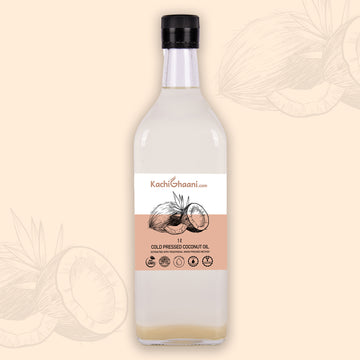
Cold Pressed Coconut Oil: How It Differs from Virgin, and How to Use It
Cold pressed coconut oil explained - how it differs from virgin, what it does for hair, why it sets solid in winter, and how to spot a good bottle.

Coconut oil is the one oil almost every Indian household already owns, and the one almost nobody buys carefully. It sits in the bathroom for hair, in the kitchen for thoran, and in the puja room for the lamp, and most people could not tell you which of the four bottles on the shop shelf they actually picked up.
The label vocabulary does not help. Cold pressed, wood pressed, virgin, extra virgin, pure, 100% pure, RBD, refined. Some of those terms mean something specific. Some mean nothing at all. Here is what each one actually describes, what we make and what we do not, and how to use the stuff once you have chosen.
What cold pressed coconut oil is
Cold pressed coconut oil is pressed from dried coconut kernel — copra — without heat and without solvent. The kernel is dried, broken and crushed slowly, and the oil that comes out is filtered and bottled. That is the whole process. One ingredient, no bleaching earth, no deodorising column.
Ours is pressed in a wooden ghaani, which is the slow version of the same idea: a wooden pestle turning in a wooden mortar, crushing rather than extruding. The mechanical point of pressing slowly is that the seed does not heat up on the way through, so the aromatic compounds survive the trip. That is why an unrefined coconut oil smells like coconut and a refined one smells like nothing.
Wood pressed and cold pressed are used interchangeably in the Indian market and, for our oil, they describe the same bottle. Neither term is legally defined in a way you could take to court, which is why the rest of this article is about what to check instead of what to read.
Cold pressed and virgin are not the same oil — and we only make one of them
This is the distinction that costs people the most money, so it goes near the top.
Cold pressed coconut oil starts from dried kernel. Copra is sun- or air-dried, then pressed. The drying is what gives the oil its slightly deeper, toastier aroma.
Virgin coconut oil starts from fresh kernel or coconut milk. It is a wet process — the milk is separated by fermentation, centrifuge or gentle heat, and the oil is drawn off. It smells milkier and lighter, closer to a fresh coconut than a roasted one.
We do not make virgin coconut oil. We press copra. We say so on the product page and we are saying it here, because a large number of Indian brands print "cold pressed virgin coconut oil" on the same bottle, and those two things describe two different processes that cannot both have happened to the same oil.
Which is better? Neither, really. Virgin is milder and is often preferred for the face and for anyone who finds the toasted note too strong. Cold pressed copra oil has more aroma, which is exactly what you want in a Kerala kitchen. They cost roughly the same to make. The gap between either of them and a refined oil is enormous; the gap between the two of them is a matter of taste.
"Extra virgin" applied to coconut oil is marketing. Unlike olive oil, coconut oil has no graded standard behind the phrase. There is virgin and there is not.
The comparison that actually matters: unrefined versus refined
Most coconut oil sold in India is RBD — refined, bleached, deodorised. Copra of variable quality is pressed or solvent-extracted, then neutralised with alkali, passed through bleaching earth, and steam-stripped at around 200°C to remove smell and taste.
The result is a pale, odourless, cheap oil with a higher smoke point and a long shelf life. It is safe, legal, and perfectly sensible for a deep fryer. It is also, by design, no longer the thing you were picturing when you thought about coconut oil.
The honest summary: if the bottle has no smell, refining removed it. That is not a scandal. It is just information, and it should be reflected in the price you pay.
Cooking with it
Unrefined coconut oil has a smoke point of about 177°C (350°F). In practice that means sautéing, tempering, shallow frying and baking — comfortably — and it means keeping it out of a hard deep fry, where oil sits well above that for a sustained period. For a full kadhai, mustard is the better choice; there is a fuller breakdown in our Rasoi Chart.
Where it earns its place is anywhere the coconut is meant to be tasted. A Kerala thoran made in refined oil is a different dish. Same with a coastal fish curry, an avial, a Sri Lankan tempering of curry leaves and shallots. The oil is not a neutral medium in that cooking; it is one of the flavours.
It also bakes well, and it is a straightforward swap for butter in a cake or a cookie if you want the coconut note to come through.
Hair — the one use with real published evidence behind it
Coconut oil is unusual among cooking oils in that there is actual laboratory work on what it does to hair, rather than only tradition.
Roughly half its fat is lauric acid, a medium-chain fatty acid with a straight molecular structure and a low molecular weight. A widely cited study published in the Journal of Cosmetic Science in 2003 compared coconut, sunflower and mineral oils on hair and found coconut oil reduced protein loss in both damaged and undamaged hair, where the other two did not — the authors attributed this to lauric acid's affinity for hair protein and its ability to penetrate the shaft rather than sit on top of it.
That is a structural finding about hair fibre, not a hair-growth claim, and it is worth keeping the two apart. Coconut oil does not make hair grow. What the evidence supports is that it holds protein in the fibre better than most oils, which shows up as less breakage and hair that keeps the length it grows.
How to use it: warm two or three tablespoons, work it into the scalp with fingertips in slow circles, run the rest down the length, and leave it on for at least half an hour — overnight if you can be bothered with the pillowcase. Then shampoo. This is champi, and the method matters as much as the oil. If you want a comparison against the other classical head-massage oil, we wrote one: coconut versus sesame for hair.
Skin, and an honest warning about the face
On the body, coconut oil is a good, cheap, single-ingredient emollient, and it is the standard baby malish oil across coastal India for sound reasons — it is mild, it is food-grade, and there is nothing in it to react to.
On the face, be careful. Coconut oil rates around 4 out of 5 on the comedogenic scale, meaning it is among the more pore-clogging oils in common use. Plenty of people use it on their face happily. Plenty of others break out within a week and never connect it to the bottle. If your skin is oily or acne-prone, almond oil is the safer choice, and we would rather tell you that than sell you the wrong bottle.
Patch-test anything new on the inside of your forearm for a day or two before it goes near your face.
Oil pulling
Coconut is the most popular modern choice for gandusha and kavala, largely because it tastes pleasant and solidifies less objectionably than people expect. The classical texts name sesame first — black sesame in particular — and if you are following the tradition rather than the internet, that is the one to use.
Either way the method is the same: a tablespoon, swished for ten to fifteen minutes, spat into a bin rather than the sink, because oil sets in a drain. We have written the full step-by-step, and a comparison of which oil to use.
Why it goes solid, and why that is good news
This is the single most common thing customers write to us about, so: coconut oil sets solid below about 24°C. Nothing is wrong with it.
Coconut oil is unusually high in saturated fat, which is why its melting point sits close to Indian room temperature. In Kerala in June it is liquid. In Delhi in January it is a white block. In Bangalore it will do both in the same week.
To use it, stand the bottle in warm water for a few minutes, or scoop the solid oil straight into a hot pan, where it melts on contact. Do not microwave it, and do not put a wet spoon in the jar.
The useful part: this behaviour is a purity tell. A coconut oil that stays liquid at 18°C has almost certainly been blended with something cheaper, or it is fractionated coconut oil, which is a different product sold for a different purpose. A bottle that goes stubbornly solid in winter is behaving exactly as pure coconut oil should.
How to buy a bottle worth the money
Ignore the front of the label. Check these instead.
- One ingredient. Coconut oil. If there is a second line, put it back.
- It smells of coconut. Open it if you can. An unrefined oil announces itself; a refined one is silent.
- A short shelf life. Four to six months tells you nothing was added to extend it. A twelve-month coconut oil has been helped.
- A batch number, and a lab report you can actually open. This is the only document that describes the oil in your hand rather than the factory it came from.
- It sets in winter. As above.
- Per-litre price, not per-bottle. Pack sizes across brands are deliberately uneven.
And keep it capped, out of direct sunlight, at room temperature. Coconut oil is more oxidation-resistant than most oils because of that saturated fat, so it is forgiving — but it is not immortal, and a bottle you bought in bulk eleven months ago will taste of it.
The short version: cold pressed coconut oil is pressed from dried copra without heat or solvent; virgin coconut oil is a different process starting from fresh kernel, and we do not make it. Either is a world away from refined RBD oil, which has had its smell removed on purpose. Cook with it up to about 177°C, use it on hair where it has real evidence behind it, be cautious with it on an acne-prone face, and do not worry when it goes solid in winter — that is the oil telling you it is what it says it is.
Our cold pressed coconut oil is pressed from dried coconut kernel in a slow wooden ghaani — one ingredient, unrefined, unbleached, undeodorised, with a four-to-six-month shelf life because there is no preservative in it. Batch-numbered and lab-tested, FSSAI licence 10724999001232. Available from 200 ml to 5 L, and in our five-oil trial pack if you want to smell it before committing to a litre. See the full range.
Traditional-use references describe long-standing practice, not medical advice. Patch-test before first use on skin.