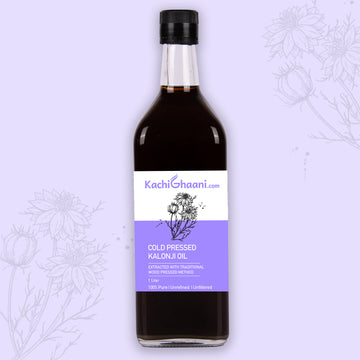
Kalonji oil with honey: the tradition, and who should not take it
An old household practice, described as tradition rather than treatment — and a plain list of who should not take it, including the absolute honey rule for infants.

Our own product page carries one line that has been there a long time: "half a teaspoon stirred into warm honey, the way it is most often taken at home." It is an accurate description of a real practice. It is also a line that has been sitting there without a single page behind it explaining what the practice is, where it comes from, and who genuinely should not do it.
This is that page. It is deliberately more careful than most of what you will find on the subject, and the most important section is not the method — it is the list of people who should leave this alone.
What the practice is
Taking kalonji with honey is old and it is widespread. In the Unani tradition and in the body of practice known as prophetic medicine, the black seed — habbat al-barakah, habbatus sauda — has a settled and respected place, and honey is its usual companion. Across South Asia and the Middle East it is a household routine passed down in families, usually taken in the morning, usually a small spoon, usually with a glass of warm water afterwards.
In India you will also meet it through Ayurvedic and Unani practitioners, where kalonji is read as balancing for Kapha and Vata. We share all of this as tradition, because that is what it is. It is a cultural practice with centuries behind it, and it does not need a health claim attached to be worth describing accurately.
What we are not saying
Let us be plain about the boundary, because almost every other page selling this oil crosses it.
We make no claim of any kind that kalonji oil with honey treats, prevents, cures or improves any condition. Not immunity. Not blood sugar. Not weight. Not blood pressure. Not digestion. Not anything else.
The research on thymoquinone, the compound behind the interest in this seed, is real and it is worth following — but it is overwhelmingly laboratory and animal work. The human trials are few, small and mixed, and reviews that have examined areas such as body weight and blood pressure say so explicitly, reporting conflicting results and cautioning about study quality. There is also a plain pharmacological problem: thymoquinone is poorly absorbed when swallowed. A spoon of oil is not a dose of anything.
So: a tradition, described honestly. Not a treatment, and not a supplement we are recommending you start.
How the practice is done
Described, not prescribed — and only for an adult with none of the reasons below to avoid it.
- A teaspoon of honey is warmed gently — stood in warm water, not heated on a flame, and never boiling.
- A quarter to half a teaspoon of kalonji oil is stirred into it until the two combine.
- It is taken in the morning, usually before food, and followed with warm water.
- Most households start with a smaller amount than they intend to settle on, because the taste is sharp and bitter and it catches people out.
We do not recommend a daily quantity, and you should be suspicious of any seller who does. If you want a reason to keep the amount small beyond taste: honey is sugar, and a spoon of oil is fat. Neither belongs in a routine in large quantities.
Who should not take it
This is the section that matters. If any of these applies to you, do not start — or speak to your doctor first.
- Any child under one year old — never honey, under any circumstances. Honey can carry the spores of a bacterium that an infant's gut is not yet able to handle, and infant botulism is a serious illness. This is not a precaution to weigh up; it is a hard line, and it applies to raw honey, processed honey, cooked honey and honey stirred into anything at all. Under twelve months, no honey.
- Pregnancy. Black seed in amounts beyond ordinary food use is reported to affect uterine contraction and is generally advised against in pregnancy.
- Breastfeeding. There is not enough information to say it is safe, so the sensible course is to avoid it.
- Anyone on blood thinners or anticoagulants. Black seed is reported to slow blood clotting, which can add to what the medicine is already doing.
- Anyone on diabetes medication. It is reported to lower blood sugar, which can push it lower than intended. And separately: honey is sugar.
- Anyone on blood pressure medication. Same logic — an added effect on top of a medicine that is already managing the number.
- Anyone on sedatives or medicines that cause drowsiness. Increased sleepiness has been reported.
- Anyone with surgery coming up. Standard advice is to stop black seed at least two weeks beforehand, because of the effects on clotting, blood sugar and sedation.
- Anyone with a known allergy to nigella or to plants in the buttercup family.
- Anyone taking regular prescription medication of any kind. See the next section.
The medicine interaction most pages leave out
Beyond the specific medicines above, there is a general point worth understanding. The liver processes most medicines using a family of enzymes, and black seed has been reported to affect how those enzymes work. When that happens, a medicine can end up more concentrated or less effective than the dose was meant to deliver — and you would have no way of knowing.
This is why "ask your doctor" is not a legal formality on this page. If you take anything regularly — thyroid medication, blood pressure tablets, anything for the heart, anything psychiatric, anything at all — that conversation should happen before you start, not after.
Reported side effects
Even in people with none of the above, the commonly reported effects of taking black seed by mouth are nausea, stomach upset, indigestion, a burning sensation and, less often, constipation or vomiting. Allergic rashes have been reported. Safety information generally extends only to a few months of use; nobody has good data on taking it for years.
If anything unusual happens after you start, stop and see a doctor. Do not push through it.
What this will not do
- It will not treat, prevent or cure any illness. That is the beginning and the end of it.
- It will not replace medication. Never stop or reduce a prescribed medicine because you have started a traditional practice.
- It will not do more if you take more. A larger spoon is not a stronger version. It is more sugar, more fat and a higher chance of an upset stomach.
- It is not for children. The honey rule below one year is absolute, and above one year this is still an adult practice we would not put in a child's routine.
If you have read all of that and it still appeals to you as a tradition you want to keep, that is entirely reasonable — it is a very old one. Take it as tradition, keep the quantity small, and check with your doctor if you take anything regularly. The oil itself is described properly in kalonji oil: what it actually is, and how to use it, and the question of which of our oils are food at all is answered in can you eat almond oil, kalonji oil and til oil.