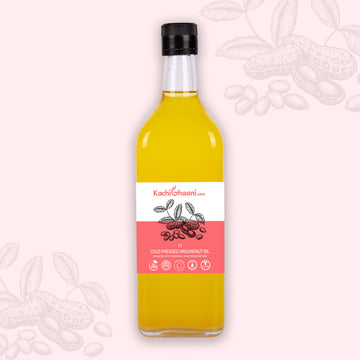
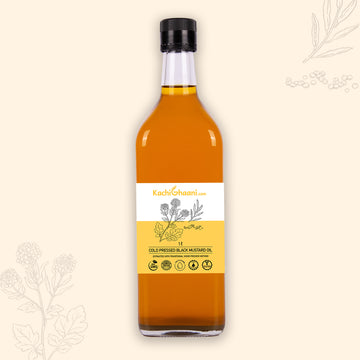
Myth vs fact: does cold pressed oil go bad too fast?

“I’d love to switch, but doesn’t cold pressed oil spoil quickly?” We hear this weekly, and the fear is understandable: our bottles say 4–6 months where the supermarket bottle says 18. So let us take the objection seriously, concede what is true in it, and then do the arithmetic that dissolves it.
Is it true that cold pressed oil has a shorter shelf life?
Yes — completely true, and we will not pretend otherwise. A refined oil is engineered to sit still: neutralised, bleached and deodorised at industrial temperatures until almost nothing reactive — or interesting — remains, which is why it can wait 12–18 months in a warehouse without complaint. Our oils are pressed slowly in a wooden ghani and bottled, and that is the whole process. Nothing added, nothing stripped. A 4–6 month life is the natural consequence, and we print it plainly rather than apologising for it.
The myth is not in the number. The myth is in the word “too” — the assumption that 4–6 months is a problem for a working kitchen. It almost never is, and here is why.
How long does a bottle actually last in a real kitchen?
Do the maths your own kitchen already knows. An Indian household cooking two meals a day uses somewhere between 15 and 30 litres of oil and ghee a year — call it a litre every three to five weeks for a family of four. Now put that against the window:
- A 1-litre bottle in daily use is empty in about a month. It never meets month four.
- Even a 5-litre pack feeding a full family kitchen is done in two to three months — comfortably inside the window, with margin to spare.
- The bottle that genuinely struggles is the hoarded one — the specialty oil bought on enthusiasm, used twice, and rediscovered during Diwali cleaning. That bottle expires in every brand and every category; ours is just honest about when.
In other words: the shelf life is shorter than refined oil’s, but it is longer than your kitchen’s appetite. The constraint only bites when a bottle is bought and then not used — which is a buying-size problem, not an oil problem.
So how should you buy to stay inside the window?
- Match the bottle to the burn rate. Everyday oils (groundnut, mustard, sesame, coconut) can be bought big — you will finish them. Finishing and specialty oils (flaxseed, kalonji, almond) should be bought small — a teaspoon-a-day bottle does not need to be a litre.
- Start with a sampler if you are new. Our trial pack of five oils exists precisely so you can find which oils your kitchen actually reaches for, before committing to full bottles of all of them.
- Store them properly — it is genuinely easy. Cool cupboard, cap closed, away from the stove’s heat and the window’s light. The full routine (and why cloudiness is normal, not spoilage) is in our storage guide.
- Trust your nose over the label. A fresh oil smells like its seed. An oil past its best smells flat, waxy or like old paint — unmistakable once met. The date on our label is guidance; your nose is the referee.
Why not just add a preservative and end the conversation?
Because the short shelf life and the reasons you buy this oil are the same fact wearing two expressions. The aroma of real mustard oil, the nuttiness of fresh groundnut, the character a wooden ghani leaves in the bottle — these exist because the oil is alive with its own seed, unprocessed and unstandardised. We press in small batches rather than warehousing pallets, and that choice shapes our price as well as our dates. An oil built to last two years in storage has to give up the things that make it worth buying in the first place. We chose the other trade.
Verdict
Myth — with an honest kernel. Yes, 4–6 months is shorter than refined oil’s warehouse life. No, it is not “too fast” for any kitchen that cooks: a family bottle is finished in weeks, not seasons. Buy the size you will finish, keep it cool and closed, and the expiry date will spend its whole life being ignored.