Myth vs fact: does hot food destroy everything good in cold pressed oil?

A question lands in our inbox every week, phrased a dozen ways: if the oil is going into a hot kadhai anyway, doesn't the cooking undo everything cold pressing preserved? It is a fair question, and the internet answers it badly in both directions — one camp says heat ruins everything, the other says heat changes nothing. The truth sits in the middle, it has numbers attached, and it decides which bottle belongs next to your stove.
What actually happens when you heat an oil?
Below its smoke point, an oil stays an oil. The fat holds together, traces of moisture cook off, and the aroma compounds soften and spread into the food — that is the job. At and past the smoke point, the picture changes: the fat itself starts to break down, the smell turns acrid, and the flavour goes sharp and bitter. The smoke point is the line between cooking with an oil and destroying it, which is why we published the measured smoke points of every oil we press rather than the flattering refined figures that circulate online.
Scale matters too. A tadka is thirty seconds; a deep fry is twenty minutes at 175°C to 190°C. The same oil has a very different afternoon in each.
Myth: cooking destroys everything good in a cold pressed oil
Fact: heat spends the delicate parts gradually — it does not undo the oil.
The core of an oil is its fatty-acid composition, and that composition does not evaporate at cooking temperatures below the smoke point. A MUFA-dominant oil is still MUFA-dominant after your sabzi. What heat does spend, gradually and with time, is the delicate top layer: part of the aroma, and some of the more fragile minor compounds that an unrefined oil carries in from the seed. A brief tadka spends a little of that. A long, roaring fry spends more — in any oil, refined or not.
So the myth has a true core: the gentler your cooking, the more of the seed's character survives to the plate. Where it collapses is the conclusion. Cooking below the smoke point does not turn a cold pressed oil into anything else. It just cooks with it.
Myth: once heated, refined and cold pressed oil are the same anyway
Fact: the difference between them was decided at the factory, before either bottle reached you.
Refining is solvent extraction with hexane, a wash with bleaching earth, and deodorisation at around 200°C — a process that strips colour, aroma, sediment and character to produce a neutral, uniform fat. Cold pressing skips all of it: seed, pressure, bottle. Your kadhai cannot reverse either history. Ten minutes of cooking will not put the seed back into a refined oil, and it will not take the seed out of ours — a baingan bharta made in mustard oil tastes of mustard from the first bite, and that is the difference surviving the flame in plain sight. Our oil comparison page lays the whole family out side by side.
Which oils should never see the flame at all?
This is where the myth flips into being right — for specific bottles. Some oils are so dominated by delicate polyunsaturated fat that heat genuinely is their enemy, and we label them accordingly:
| Oil | Limit | Honest use |
|---|---|---|
| Flaxseed | about 107°C / 225°F — never heat | Cold drizzle only: dal, salads, smoothies |
| Safflower (kardai) | about 107°C / 225°F | Raw use and the lowest flame, briefly |
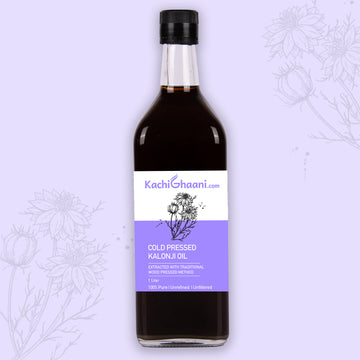
| Kalonji | Raw only | Drizzles and the hair ritual |
| Almond | Not a cooking oil | Raw use, and the badam rogan malish |
Handle Truly Cold Pressed flaxseed oil like fresh coriander, not like ghee: it goes on after the flame is off, full stop. At the other end of the shelf, mustard oil and ghee at 250°C, sesame at 177°C and groundnut at about 180°C are cooking oils and are meant to be cooked with — inside their numbers.
When does raw use matter most?
Whenever aroma is the point of the exercise. A koshimbir dressed in kardai oil, flaxseed over warm dal after the flame is off, a thread of sesame oil on curd rice, kalonji oil worked into a chutney — these are the places where every fragile thing the wooden ghani preserved arrives at the table intact. If you buy one bottle specifically to use raw, you will taste the case for cold pressing more clearly there than in any fry.
What about oil that has already been through a fry?
Reuse is where heat genuinely does spend an oil, and no pressing method changes that. If you must reuse a frying oil, the house rules are strict: strain it while still warm, keep it in a closed bottle away from light, use it once or twice more at most, and never top fresh oil into old — the used oil drags the new one down with it. Discard it the day it darkens, thickens or smells sharp when cold. Our oils carry a 4 to 6 month shelf life when they have never seen a flame; oil that has been through a fryer has considerably less, whoever pressed it.
The honest bottom line
Cold pressed oil is not fragile below its smoke point — it is simply honest about where that point is. Cook with the cooking oils, inside their numbers. Keep the raw-use oils raw. And distrust both halves of the internet on this one: the half that says a tadka destroys an oil, and the half that quotes a refined smoke point to sell you an unrefined bottle. The first is fear, the second is borrowing — and a kitchen runs better on neither.