How to make rosemary oil for hair at home, and which base oil
How to make rosemary oil at home, step by step: the warm and cold methods, how to pick a base oil for your hair, how long it keeps, and an honest look at the one study everyone quotes.

Here is how to make rosemary oil for hair at home: cover dried rosemary with a base oil such as coconut, black sesame or almond, warm it very gently for an hour or two, or steep it in a dark cupboard for two weeks, then strain and bottle it. Use dried sprigs, not fresh, and finish the oil within a month.
Rosemary oil is one of the most talked-about hair rituals in the world, thanks largely to one small study and a lot of social media. A homemade infusion is easy and pleasant to use, but it is not the same as the rosemary oil product used in research. Here is how to make it well, which base oil to choose, and what the evidence really says.
At a glance
- Use dried rosemary. Fresh sprigs carry water, and water in oil invites mould.
- Warm method: 1 to 2 hours of gentle heat. Cold method: 2 to 4 weeks in a dark cupboard.
- Base oil: coconut for a pre-wash, black sesame for a traditional scalp oil, almond for fine hair, castor only as a small share.
- Strain well, bottle in dark glass, write the date on it and use it within about a month.
- The famous 2015 study was a single six-month trial in 100 men, and it did not use a kitchen infusion.
How to make rosemary oil for hair: two easy methods
You need dried rosemary, a base oil, a clean and completely dry glass jar, and a fine strainer or muslin cloth. Use about 3 tablespoons of dried rosemary leaves for every 100 ml (a little under half a cup) of oil.
Warm method, ready in an afternoon
- Put the dried rosemary in a dry, heatproof glass jar.
- Pour in the oil until it covers the herbs by about 2.5 cm (an inch).
- Stand the jar in a pan of hot water over the lowest heat, like a double boiler. The oil should feel warm and must never bubble or smoke.
- Keep it gently warm for 1 to 2 hours, stirring now and then with a dry spoon.
- Let it cool, then strain it through muslin into a dark glass bottle, squeezing the cloth to get the last of the oil.
- Write the date on the bottle.
Cold method, slower and gentler
- Fill a dry jar with dried rosemary and oil in the same proportion.
- Close it and leave it in a warm, dark cupboard for 2 to 4 weeks, shaking it gently every day or two.
- Strain, bottle and date it as above.
Skip the sunny windowsill that many videos suggest. Light and heat make oil go stale faster, which is why oil is best stored away from both.
Should fresh or dried rosemary be used to infuse oil?
Dried. Fresh rosemary holds water, and water trapped under oil is where mould and bacteria grow.
Food-safety specialists at the University of Georgia note that even small pockets of moisture can let bacteria survive in infused oils, and that home-infused cooking oils made without an acidifying step must be kept in the fridge and thrown out after four days. Your hair oil is not food, so the main worries are mould and rancidity, but the lesson is the same: keep water out. If you grow your own rosemary, hang the sprigs in an airy, shaded spot for a week or two until the leaves snap, then strip them from the stems.
Which oil is best to mix with rosemary for hair?
The one that suits your hair, and that you will wash out properly. Here is a simple guide.
| Your hair and goal | Base oil | Why | How to use |
|---|---|---|---|
| Thick, dry or frizzy hair; oiling before a wash | Coconut (from copra) | The traditional pre-wash oil of South India and Sri Lanka; light once melted | Melt it in warm water if it has set; leave on 1 to 2 hours, then wash |
| A traditional Indian scalp massage | Black sesame | Sesame oil is the classic base of Ayurvedic head oils | Warm slightly and massage the scalp for 5 minutes |
| Fine or thin hair | Almond | Smooth and mild; many people find it less heavy than coconut or castor | Use a little, on the scalp only |
| Extra body in a blend | Castor | Very thick; best as 1 part to 4 parts of another oil | Never alone; it is hard to wash out |
The massage is the pleasant part, and our step-by-step guide to champi, the warm-oil head massage, shows how to do it. For a fuller comparison of base oils, see which oil for your hair.
Does rosemary oil really help hair grow?
There is a little evidence, but far less than social media suggests. The study everyone quotes is a 2015 trial published in the journal SKINmed.
In it, 100 men with androgenetic alopecia (male-pattern hair loss) used either a rosemary oil preparation or 2% minoxidil, a standard hair-loss medicine, for six months. At three months neither group had changed. At six months both had a higher hair count than at the start, with no significant difference between them, and scalp itching was more common with minoxidil. Read it with care:
- It was one trial with no placebo group, so natural ups and downs cannot be ruled out.
- It compared rosemary with the weaker 2% minoxidil, not the 5% strength many dermatologists recommend for men.
- Only men took part, and only one type of hair loss was studied.
- It tested a rosemary oil preparation, not a kitchen infusion like the one in this guide.
An independent drug-information monograph sums up the evidence as limited. Enjoy homemade rosemary oil as a scalp ritual, not a promise. If your hair is thinning, falling out in patches or shedding suddenly, see a dermatologist, because thyroid problems, low iron, stress and some medicines can all play a part.
Rosemary oil vs rosemary water: which should you use?
Use the oil for a pre-wash massage and rosemary water as a light rinse or spray; neither is proven better. Rosemary water is simply a strong tea: simmer a handful of sprigs in about 500 ml (2 cups) of water for 10 to 15 minutes, then cool and strain it. Because it is water-based, it spoils quickly, so keep it in the fridge and use it within a few days.
Is rosemary infused oil as strong as rosemary essential oil?
No. Rosemary essential oil is distilled and highly concentrated, while a kitchen infusion pulls only a small share of the plant's aroma into the oil. If you want a stronger blend, add rosemary essential oil to your base instead, starting with about 2 drops in 10 ml (roughly a 1% blend), and read the cautions below first.
Who should be careful with rosemary oil?
- Patch test any new oil behind your ear or on your inner forearm and wait 24 hours.
- Stop if your scalp itches, burns or breaks out. Skin allergy to rosemary has been reported.
- Rosemary essential oil is rich in camphor. People with epilepsy, and anyone pregnant, should avoid it unless their doctor agrees.
- Keep oil out of your eyes and off broken or inflamed skin.
- Do not use your hair oil in food. A rosemary oil for cooking needs the fridge and the four-day rule.
- Never leave warming oil unattended, and castor oil is for external use only.
Base oils from our range
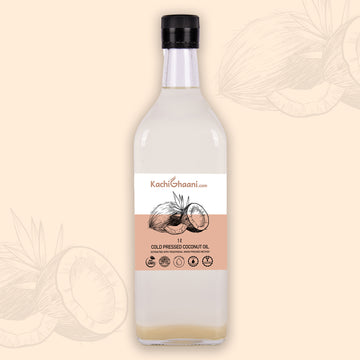
If you want a single-ingredient base, our Truly Cold Pressed coconut oil (pressed from dried copra), Truly Cold Pressed black sesame oil and Truly Cold Pressed almond oil are pressed slowly in wooden ghaanis and left unrefined, with nothing added. Unfiltered oils can show a little sediment or cloud in the cold; that is normal. They are best used within four to six months, so infuse only what you will use in a month.
The bottom line
Homemade rosemary oil is easy: dried rosemary, a base oil that suits your hair, gentle warmth, a good strain and a one-month rule. Enjoy it as a scalp ritual, and see a dermatologist for real hair loss, because one small trial is not proof.
Frequently asked questions
How long does homemade rosemary oil last?
Use it within about a month. Keep it in a dark glass bottle away from heat and light, and pour it out rather than dipping wet fingers in. Throw it away if you see fuzzy spots or slime, or if it smells sour or like old paint.
Can I leave rosemary oil in my hair overnight?
You can if your scalp tolerates it, but there is no evidence that overnight works better than an hour or two. Cover your pillow with an old towel and stop if you notice itching, bumps or flakes. Our guide to washing hair oil out without stripping your hair helps the next morning.
How often should I use rosemary oil on my hair?
Once or twice a week before washing is plenty for most people. There is no evidence that daily use helps more. Oils from hair products can also cause small breakouts along the hairline and forehead, so if you are prone to acne, use less and keep the oil off your face.
Why did my homemade rosemary oil turn cloudy?
If it clouds in the cold and clears when warmed, the oil is simply thickening; coconut oil sets solid below about 24°C (75°F). If it stays cloudy when warm, smells sour or grows fuzzy spots, water has got in and the oil belongs in the bin.