Toasted sesame oil vs sesame oil: how Asia and India use each
Toasted sesame oil vs sesame oil: Korea and China finish dishes with the dark, toasted kind; Japan fries tempura in clear taihaku oil; India cooks with untoasted til oil. Here is which to use, and when.

Toasted sesame oil vs sesame oil comes down to one step: roasting. Toasted sesame oil is pressed from roasted seeds; it is dark brown, smells strongly of nuts and is used a few drops at a time to finish food in Korea, China and Japan. Plain, untoasted sesame oil, like India's til or gingelly oil, is pressed from raw seeds. It is pale gold and mild, and it is meant for cooking.
Mix them up and a dish goes wrong in a quiet way. Untoasted oil makes bibimbap taste flat; toasted oil in a long tadka can turn bitter. Many recipes simply say "sesame oil", and a Korean cook and a Tamil cook mean two different bottles.
At a glance
- Toasted sesame oil is a seasoning. Korea's chamgireum, China's xiang you and Japan's goma abura are all made from roasted seeds.
- Untoasted sesame oil is a cooking oil. India's til and gingelly oils and Japan's clear taihaku oil are pressed from raw seeds.
- Toasting changes colour and aroma, not the basic fat: both are roughly two-fifths monounsaturated and two-fifths polyunsaturated fat.
- You can cook with toasted oil over gentle heat, but its aroma fades and it can turn bitter if pushed hard.
- Our sesame oils are untoasted, so they will not give a Korean or Chinese dish its roasted aroma.
Toasted sesame oil vs sesame oil: are they the same?
No. They come from the same seed, but one is roasted first and the other is not, and that single step changes almost everything about how they taste and how they are used.
For toasted oil, the seeds are roasted until golden brown before pressing. The heat browns the seeds the way it browns bread crust, which gives the oil its deep colour and roasted smell. For untoasted oil, the seeds are cleaned, dried and pressed raw. The oil comes out pale, with a soft, slightly nutty taste. Shops sometimes call the two "dark" and "light" sesame oil; "light" here means colour, not fewer calories.
| Toasted sesame oil | Untoasted sesame oil | |
|---|---|---|
| Seeds | Roasted before pressing | Pressed raw |
| Colour | Amber to dark brown | Pale gold |
| Aroma | Strong, nutty, roasted | Mild, faintly nutty |
| Main job | Seasoning and finishing | Cooking, dressings, body oiling |
| Heat | Little or gentle | Everyday cooking; about 177°C (350°F) when unrefined |
| Common names | Chamgireum (Korea), xiang you or zhima you (China), goma abura (Japan), "dark" or "Asian" sesame oil | Til or gingelly oil (India), nallennai (Tamil), taihaku goma abura (Japan), "light" or "plain" sesame oil |
One more label tip: read the ingredients. Some bottles sold as sesame oil are blends with cheaper oils.
Why both keep fairly well
Sesame seeds carry their own natural antioxidants, called lignans, such as sesamin and sesamolin. Roasting turns part of the sesamolin into another antioxidant, sesamol, which is one reason a bottle of toasted oil holds its flavour for months. Both kinds still dislike light, heat and air.
What is Korean sesame oil, and how is it used?
Korean sesame oil, chamgireum, is toasted. It is added at the end, often off the heat, so its aroma stays bright.
- Namul: blanched spinach, bean sprouts or fern shoots, squeezed dry and dressed by hand with a little sesame oil, garlic, salt and toasted seeds.
- Bibimbap: a final spoonful of sesame oil goes in with the chilli paste before everything is mixed.
- Gim: sheets of laver seaweed brushed with sesame oil, salted and crisped over a flame.
- Dipping oil: sesame oil with salt and pepper, served with grilled pork.
Korea has a second roasted seed oil, deulgireum, pressed from perilla seeds. It tastes grassier and is used in much the same way.
How do China and Japan use sesame oil?
China: the fragrant oil
In Chinese kitchens, toasted sesame oil is called xiang you, "fragrant oil". The cooking itself is done in a neutral oil, and sesame oil goes in last: a few drops in a dumpling dip of black vinegar and soy sauce, a swirl over wonton soup, a little in cold dressed dishes of cucumber or noodles, and a splash in marinades.
Japan: one roasted, one clear
Japan uses both kinds. Roasted goma abura brings flavour to gyoza, ramen, stir-fried burdock and dressings. Taihaku goma abura, meaning "very white", is pressed from raw seeds. It is almost clear and mild, and Japanese cooks reach for it for tempura and for baking, where they want sesame's richness without the roasted smell. Some tempura cooks blend in a little roasted oil for aroma.
What is untoasted sesame oil used for in India?
In India, sesame oil is untoasted, and it is used generously for cooking, pickling and oiling the body. In Hindi it is til ka tel; in South India it is often called gingelly oil, and in Tamil nallennai, "good oil". Our guide to til, gingelly and sesame oil names lists the rest.
- Cooking: tempering mustard seeds and curry leaves for kuzhambu and poriyal, and a spoonful stirred into idli podi, the spiced lentil powder served with idli.
- Pickles: many South Indian pickles are made and topped with sesame oil, which helps keep air out.
- Body oiling: the oil bath on Deepavali morning in Tamil homes, and the daily self-massage of Ayurveda; see our guide to abhyanga at home.
- Oil pulling: black sesame oil is the oil the classical Ayurvedic texts name for gandusha and kavala, swishing oil in the mouth.
A toasted oil would overwhelm a tadka and would make no sense on the skin, which is why Indian homes never adopted it.
Can you cook with toasted sesame oil, or swap one for the other?
You can cook with toasted sesame oil over gentle heat, and you can swap the two for cooking, but not for flavour.
Cooking with toasted oil
Use it for a quick stir-fry on medium heat, for fried rice, or for Korean pancakes, ideally mixed with a neutral oil. Long, fierce heat drives off the aroma you paid for and can leave a bitter, burnt taste. It is not a deep-frying oil.
Using untoasted oil instead of toasted
For cooking with heat, untoasted oil works well. For finishing, it will not taste the same. To get closer, toast a spoonful of sesame seeds in a dry pan until golden, crush them lightly and stir them in with the oil.
Using toasted oil instead of untoasted
In a dressing, use a quarter of the amount and make up the rest with a mild oil. For a South Indian tadka or a massage, there is no good swap; use untoasted oil.
Quick guide: which sesame oil for which job
| Dish or use | Which oil |
|---|---|
| Bibimbap, namul, dumpling dips, wonton soup | Toasted, a few drops at the end |
| Fried rice, stir-fries | Untoasted or neutral oil to cook, toasted to finish |
| Tempura and baking | Clear, untoasted oil |
| Tadka for kuzhambu, sambar or poriyal | Untoasted (til or gingelly) |
| Idli podi, South Indian pickles | Untoasted |
| Salad dressing | Untoasted, with a few drops of toasted if you like it nutty |
| Abhyanga, oil bath, oil pulling | Untoasted; black sesame for oil pulling |
Who should be careful with sesame oil?
- Sesame allergy: sesame is a major food allergen in the US, UK, EU, Canada and Australia. Unrefined sesame oil can carry sesame protein, so anyone with a sesame allergy should avoid it, toasted or not.
- Skin use: patch-test a few drops on the inner arm a day before a full massage, and keep oil away from the eyes and broken skin.
- Freshness: keep bottles away from light and heat, and discard oil that smells like crayons or old paint, a sign it has gone rancid.
How to use our sesame oils
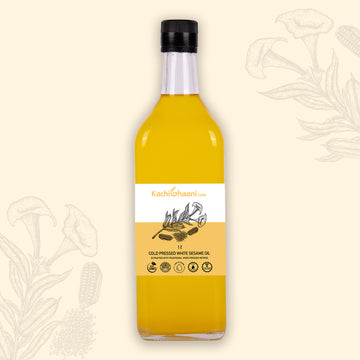
Both of ours are untoasted, so use them as cooking and body oils, not as finishing oils for Korean or Chinese food. Our Truly Cold Pressed white sesame oil is pressed slowly in a wooden ghaani and left unrefined; use it for tadka, sautéing, dressings and abhyanga. Our Truly Cold Pressed black sesame oil suits massage and oil pulling. Keep a small bottle of toasted oil for finishing East Asian dishes.
The bottom line
Toasted sesame oil is a seasoning, used by the drop; untoasted sesame oil is a cooking and body oil, used by the spoon. Korea and China finish with the first, India cooks with the second, and Japan keeps both, so a well-stocked kitchen often needs two bottles.
Frequently asked questions
What is the difference between light and dark sesame oil?
Light sesame oil usually means untoasted oil pressed from raw seeds: pale, mild and made for cooking. Dark sesame oil means toasted oil from roasted seeds: brown, strongly nutty and used for finishing. Light refers to colour and flavour only; both carry about 120 kcal per tablespoon.
Is toasted sesame oil healthier than untoasted?
Not in any way that matters. Toasting changes colour and aroma, but the fat is almost the same, and you use toasted oil by the drop anyway. Choose by flavour and job: toasted for finishing, untoasted for cooking and body oiling.
Does toasted sesame oil need to be refrigerated?
No. Keep it tightly closed in a cool, dark cupboard and use it within a few months of opening. Sesame oil has natural antioxidants that help it keep, but light, heat and air still wear it down. If it smells stale or sharp, replace it.
What is perilla oil, and is it the same as sesame oil?
No. Perilla oil, deulgireum in Korean, is pressed from the roasted seeds of the perilla plant, a relative of mint. It is dark and fragrant like toasted sesame oil but grassier, and it is rich in omega-3 fat. Koreans use it on namul, rice and noodles.
Can I use untoasted sesame oil in bibimbap?
You can, but it will taste milder than the bibimbap you know. The roasted aroma comes from toasted oil. If untoasted is all you have, add a spoonful of freshly toasted, lightly crushed sesame seeds with it for a closer flavour.