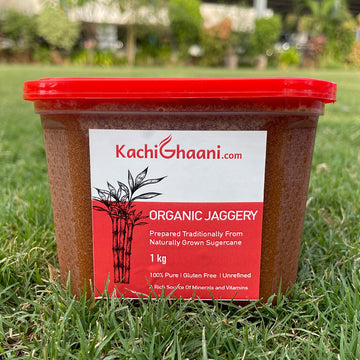
Jaggery benefits: why Indians eat gur after meals, honestly weighed
The real jaggery benefits, from flavour to small amounts of minerals, why so many Indian families end a meal with a piece of gur, and how to keep the habit sensible, with or without ghee.

The real jaggery benefits are modest but genuine: a deep caramel flavour, minimal processing and small amounts of minerals that refining strips out of white sugar. Many Indian families also end lunch or dinner with a small piece of jaggery (gur), said to aid digestion, though there is no good clinical evidence for that. It still counts as sugar.
The habit runs deep in Rajasthan, Gujarat, Punjab, Haryana, Uttar Pradesh and Maharashtra, and it travels with families to London, New Jersey and Dubai. Grandparents keep a block on the dining table, and village guests are still welcomed with gur and a glass of water. Here is what jaggery does and does not offer, where the custom of jaggery after meals comes from, and how to keep it sensible.
At a glance
- A small piece of gur after lunch or dinner is a household custom across North and West India, much like saunf and mishri after a restaurant meal.
- Families say it settles the meal and ends sweet cravings, but there is no good clinical evidence that it improves digestion.
- Jaggery's real benefits are flavour and small amounts of minerals, but it is 65 to 85% sucrose: a 5 g piece carries about 19 kcal, close to a teaspoon of sugar.
- The classical order of tastes credited to Sushruta actually puts sweet at the start of a meal, not the end.
- Count it within your daily sugar: ICMR-NIN suggests 20 to 25 g for adults.
What are the real jaggery benefits?
Flavour, simple processing and a little mineral content. It is still sugar, though, and not a health food.
| What jaggery offers | What it does not |
|---|---|
| A deep caramel, molasses flavour, so a small piece satisfies | Fewer calories: about 383 kcal per 100 g, close to white sugar |
| Simple processing: cane juice boiled down, with the molasses kept | A gentler effect on blood sugar: it is 65 to 85% sucrose |
| Small amounts of minerals; one review lists about 11 mg of iron per 100 g | A meaningful iron source in sensible portions: a 5 g piece gives about 0.5 mg |
| A pleasant, sweet end to a meal | Proven help with digestion, or any cleansing effect |
So the honest benefit is a better-tasting sugar with a little more left in it, enjoyed in small pieces.
Why do Indians eat jaggery after meals?
Out of habit, belief and simple pleasure.
Ask around a family table and you will hear the same reasons: gur 'helps digestion', it 'settles' a heavy or spicy meal, it brings the meal to a sweet close so nobody goes looking for more, and in winter it is 'warming'. It is also local and easy to keep. Farm families have long carried gur to the fields for quick energy, and offering gur with water is an old gesture of welcome.
Other after-meal customs follow the same instinct: saunf and mishri at the restaurant door, paan, or a pinch of mukhwas. If you are curious about mishri, see dhaga mishri vs regular mishri.
Does jaggery help digestion?
There is no good clinical evidence that it does.
Online claims say jaggery 'activates digestive enzymes', 'cleanses the stomach' or eases acidity. None of these has been shown in proper human trials. Jaggery is mostly sucrose, about 65 to 85%, with 9 to 15% other sugars and small, variable amounts of minerals. Nothing in that make-up is known to speed up digestion.
Why does the habit feel helpful, then? A sweet taste signals that the meal is over, which can stop the urge to keep eating. The pause, the glass of water and the ritual itself are calming. Those are real pleasures, even if they are not medicine.
There is also an interesting twist in Ayurveda. The classical order of tastes credited to Sushruta, as summarised in a 2019 review in the Journal of Ethnic Foods, puts sweet taste first, then salty and sour, and pungent, bitter and astringent last. So the after-meal piece of gur is best seen as a cherished regional custom rather than a rule from the classical texts.
Is it good to eat jaggery after dinner?
A small piece is fine for most healthy adults. The real concerns are your teeth and your total sugar for the day.
The World Health Organization's sugar guideline links free sugars with weight gain and tooth decay, and jaggery counts as a free sugar. Sticky sugar eaten just before bed sits on the teeth through the night, so brush afterwards, or at least rinse well with water. There is no good evidence either way that a piece of gur changes how well you sleep.
How much jaggery can you eat after a meal?
About a thumbnail-sized piece, roughly 5 g.
| Portion | Approx. weight | Approx. energy | Share of a 25 g daily sugar limit |
|---|---|---|---|
| Thumbnail-sized piece | 5 g | 19 kcal | About a fifth |
| Walnut-sized piece | 10 g | 38 kcal | About two-fifths |
| Small block | 25 g | 96 kcal | The whole day |
- Break the block into small pieces in advance, so you are never chipping at a large one.
- Have it once a day, after the main meal, rather than after every meal.
- Skip it on days you have had dessert or sweet chai.
For how jaggery compares with sugar more broadly, read Is jaggery just sugar? An honest answer.
Is jaggery with ghee after meals a good idea?
It is a delicious tradition, best kept as an occasional pleasure.
In Rajasthani and Punjabi homes, crumbled gur with ghee on a warm bajra roti, or mashed into churi, is a much-loved way to end a meal, and families often say the ghee 'balances' the gur. In nutrition terms it doubles up on energy: a teaspoon (5 g) of ghee adds about 45 kcal on top of the jaggery. Ghee is mostly saturated fat, and ICMR-NIN's 2024 guidelines list ghee and butter among the saturated fats to limit, so make gur-ghee part of the meal rather than an extra after it. For the tradition behind it, see ghee in Ayurveda and what the bilona method is.
Is jaggery after meals okay if you watch your blood sugar?
Count it as sugar, and ask your doctor.
- Diabetes or prediabetes: jaggery is mostly sucrose and raises blood glucose much as white sugar does. It is not a diabetic-friendly sweetener, so any regular piece should be agreed with your doctor or dietitian.
- Babies: ICMR-NIN advises no added sugar, including jaggery, for children under two.
- Teeth: brush or rinse after sticky sweets, especially at night.
- Weight: after-meal gur adds up quietly. Keep the piece small.
If you keep up the habit
Our jaggery is cane juice reduced in open pans in small batches, with no sulphur, soda, bleach or chemical clarifiers. Break a block into thumbnail-sized pieces and keep a few in a small box for after meals. For the Rajasthani way, crumble a little over a warm bajra roti with a few drops of our A2 Gir cow ghee, made by the bilona method.
The bottom line
Jaggery's benefits are its flavour and a little mineral content, and a small piece of gur after a meal is a warm regional ritual, not a digestive aid with proof behind it. Keep it to a thumbnail-sized piece, count it as sugar and brush your teeth afterwards. If you live with diabetes, follow your doctor's advice first.
Frequently asked questions
What are the benefits of eating jaggery after meals?
The honest benefits are small: a sweet full stop that can end the urge to keep eating, a calm moment at the end of a meal, and a flavour-rich sweet in a tiny portion. There is no good clinical evidence that it improves digestion, and it still counts as sugar, so keep it to a thumbnail-sized piece.
Is jaggery a better after-dinner sweet than mithai or chocolate?
Usually only because the portion is smaller. A 5 g piece of jaggery carries about 19 kcal, while a single piece of mithai or a few squares of chocolate can carry several times that. Gram for gram, all of them are sweets, so the size of the piece matters most.
Can jaggery stop acidity after meals?
There is no good evidence that it can. Some people feel more comfortable after a little gur, while others notice no change at all. Frequent heartburn or acidity deserves a conversation with your doctor, since diet, meal timing and medicines can all play a part.
Should I eat jaggery with warm water after meals?
Many families do, and a glass of warm water is a pleasant way to end a meal. There is no proof that the pairing improves digestion. If you enjoy it, keep the jaggery small and remember that the water does nothing to cancel the sugar's calories.
Is saunf-mishri better than jaggery after meals?
They are cousins. Saunf (fennel seed) is a traditional mouth freshener, and mishri is crystallised sugar, so a spoon of the mix carries a little sugar. Jaggery keeps more minerals than mishri, but both should stay small. Choose the one you enjoy and keep it to a pinch or a thumbnail-sized piece.
Can children have jaggery after meals?
Not before the age of two: ICMR-NIN advises no added sugar for children under two, and that includes jaggery. Older children can share a small piece now and then as part of their sweets for the day. Brushing afterwards matters even more for children's teeth.
Sources
- Dhanya, Ramesh and Mishra, Traditional methods of food habits and dietary preparations in Ayurveda, Journal of Ethnic Foods, 2019
- Venkatesh et al., Current production strategies and sustainable approaches towards the resurgence of non-centrifugal cane sugar production (review), Royal Society of Chemistry, 2023
- World Health Organization, Guideline on sugars intake for adults and children, 2015
- ICMR-National Institute of Nutrition, Dietary Guidelines for Indians, 2024