Is coconut oil good for you, or 'pure poison'?
Is coconut oil good for you? From superfood to 'pure poison' in a decade: what it really does to cholesterol, where the hype came from, and how much fits a balanced diet.

Is coconut oil good for you? It is neither a superfood nor poison. It is mostly saturated fat and raises LDL cholesterol more than unsaturated plant oils, and the weight-loss and brain claims made for it are not supported by good evidence. Used in modest amounts for flavour, as Kerala cooks have always used it, it can fit a balanced diet.
Few foods have swung so hard in public opinion. In the 2010s it was sold as a wonder fat for weight, brains and hearts; by 2018 a viral lecture called it 'pure poison'. Neither label survives a look at the trials. Here is what the evidence shows and how to use coconut oil sensibly.
At a glance
- About 82 per cent of the fat in coconut oil is saturated, more than in butter or ghee. A tablespoon carries roughly 11 g of saturated fat.
- A 2020 meta-analysis of 16 trials found coconut oil raised LDL by about 10 mg/dL compared with non-tropical vegetable oils, with no significant effect on weight, blood sugar or inflammation.
- The 'pure poison' line came from a 2018 university lecture. It overstates a real concern.
- In modest amounts, especially where its flavour matters, coconut oil can be part of a balanced diet.
Is coconut oil healthy?
It is a traditional, flavourful cooking fat, not a health food. Its defining feature is a very high share of saturated fat.
Coconut oil is almost pure fat, about 120 kcal per tablespoon, and roughly 82 per cent of that fat is saturated. Nearly half is lauric acid, with smaller amounts of myristic and palmitic acid; these are the saturated fats most linked to raising LDL cholesterol. It carries no fibre or protein and only traces of vitamins. That does not make it dangerous in small amounts. It makes it a fat to use thoughtfully.
Is coconut oil bad for you? What it does to cholesterol
Yes. Compared with unsaturated plant oils, coconut oil raises LDL, the cholesterol most closely tied to heart disease.
The clearest evidence is a 2020 meta-analysis in Circulation, the American Heart Association's journal. Pooling 16 trials, researchers found coconut oil raised LDL by about 10.5 mg/dL compared with non-tropical vegetable oils such as soybean, safflower, canola and olive oil. It also raised HDL, the 'good' cholesterol, by about 4 mg/dL, but had no significant effect on body weight, waist size, blood sugar or a key marker of inflammation.
A small rise in HDL does not cancel a rise in LDL, because doctors judge heart risk mainly by LDL. An editorial alongside the study concluded that coconut oil should not be used as a regular cooking oil, though it can be used sparingly for flavour.
| Fat | Share of its fat that is saturated | Saturated fat per tablespoon |
|---|---|---|
| Coconut oil | About 82% | About 11 g |
| Ghee | About 60 to 62% | About 8 g |
| Mustard oil | About 12% | About 1.6 g |
For context, the American Heart Association suggests keeping saturated fat to about 13 g a day on a 2,000 kcal diet.
Why did a Harvard professor call coconut oil 'pure poison'?
Because of its saturated fat. In a 2018 lecture at the University of Freiburg in Germany, titled 'Coconut oil and other nutritional errors', Karin Michels, an epidemiologist and adjunct professor at the Harvard T.H. Chan School of Public Health, called it 'pure poison' and 'one of the worst foods you can eat'. The video passed a million views.
Her concern was real; the wording was not. A poison harms you in small doses, and there is no evidence that a teaspoon of coconut oil in a curry does that. A year earlier, the American Heart Association had reached a calmer version of the same verdict: coconut oil raised LDL in all seven controlled trials it reviewed and has no known offsetting benefits, so it advised against using it.
Where did the superfood claims come from?
Mostly from research on a different oil, and from small or early studies stretched too far.
- Weight loss: borrowed from studies of MCT oil, a fraction made of shorter fats. Ordinary coconut oil is mostly lauric acid, which the body largely handles like a long-chain fat, and no good trials show that it helps weight loss.
- Brain health: based on the idea that MCTs make ketones, an alternative fuel for the brain. There is no good evidence that eating coconut oil protects memory or helps dementia.
- Heart health: based partly on its HDL-raising effect, which does not offset the LDL rise.
- Traditional diets: some coastal and island communities eat a lot of coconut, but they also eat whole coconut, fish and few processed foods. One ingredient cannot take the credit for a whole way of life.
Is coconut oil good for you in everyday cooking?
In small amounts, yes, but it works best as one of several fats rather than the only one.
Kerala cooking shows the sensible way: a spoon of coconut oil for the tadka of mustard seeds and curry leaves in a dish such as a Kerala thoran, where its flavour belongs, with plenty of vegetables, pulses and fish around it. India's ICMR-NIN guidelines suggest keeping cooking oils to about 25 to 30 g a day in total, and a balanced kitchen uses a mix. Our piece on why no single oil does everything explains how to rotate, and MUFA, PUFA and omega fats in plain language covers the fats worth eating more of.
Unrefined coconut oil smokes at about 177°C (350°F), which suits tadka and sautéing at medium heat rather than deep frying.
Who should be careful with coconut oil?
- People with high LDL, heart disease, diabetes or a family history of early heart disease should keep it small and follow their doctor's advice.
- Anyone on cholesterol-lowering medicine should not swap unsaturated oils for coconut oil without asking their doctor.
- People allergic to coconut should avoid it, in food and on skin.
- Anyone watching their weight should remember that each tablespoon adds about 120 kcal.
Our coconut oil, used sensibly
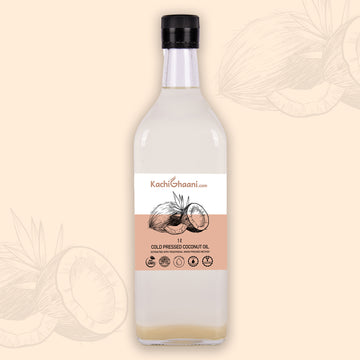
Our Truly Cold Pressed coconut oil is pressed from dried copra in a wooden ghaani and left unrefined, so it carries a full coconut aroma and a little goes a long way in a tadka. It is the same kind of fat as any coconut oil, so we suggest using it the Kerala way: a spoon for flavour, not a cupful. Our guide to how copra oil differs from fresh-kernel oil explains what makes ours different.
The bottom line
Coconut oil raises LDL cholesterol more than unsaturated oils, and its weight-loss and brain claims do not hold up. It is not poison, though: in modest amounts, where its flavour matters, it can sit comfortably in a balanced diet. Rotate it with unsaturated oils and keep the spoon small.
Frequently asked questions
Is coconut oil better than butter or ghee?
Not for your cholesterol. All three are mostly saturated fat, and coconut oil has the highest share, about 82 per cent of its fat against about 60 per cent for ghee. Choose any of them for flavour, use small amounts and cook most everyday meals in unsaturated oils.
How much coconut oil per day is OK?
There is no official coconut oil limit. For context, the American Heart Association suggests keeping saturated fat to about 13 g a day on a 2,000 kcal diet, and one tablespoon of coconut oil carries roughly 11 g. Most people who use it daily keep it to a teaspoon or two, alongside unsaturated oils.
Does cold pressed coconut oil affect cholesterol differently from refined?
Not in any proven, meaningful way. The pressing method changes flavour, aroma and small amounts of natural compounds, but the fatty acids are essentially the same, so both raise LDL compared with unsaturated oils. Choose unrefined for flavour and refined for neutral frying, and keep the amount modest either way.
Is coconut oil good for skin and hair?
That is a separate question from eating it, and the answer is more positive. Coconut oil is a good moisturiser for dry skin for many people, and a lab study found it reduced protein loss from hair during washing. People with acne-prone skin may find it too heavy for the face.
Is coconut oil good for weight loss?
No good evidence says so. The idea comes from studies of MCT oil, a different product, and even those found only small effects. Coconut oil adds about 120 kcal per tablespoon, so adding it to coffee or meals for weight loss usually just adds calories.
Sources
- Neelakantan et al., coconut oil and cardiovascular risk factors, Circulation, 2020
- Cracking coconut oil's health halo, Harvard Health Publishing, 2020
- American Heart Association, Saturated fats (accessed 2026)
- On the AHA presidential advisory on dietary fats, Cardiometabolic Health Congress, 2017
- 'Coconut oil is pure poison': the lecture that went viral, Scroll.in, 2018