Is coconut oil good for your skin? Myth vs fact
Is coconut oil good for your skin? On dry body skin, elbows and heels, yes; on acne-prone faces it can clog pores. Here is what the eczema and antifungal studies really show.

Is coconut oil good for your skin? For dry body skin, yes: it is a good, simple moisturiser that seals water into the skin of elbows, heels, hands and legs. On acne-prone or oily faces it is often a poor choice, because it can clog pores. And it is neither a proven antifungal nor a fix for eczema.
Coconut oil is one of the most recommended home remedies for skin, and one of the most argued about. The honest answer depends on where you put it, your skin type and which coconut oil you mean. Ours is pressed from dried copra, while most skin studies used virgin coconut oil, so we will be clear about what the research does and does not cover.
At a glance
- Good for: dry body skin, rough heels and elbows, cuticles, and as a body oil after a bath.
- Often a poor choice for: acne-prone or oily faces. It is rich in lauric acid and can clog pores.
- Eczema: small trials found virgin coconut oil helped children's mild to moderate eczema more than mineral oil. It is a different oil from copra oil, and it does not replace your doctor's plan.
- Antifungal: some activity in lab dishes, unproven on human skin.
- Patch test first, and stop at the first sign of bumps, itching or redness.
Is coconut oil good for your face?
It depends on your skin. On a dry face that rarely breaks out, a few drops pressed in at night may feel comfortable. On oily or acne-prone skin it is more likely to block pores and bring on spots, so a light, non-greasy moisturiser is usually the better choice.
Many people put coconut oil on their face without meaning to, through hair oil. The American Academy of Dermatology notes that oils in hair care products can cause tiny breakouts along the hairline and forehead, and suggests choosing products labelled "won't clog pores" or non-comedogenic. If you oil your hair with coconut oil and see small bumps along your hairline, that may be the reason.
As a makeup remover, coconut oil works well as long as you wash it off afterwards. Our guide to taking off makeup with oil explains the method and who it is not for.
Does coconut oil clog pores?
It can, especially on the face, chest and back, where oil glands are busiest. About 42% of coconut oil is lauric acid, a medium-chain fatty acid. In a classic 1989 study of skin care ingredients, J. E. Fulton found that medium-chain fatty acids were more potent than short- or long-chain ones at causing the blocked follicles that lead to blackheads.
Those tests were done on rabbit ears, which do not match human skin exactly, and the pore-clogging scores you see online come largely from that kind of work. Still, plenty of people do break out after using coconut oil on the face. On the arms, legs and feet, where pores are far less busy, it is much less of a worry.
Is coconut oil good for eczema?
There is encouraging evidence, but for virgin coconut oil, used as a moisturiser alongside proper care.
In a trial presented in 2013 by Dr Mara Evangelista and colleagues in Manila, 117 children with mild to moderate atopic dermatitis (eczema) used either virgin coconut oil or mineral oil twice a day for eight weeks. Eczema scores improved in 93% of the children using coconut oil, against 53% of those using mineral oil, and the coconut oil group's skin also held on to water better. A 2018 review of plant oils on skin describes the same findings, and notes earlier work in which coconut oil was as effective and safe as mineral oil for dry skin.
What this does and does not mean:
- The trials used virgin coconut oil, made from fresh coconut. Ours is pressed from dried copra. They are related, but we cannot claim the results carry over.
- The comparison was with mineral oil, not with the creams a dermatologist would prescribe.
- Eczema flares for many reasons, and broken or weeping skin can become infected. Follow your doctor's plan and ask before adding any oil.
Is coconut oil antifungal?
In the lab, partly. Monolaurin, a compound made from lauric acid, can disrupt the outer membranes of some microbes in a dish, and coconut oil has stopped the growth of several kinds of bacteria in lab tests.
But no good human trial shows that coconut oil clears ringworm, athlete's foot or other fungal skin infections. These need proper antifungal medicine from a pharmacist or doctor, and keeping the skin clean and dry matters more than any oil.
| Claim | What the evidence says | Verdict |
|---|---|---|
| Moisturises dry body skin | As effective as mineral oil for dry skin in small trials | Fact |
| Suits every face | Can clog pores, especially on acne-prone skin | Myth |
| Helps eczema | Virgin coconut oil helped children's mild eczema in small trials | Partly true, for virgin oil |
| Kills skin fungus | Lab results only, no good human trials | Not shown |
| Lightens skin or fades spots | No good evidence | Myth |
Is coconut oil good for your skin type, and who should skip it?
Coconut oil is likely to suit you if your skin is dry, on the body rather than the face. Skip it, or ask a doctor first, if any of the following apply:
- Acne-prone or very oily facial skin, or breakouts along the hairline.
- Active eczema, or broken, weeping or infected skin.
- A rash you think may be fungal; see a pharmacist instead.
- A known coconut allergy.
Before using it widely, do a simple patch test:
- Dab a little on the inside of your forearm or behind your ear.
- Leave it for 24 hours.
- If you see redness, itching or bumps, do not use it.
- For the face, try a small patch along the jawline for a few nights first.
For babies, follow the safety rules in our baby malish guide, and ask your paediatrician first if your baby has eczema.
Using our coconut oil for skin
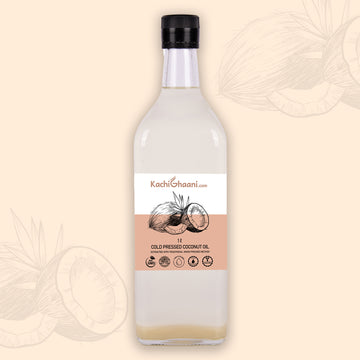
Our Truly Cold Pressed coconut oil is pressed slowly from dried copra in a wooden ghaani and left unrefined. It is not virgin coconut oil. On the body, smooth a few drops onto damp skin after a bath, or rub it into your heels at night under cotton socks, as in our cracked heels routine. For the face, many people prefer a lighter oil such as our Truly Cold Pressed almond oil, though anyone can react to any oil, so patch test.
The bottom line
Coconut oil is a good, simple moisturiser for dry body skin, heels and hands. It is a poor bet for acne-prone faces, the eczema evidence is for virgin coconut oil, and it is not a proven antifungal. Patch test, and match the oil to the skin.
Frequently asked questions
Can I put coconut oil on my face overnight?
If your skin is dry and rarely breaks out, a thin layer overnight is unlikely to cause trouble. If you get acne or blackheads, it is better not to, because oil left on the face for hours is more likely to clog pores. Try a small patch for a few nights before using it all over.
Does coconut oil lighten skin or remove dark spots?
No. There is no good evidence that coconut oil lightens skin, fades dark spots or smooths wrinkles. Daily sunscreen and, for stubborn marks, advice from a dermatologist will do far more. Coconut oil is not a sunscreen either, so do not rely on it when you are out in the sun.
Is coconut oil good for dry lips?
Many people find it a pleasant, simple lip balm, because it softens dry lips and seals in moisture. Use a tiny amount. In cold weather keep the bottle somewhere warm, since coconut oil turns solid below about 24°C (75°F). Stop if your lips become itchy or swollen.
Is coconut oil or almond oil better for skin?
It depends on where you use it. Coconut oil makes a good body oil and seals in moisture well. Almond oil feels smoother, and many people with sensitive or combination facial skin get on better with it. Anyone can react to either, and almond is a tree nut, so patch test first.
Sources
- Lin T.K., Zhong L., Santiago J.L., plant oils and skin barrier repair, International Journal of Molecular Sciences, 2018
- Virgin coconut oil and mineral oil in dermatitis and xerosis, meeting report, MDedge, 2013
- Fulton J.E., comedogenicity and irritancy of skin care ingredients, Journal of the Society of Cosmetic Chemists, 1989
- Hair care products and acne, American Academy of Dermatology, accessed 2026
- Coconut oil: composition and melting point, Wikipedia, accessed 2026